


US offices averaged 226 square feet per worker in 2024, down from 250 square feet per person before the pandemic. At that density, the office space floor plan determines whether a workspace supports productivity or creates daily friction for every team member.
An office layout is a workflow framework governing how teams communicate and how noise distributes across the entire work environment. A layout designed for a 10-person legal practice differs significantly from one for a 60-person tech team using the same square footage.
This guide covers US workspace planning standards and a six-step professional layout process for commercial interior designers. It also addresses four office floor plan types and the design decisions that affect compliance and long-term performance across commercial projects.

US Workspace Planning Standards Every Commercial Interior Designer Should Know
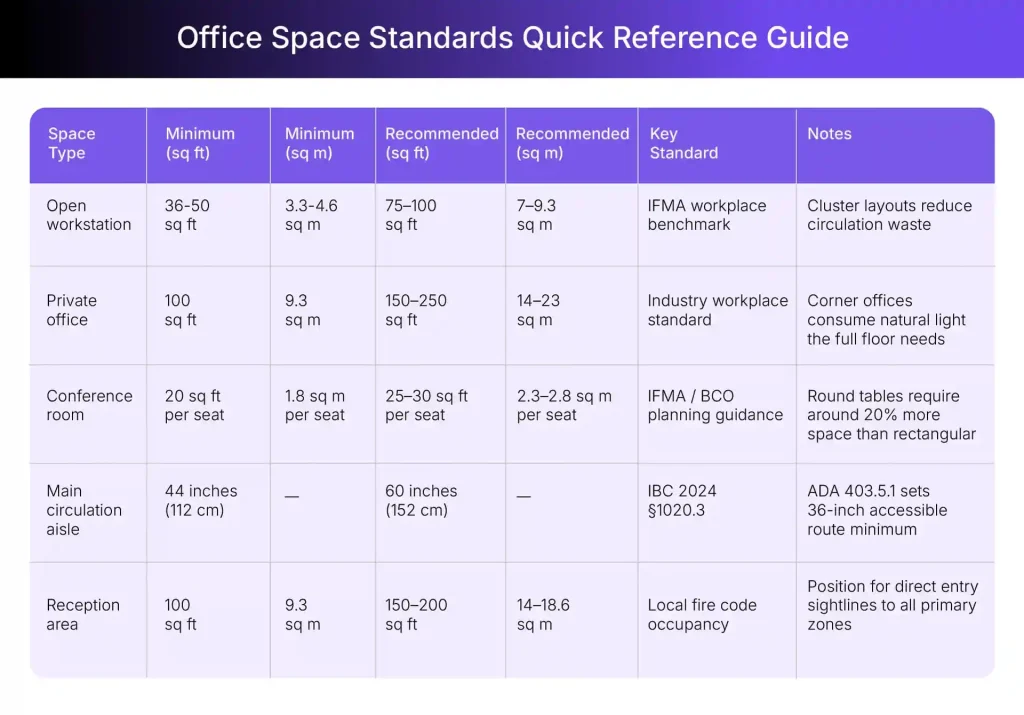
These four standards form the compliance baseline you must document on every office layout before any procurement decision is made for the project.
- OSHA Workstation and Egress Clearance: OSHA does not establish a specific square-footage minimum for office workstations or desk-to-desk spacing on commercial floor plans. The OSHA computer workstation eTool recommends under-desk knee clearance of 20 to 28 inches (500 to 720 mm) for a neutral seated posture. OSHA 1910.37 requires exit routes to always stay free and unobstructed, including during phased occupancy and active renovation work.
- GSA Space Utilization Standard: The current federal design standard per the OMB August 2024 occupancy memorandum is 150 usable square feet (14 sq m) per person in newly acquired office spaces. The earlier 135 sq ft (12.5 sq m) primary-space figure now serves as a legacy benchmark for federal capacity planning.
- ADA Accessible Route and Workstation Clearance: ADA Section 403.5.1 requires a 36-inch (915 mm) minimum continuous clear width on every accessible route inside the office. The clear width may reduce to 32 inches (815 mm) at doorways for a maximum of 24 inches. ADA Section 305.3 requires a 30×48-inch (760×1220 mm) clear floor space at every accessible workstation.
- IBC Egress: IBC 2024 Section 1020.3 sets a 44-inch (1118 mm) minimum corridor width for any commercial building serving 50 or more occupants. Corridors serving fewer than 50 occupants may reduce to a 36-inch (915 mm) clear width per the same code section.
How to Plan an Office Layout Step by Step?
The decision sequence below protects you from mid-project corrections that poorly ordered office layout decisions consistently generate on commercial projects.
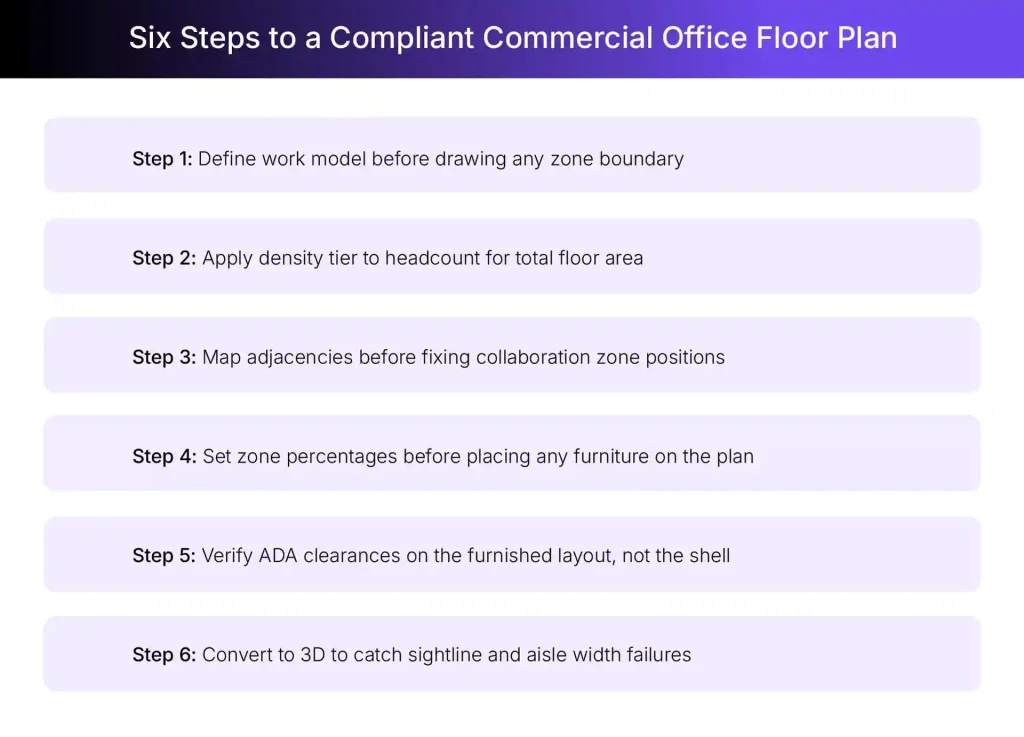
- Step 1: Define the Work Model: Defining the work model first determines the density tier that governs every zone decision on the office floor plan. A hybrid work model requires fewer fixed desks than a full in-person setup at the same headcount, which changes the entire zone allocation logic.
- Step 2: Calculate Space Requirements: Calculate total floor area using the density tier: open office layouts need 75 to 150 sq ft (7 to 14 sq m) per person as the baseline for the office space. Mixed private and open configurations need 150 to 300 sq ft (14 to 28 sq m) per person under the GSA density benchmark.
- Step 3: Map Departmental Adjacencies: Map which departments must be adjacent before drawing any zone boundary on the commercial office floor plan. Collaboration areas and quiet zones need acoustic separation, since noise from collaboration directly undermines deep concentration in adjacent focus workstation areas.
- Step 4: Allocate Zones as Percentages: Allocate floor area by zone percentage before placing any furniture on the office layout floor plan or committing to partition positions. Changing zone allocations after furniture is placed requires redesigning the full spatial logic, which adds cost to every commercial project.
- Step 5: Verify ADA and IBC Compliance: Verify ADA clearances and IBC egress widths on the furnished office layout before any procurement order is issued for the project. Empty shell plan checks miss the workstation configurations that most often produce ADA violations in commercial office space.
- Step 6: Produce a Scaled 3D Model: Convert the office floor plan to 3D before finalizing any wall positions or furniture specifications for the commercial project. Aisle width failures and sightline problems invisible on a 2D plan appear immediately in the navigable 3D walkthrough view.
Check out this video to learn how you can create 3D walkthroughs using Foyr Neo for your next office design project:
4 Office Layout Floor Plans for Different Business Types
Each of the four office floor plan types below resolves a different client brief and works best with a specific headcount and building configuration. The starting point is the client’s work model and lease footprint, not aesthetic preference alone.
1. The Open-Plan Office Layout

Source: Pinterest
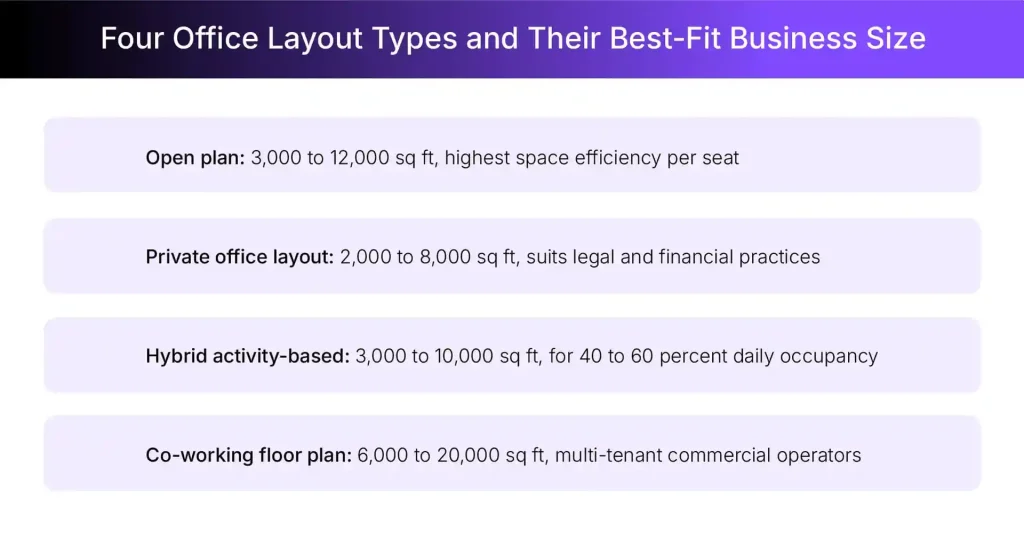
An open office layout removes all private offices, placing workstations on a shared floor plate organized by team cluster. It delivers the highest space efficiency and the lowest per-seat construction cost of the four office floor plan types covered in this guide.
Recommended Size: 3,000 to 12,000 sq ft (280 to 1,115 sq m)
Best For: Tech companies, creative agencies, and growth-stage businesses prioritizing visual openness and cost savings per seat
Layout Highlights:
- Highest space utilization rate of any office design type.
- Shared open space reduces real estate cost per team member.
- Easy access between different departments without fixed partition walls.
Foyr Tip: Map collaboration zones and pantry positions on the 2D floor plan and verify 20 ft (6 m) minimum distance from quiet work zones before finalizing acoustic panel placement.
“The people aspect has never been more important. There’s been a real shift from real estate metrics to people metrics. It’s all about attracting and retaining the top talent.”
— Janet Pogue McLaurin, Global Director of Workplace Research, Gensler (Source)
2. The Private Office Floor Plan

Source: Pinterest
A private office layout lines enclosed individual offices along the building perimeter with shared meeting rooms occupying the interior core. It suits legal and financial practices where sensitive information must stay contained within individual offices throughout the working day.
Recommended Size: 2,000 to 8,000 sq ft (185 to 745 sq m)
Best For: Legal, financial, and medical practices requiring a quiet environment and a strong sense of privacy for client-facing work
Layout Highlights:
- Each individual office provides personal space and less privacy compromise than open plan
- Natural light reaches perimeter offices while the core handles support and storage
- Suits cellular offices serving professionals with distinct private work zones
Foyr Tip: Simulate morning and afternoon light in the 3D model and specify glazed partition walls for interior core areas that lack direct natural light from the perimeter windows.
3. The Hybrid Activity-Based Office Layout

Source: Pinterest
A hybrid office layout assigns zones for deep work and collaboration rather than fixed seats, serving both in-office and remote employees on alternating hybrid work schedules. It suits organizations with 40 to 60 percent daily office occupancy, where space utilization and personal preferences determine which zone each team member uses each day.
Recommended Size: 3,000 to 10,000 sq ft (280 to 930 sq m)
Best For: Organizations operating hybrid work models with different teams using different work styles across a single office space
Layout Highlights:
- Phone booths and focus pods support deep work and quiet space requirements
- Collaboration zones absorb team members needing group activity throughout the day
- Hot desks and lounge areas serve personal preferences without assigned seating
- Small meeting rooms and open collaborative spaces cater to different teams simultaneously
Foyr Tip: Mark power outlet positions and floor box locations on the 2D floor plan before furniture is specified. Flag HVAC diffuser zones above open collaboration areas to avoid call-quality disruption.
After you are done with the floor plan, you would want to get a realistic render of the design to share with the client. This Foyr video will help you understand how to render realistic interiors quickly:
4. The Co-Working Office Space Floor Plan

Source: Pinterest
A co-working office space floor plan organizes shared hot desks and private day offices for multiple tenants across a single commercial building floor. It suits flexible workspace operators serving businesses with diverse work styles, teams, and space-usage requirements under one commercial roof.
Recommended Size: 6,000 to 20,000 sq ft (560 to 1,860 sq m)
Best For: Commercial landlords and flexible workspace operators requiring a popular choice for short-term lease office design
Layout Highlights:
- Reception desk controls easy access and visibility across the full floor plate
- Cellular offices and private day suites offer sense of privacy within shared space
- Lounge area and amenity zones attract members with different personal preferences
Foyr Tip: Verify STC-rated partition assembly positions in the 2D floor plan. Confirm reception sightlines cover all entry points and primary workstation zones simultaneously before any partition is built.

Design Your Office Floor Plan with Foyr Neo
Once zone allocation is confirmed and compliance is verified, you need a professional delivery package for the client and planning authority. Foyr Neo maps directly to the six-step workflow above, covering the full office layout process from initial floor plan tracing through to render delivery.
Let’s have a look at the steps to create your next office layout with our interior design software:
- Trace the Existing Office Floor Plan: Upload any existing shell plan or office building floor plan to Foyr Neo and trace walls using the auto-snapping tool to build an accurate dimensioned base. One-click 2D-to-3D conversion lets you verify corridor widths and sightlines at real scale before any partition wall is committed to the construction drawing.
- Mark ADA Clearances and IBC Egress Paths: Mark ADA clearances and IBC egress paths as verified dimensions directly on the 2D office floor plan in Foyr Neo before any furniture is ordered. This positions compliance verification at the planning stage, where corrections cost a fraction of the on-site equivalent on any commercial project.
- Access 60,000+ Render-Ready Furniture Models: Foyr Neo’s 60,000+ render-ready models include commercial workstations, phone booths, and partition systems at accurate dimensions for pre-procurement clearance validation. Accurate model dimensions reveal the clearance conflicts that placeholder blocks miss and that would otherwise survive into the finished office build.
- Test Natural and Artificial Lighting Across Zones: Test natural light and artificial lighting across open plan and private zones in Foyr Neo before issuing the electrical brief to the project engineer. This confirms the specification meets illumination standards and supports employee health and job satisfaction outcomes before any fixture is ordered.
- Generate 12K Photorealistic Renders: Foyr Neo generates 12K photorealistic renders of the office layout in minutes for board presentations and landlord approval packages on every commercial project. One designer reported cutting client revision rounds from four to one by presenting a 12K render at the first approval meeting.
Foyr Neo covers the full office layout workflow from floor plan tracing through to render delivery in one platform. Designers using Foyr Neo on commercial office projects can enjoy faster approval cycles and fewer revision rounds per engagement.
Try Foyr Neo free for 14 days and design your office layout before any procurement is committed.
FAQs
What is a good office layout?
A good office layout maps zone percentages and ADA-compliant circulation paths before furniture placement begins on the commercial floor plan. The right office layout allocates 40 to 50 percent of floor area to workstations under OSHA and GSA standards and reserves at least 20 percent as clear circulation space. The remaining area covers collaboration space and support rooms based on the client’s headcount and preferred work model.
How do you design a 10 x 10 private office?
A 10 x 10 office at 100 sq ft (9.3 sq m) meets the GSA minimum for a private office and works for a single occupant with careful planning around the four binding constraints. The desk needs 3 ft (91 cm) front clearance per OSHA guidance, and the door swing must not overlap the desk position or the ADA approach space. A 10 x 10 home office layout or commercial private office works at this footprint only if the door opens outward or slides rather than swinging into the floor space.
What are the seven principles of office layout design?
The seven principles are: clear zone allocation before furniture placement, ADA-compliant circulation widths verified on the furnished plan, acoustic separation between collaboration areas and quiet zones, natural light access distributed across all workstation areas, efficient use of space measured against the GSA density benchmark, technology integration with outlet positions marked before furniture specification, and egress paths verified under IBC 2024 occupant load calculations.
What are the three types of office layouts used in most commercial buildings?
The three primary office floor plan types are the open office layout at 75 to 150 sq ft (7 to 14 sq m) per person, the private office layout at 150 to 250 sq ft (14 to 23 sq m) per individual office, and the hybrid activity-based layout at 75 to 120 sq ft (7 to 11 sq m) per person based on a partial daily occupancy model. The traditional office layout and the cubicle office layout are subsets of the private office model, differentiated by whether cellular offices use full-height walls or partial-height cubicle partitions to create a sense of privacy.
Can AI tools draw office floor plans accurately?
AI tools can quickly generate initial commercial building plans and open space configurations from basic room dimensions, but they cannot verify ADA clearances, IBC egress widths, or GSA density compliance in the generated floor plan. The output from AI floor plan generators requires validation against OSHA, ADA, and IBC standards before it can be submitted for planning authority approval on any new office project. Using a platform like Foyr Neo at the 3D model stage is the professional workflow step that confirms the AI-generated office layout performs at real scale with accurate furniture dimensions before any procurement order is committed.