


A cafe floor plan must resolve the customer journey from entry to seating and the barista workflow between equipment and service points simultaneously. Industry guidance suggests a 60/40 front-of-house split, but this ratio shifts with service model and menu complexity.
A cafe layout plan that ignores the customer flow path creates queue congestion at the entry, and customers who leave due to no visible seating. A café interior design that ignores the barista workflow produces staff movement conflicts that increase service times at peak hours.
This guide covers US code requirements, a six-step professional layout process, and five cafe floor plan configurations for different formats. We will also cover how to design a cafe kitchen layout that passes health inspection on the first permit submission.

US Code Requirements for Cafe and Coffee Shop Design
These four standards govern every cafe floor plan submitted for US planning approval. Each of them constrains a specific layout decision you must resolve before the floor plan is finalized.
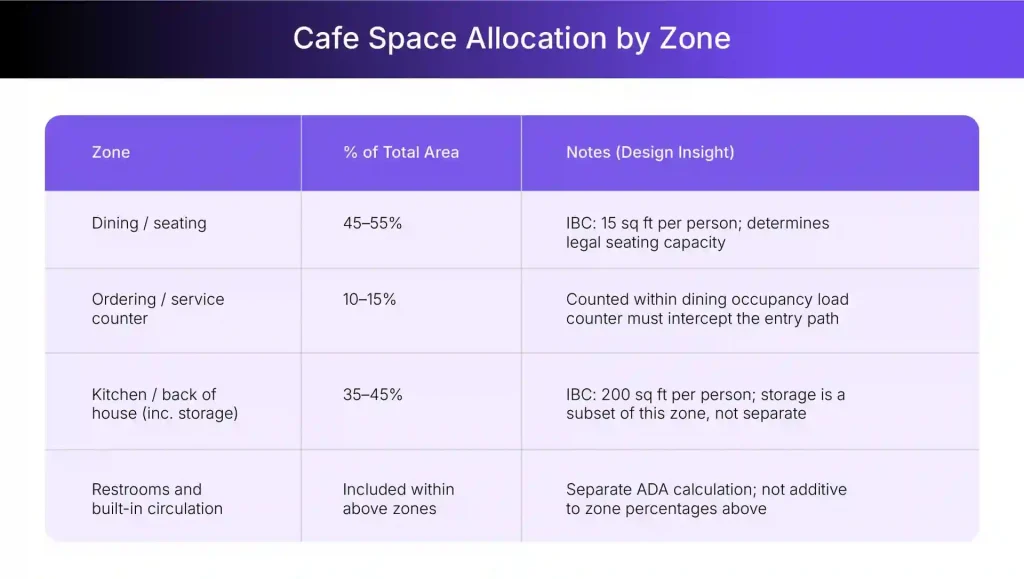
- IBC Occupant Load: According to the IBC, dining areas are calculated at 15 sq ft per person and commercial kitchens at 200 sq ft. These figures set the legal seating capacity and determine where exit doors must appear on the coffee shop floor plan.
- ADA Aisle Width: The ADA Standards specify a minimum 36-inch aisle between occupied tables, with 44 inches preferred for main circulation routes. This governs table spacing and the corridor width between the service counter and the dining zone throughout the cafe layout.
- FDA Food Code: The FDA Food Code requires a dedicated handwashing sink and a separate equipment-washing sink in every commercial kitchen. This drives cafe kitchen layout zoning and constrains where the pastry prep and brew zones can be physically positioned in the back of house.
- ADA Counter Height: As per the ADA Standards, one service counter section must sit at 34 inches maximum with 27 inches of knee clearance below. This constrains the counter design and requires a verified accessible approach zone on the coffee bar floor plan.
How to Design a Cafe Floor Plan Step by Step
Getting this sequence right is the difference between a cafe layout that reads as resolved and one that requires expensive corrections during the buildout phase.
- Step 1: Define the Service Model: Define whether the format is counter-only service, counter with table service, or full table service before drawing any zone boundary. The service model governs every zone allocation, queue length and counter position decision that follows in the coffee shop layout design.
- Step 2: Allocate Front-of-House and Back-of-House Space: Apply the 60/40 front-of-house-to-back-of-house split as a starting framework, not a fixed rule, across the total floor space. This ratio varies with the service model and menu complexity. So, verify it against the legal IBC occupant load calculation for the specific cafe floor plan before committing to any zone boundary.
- Step 3: Map the Customer Journey: Map the full guest path from entry through queue flow, ordering, waiting and seating before placing any furniture or fixtures. Entry visibility and customer movement to the seating zone are the two named spatial requirements to resolve at this step. They both directly affect foot-traffic conversion and repeat visits from guests who find the space intuitive.
- Step 4: Position the Service Counter: Position the service counter to intercept the natural entry path without blocking the dining zone from view at the front door. I always verify this from the entry threshold in the 3D model before any counter position is committed to the construction drawing for the coffee shop floor plan.
- Step 5: Align the Kitchen Layout with the Counter: Position the kitchen to run parallel to the service counter so baristas face the guest side during service and management holds sightlines across both zones simultaneously. This alignment supports both operational efficiency for staff and guest satisfaction through visible drink preparation in the world of coffee service environment.
- Step 6: Verify Compliance and Prepare for Permit Submission: Verify IBC occupant load, ADA aisle clearances and FDA sink positions on the furnished plan before issuing any permit submission package. This step produces the documentation required for both permit approval and health inspection readiness at the cafe buildout stage.
5 Cafe Floor Plan Layout Examples
My take is that the layout type should follow the service model and the building footprint, not the client’s aesthetic preferences. Each of these five configurations is designed around a distinct operational logic.
1. The Linear Counter Layout
Source: Pinterest
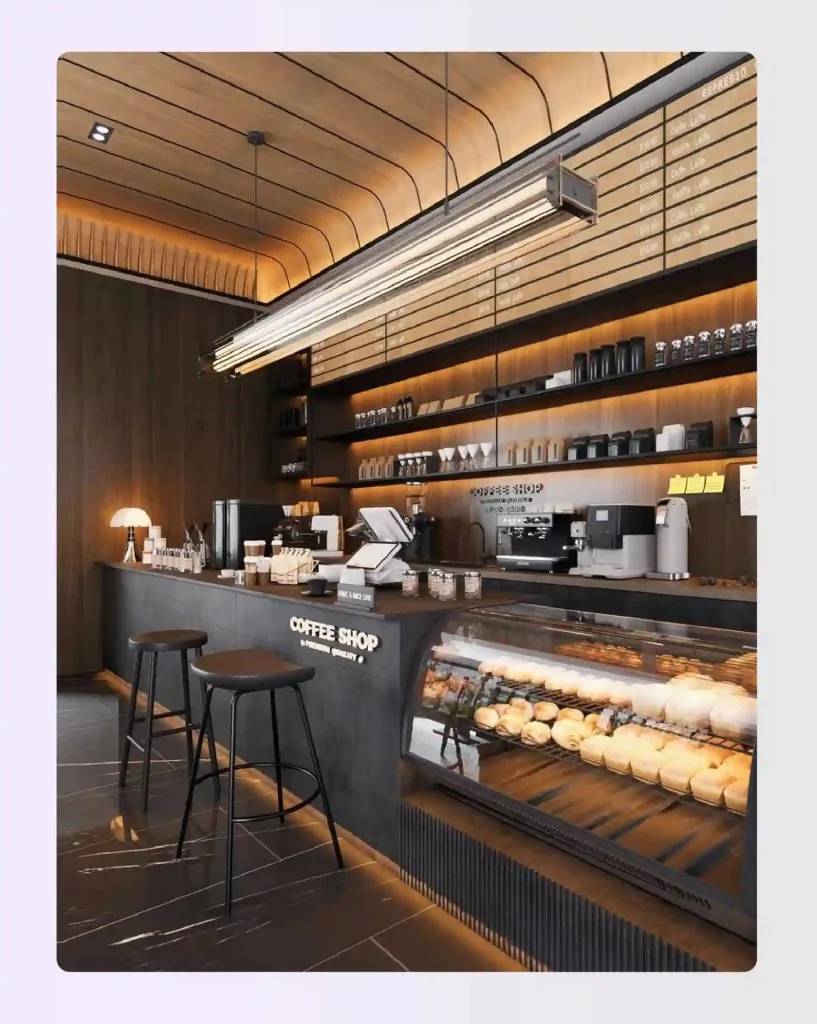
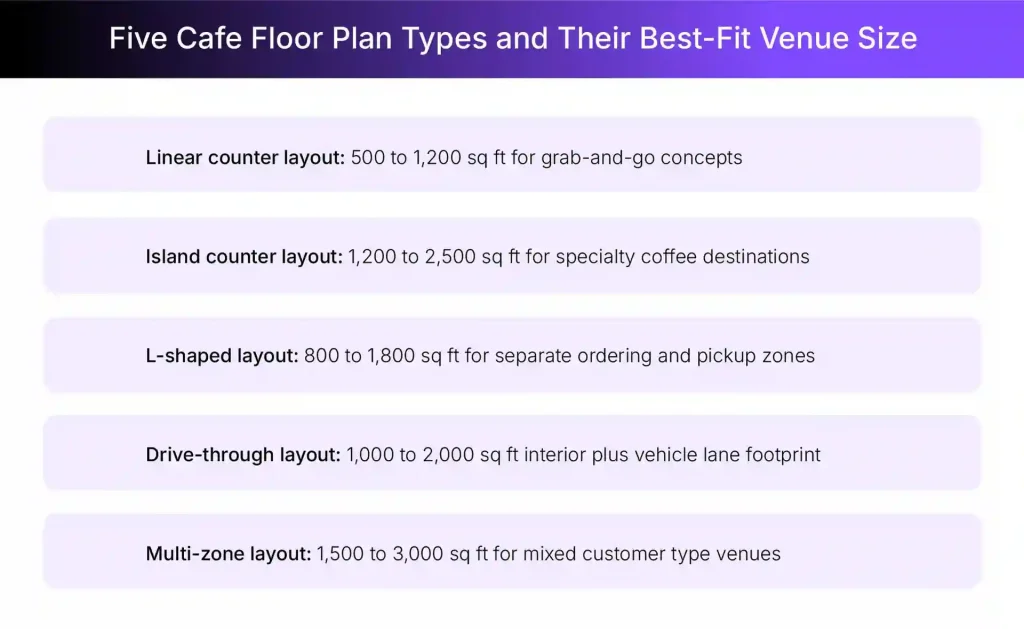
A linear coffee shop layout runs the service counter along one wall from entry to back wall, with seating filling the parallel floor area on the opposite side. This cafe layout suits long narrow footprints and delivers the lowest plumbing cost of any coffee shop layout design, making it the most common format for small cafes and urban grab-and-go concepts in the United States.
Recommended Size: 500 to 1,200 sq ft (46.5 to 111.5 sq m)
Best For: Grab-and-go coffee concepts, small cafes, and high-foot traffic urban sites where counter speed and service speed take priority over dwell time
Zone Breakdown:
- Service counter running the full wall length with the espresso machine at mid-point.
- Comfortable seating on the opposite wall at 15 sq ft per seat minimum.
- Clear 44-inch main circulation aisle between the counter queue and the seating zone.
- Task lighting above the counter and natural light from the front façade.
Foyr Suggestion: Validate the entry perspective in the 3D model to confirm that the dining zone reads as welcoming from the door and the counter does not create a visual wall that discourages entry into the cafe.
2. The Island Counter Cafe Layout
Source: Pinterest
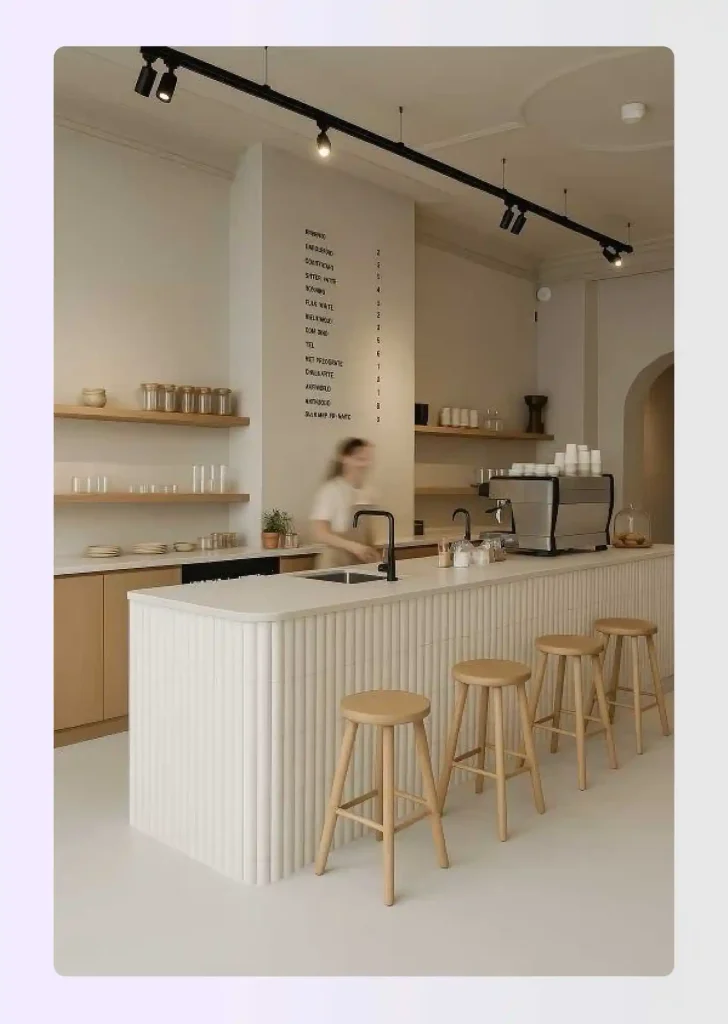
The island coffee shop floor plan positions the service bar as a freestanding structure in the centre of the floor, creating a 360-degree workflow for baristas and a natural customer movement loop around the perimeter. This cafe layout plan suits square or open floor plates, where the counter can serve as the visual anchor and brand showcase of the entire space.
Recommended Size: 1,200 to 2,500 sq ft (111.5 to 232 sq m)
Best For: Specialty coffee destinations, coffee shop layout design projects where the bar is the primary design feature, and venues prioritizing customer experience over seating density
Zone Breakdown:
- Communal tables and individual tables arranged in the perimeter seating zone.
- Outdoor seating zone visible from the entry to draw in passing foot traffic.
- Retail and bean display positioned near the counter for brand identity reinforcement.
Foyr Suggestion: Verify the minimum 44-inch clearance on all four faces of the island counter in the 3D model, since plan view review typically validates only the primary approach face and misses the secondary circulation paths.
If you are working on a cafe floor plan from the initial shell to a client-ready 3D model, this Foyr video covers the full 2D-to-3D conversion workflow.
3. The L-Shaped Coffee Shop Floor Plan
Source: Pinterest
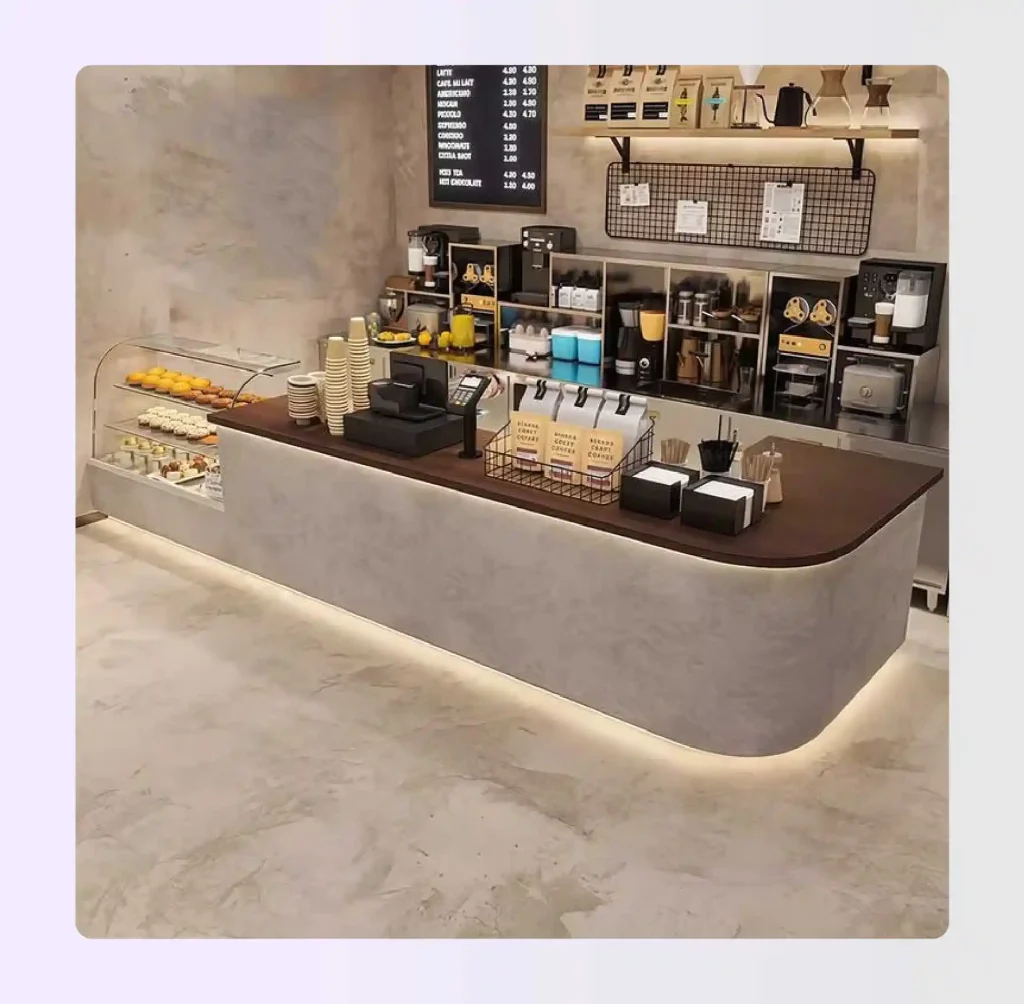
The L-shaped cafe floor plan places the service counter and kitchen on two perpendicular walls, using the corner junction as the primary workflow hub and the open diagonal floor area for flexible mix of seating options. In my experience, this layout suits mid-size venues where the brief requires separate ordering and collection zones within a single continuous counter structure.
Recommended Size: 800 to 1,800 sq ft (74.3 to 167.2 sq m)
Best For: Cafes requiring a separate ordering and pickup point and venues with L-shaped footprints.
Zone Breakdown:
- One counter run handling ordering, with a clear queue zone along the longer wall.
- A second counter run handling drink pickup and food collection at the perpendicular wall.
- Communal tables and individual tables filling the open diagonal seating zone.
- Modular furniture to support reconfiguration for peak hours versus quieter periods.
Foyr Suggestion: Verify the barista movement radius at the corner junction in the 3D model before finalizing. The corner is where workflow conflict occurs during peak service and this is invisible on a flat plan view.
4. The Drive-Through Cafe Floor Plan
Source: Pinterest
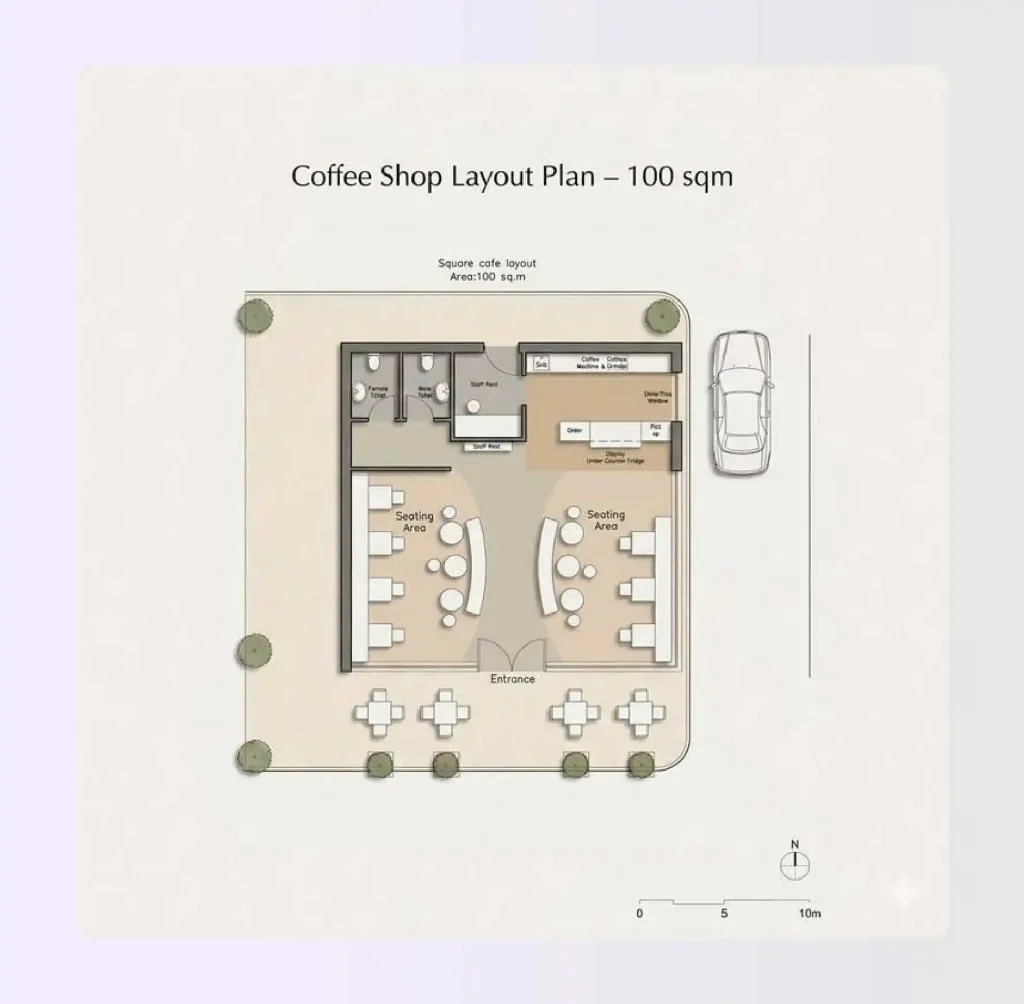
The drive-through coffee shop floor plan separates a walk-in service area from a dedicated drive-through window lane. It requires the kitchen to serve both channels from a single production line without staff crossover. This cafe shop floor plan suits highway-adjacent and suburban sites where the types of customers split between vehicle and walk-in guests across different busy times of the day.
Recommended Size: 1,000 to 2,000 sq ft (92.9 to 185.8 sq m) interior, plus dedicated lane footprint
Best For: Suburban drive-through concepts, highway service sites, and high-volume coffee shop layout formats serving both walk-in and vehicle customers at peak hours
Zone Breakdown:
- Walk-in counter with a separate queue zone away from the drive-through window
- Drive-through window positioned at the end of the production line for single-direction workflow
- Kitchen production line verified to serve both service points from one barista station
Foyr Suggestion: Verify that the kitchen production line covers both the walk-in counter and the drive-through window from a single barista position in the 3D model. This confirms there is no staff crossover conflict during peak dual-channel service.
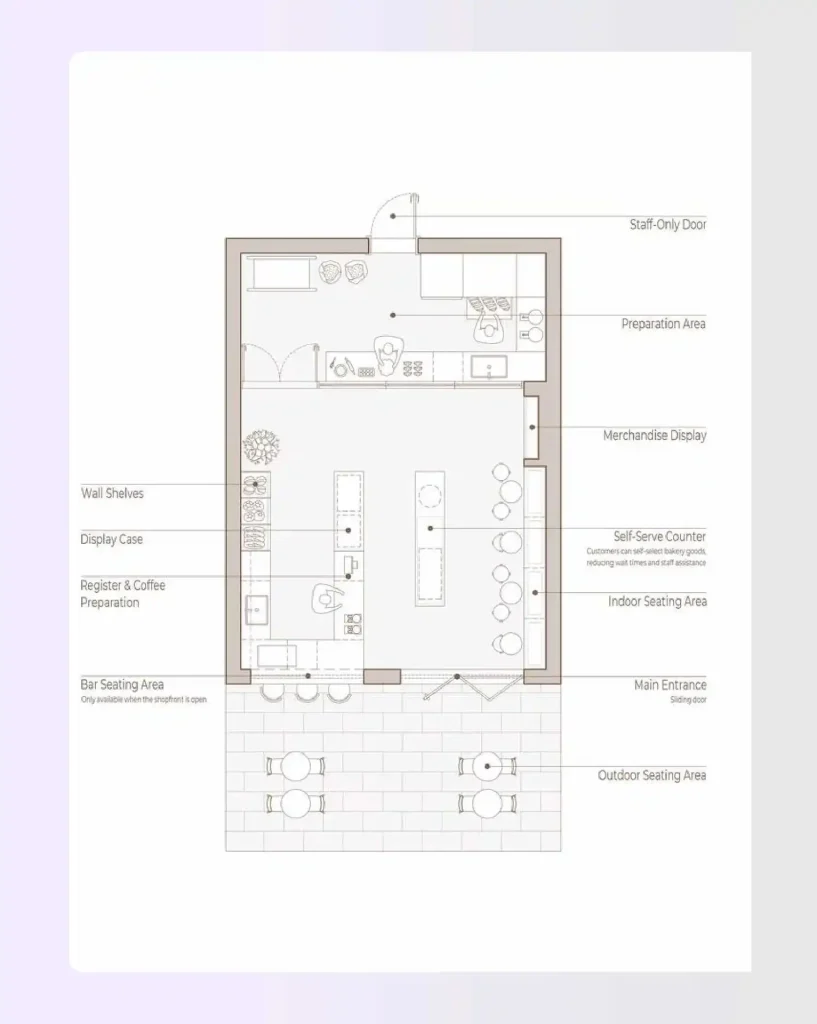
5. The Multi-Zone Specialty Cafe Layout
Source: Pinterest
The multi-zone cafe shop layout separates the space into distinct areas: a quick grab-and-go counter, a seated work zone with power access, and a quieter lounge with comfortable seating for longer dwell times. This coffee shop layout suits specialty coffee destinations serving different types of customers across morning, midday and evening dayparts throughout the week.
Recommended Size: 1,500 to 3,000 sq ft (139.4 to 278.7 sq m)
Best For: Specialty coffee venues targeting both transient and dwell customers, and high-ambiance venues where acoustics and ambiance matter as much as service speed.
Zone Breakdown:
- Seated work zone with individual tables, power outlets and task lighting at each position.
- Lounge zone with comfortable seating, lower lighting and hard surfaces replaced by soft finishes to control acoustics.
- Clear visual zone boundaries readable from the entry without signage or decor intervention.
Foyr Suggestion: Verify that all three zone boundaries are spatially legible from the entry in the 3D walkthrough before specifying any furniture. Confirm acoustic separation between the work zone and the lounge zone in the same model view.
After you have created the café floor plan, it is time to present to the client. Check out this Foyr video to learn how to create high-quality renders for your designs in minutes:
Cafe Kitchen Layout: What the Back of House Actually Needs
The back-of-house zone is where most poor design decisions on a cafe floor plan become permanent. MEP commitments made at the kitchen stage cannot be moved without full demolition.
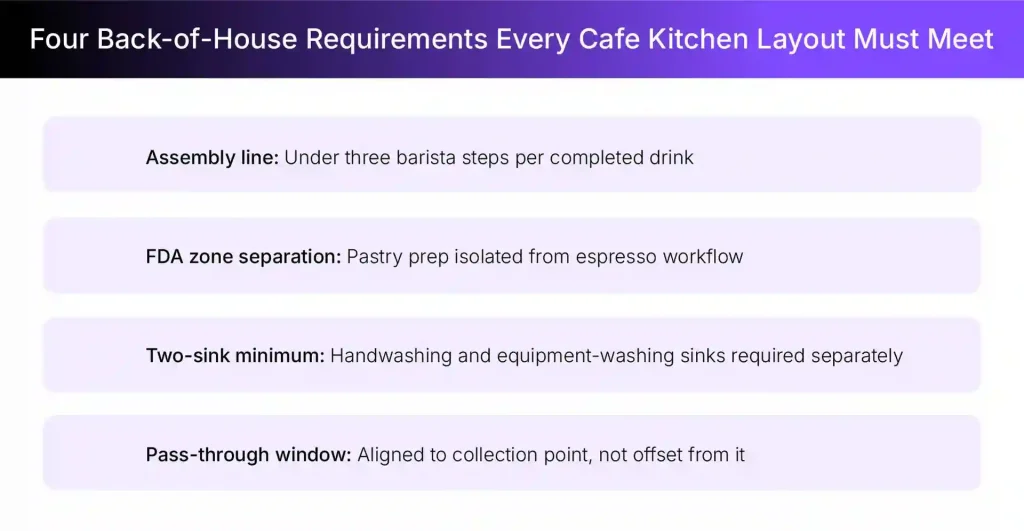
- Assembly Line Configuration: An assembly line sequences each drink preparation step, from grinding to brewing to texturing, as a left-to-right workflow that keeps baristas to three steps per drink. Reducing movement per drink at this level directly determines throughput speed at peak hours.
- Zone Separation The FDA Food Code requires physical separation between raw food prep and finished product areas in every commercial kitchen. In a cafe context, the pastry prep zone must be isolated from the espresso workflow to meet this compliance requirement. It will help protect the guest satisfaction standard expected during health inspections.
- Two-Sink Requirement: The FDA Food Code mandates a dedicated handwashing sink and a separate two-compartment equipment-washing sink in every commercial kitchen as a minimum standard. Failing to include both on the submitted cafe kitchen layout is the most common reason health inspectors require a full kitchen redesign before a permit is issued.
- Pass-Through Window: A pass-through window between the kitchen and the service counter reduces staff crossings and prevents the front counter from becoming the kitchen’s final assembly station during busy service. Its position relative to the customer collection point determines whether customer movement flows cleanly past the counter or creates a congestion bottleneck at the front of the cafe.

Design Your Cafe Floor Plan with Foyr Neo
Once zone allocation and compliance planning are complete, you need to validate the cafe layout in 3D and produce delivery assets for client approval and permit submission. Foyr Neo covers every stage of that workflow on a single platform, without switching tools between planning and presentation.
Here are the steps you must follow to create your cafe floor plan with our interior design software:
- Real-Time Layout Editing: Trace the cafe shell plan in Foyr Neo and edit zone boundaries directly on the 2D floor plan before any structural decision is committed to the construction drawing. This removes the manual redrawing step that costs two to three billable hours on every new coffee shop floor plan project and introduces measurement errors into the submitted plan.
- 3D Eye-Level Validation One-click 2D-to-3D conversion converts the cafe floor plan into a navigable 3D model to verify entry sightlines, counter visibility and seating legibility from the front door. This view reveals whether the cafe shop layout reads as welcoming and clear at eye level, which a flat plan view cannot confirm before a client walks the space.
- Lighting Simulation: Test natural light and artificial lighting distribution across the dining zone, service counter and kitchen in Foyr Neo before the electrical specification is issued to the engineer. This confirms the lighting supports the intended ambience of the cafe and that task lighting above the counter meets functional requirements for baristas during early-morning service.
- Visualization Generation: Produce photorealistic renders of the finished coffee shop floor plan for client approval, investor presentations and permit submission packages directly from Foyr Neo.
Try Foyr Neo free for 14 days and design your cafe floor plan before any buildout cost is committed.
FAQs
What are the five types of commercial kitchen layout used in cafes?
The five configurations are assembly line, zone, galley, L-shape and U-shape. Assembly lines suit high-volume cafes where drinks are built in a linear sequence from grind to serve. Galley and L-shape suit small cafes where the counter runs along one or two walls, while zone and U-shape suit larger kitchens serving multiple output points simultaneously.
What is the three-sink rule in US commercial kitchen design?
The FDA Food Code requires three distinct sinks in a full commercial kitchen: a handwashing sink, a two-compartment equipment-washing sink, and a produce-rinse sink where food prep occurs. In a cafe context, at a minimum, a handwashing sink and a separate equipment-washing sink must appear on the cafe kitchen layout submitted for health inspection. Positioning both sinks on the same wet wall reduces plumbing costs while meeting compliance requirements.
What is the ideal minimum size for a standalone coffee shop?
A standalone coffee shop floor plan starts at 600 sq ft (55.7 sq m) for a counter-only format serving 10-15 seated guests under the IBC 15 sq ft per person occupancy calculation. A full-service cafe with a dining zone, outdoor seating and a back-of-house kitchen needs 1,000 to 1,500 sq ft (92.9 to 139.4 sq m) minimum to maintain compliant ADA aisle widths throughout.
What is the standard service counter height for an ADA-compliant coffee bar?
The ADA Standards require one service counter section at a maximum height of 34 inches (86 cm) with a minimum 27 inches (69 cm) of knee clearance below the surface. This accessible section must be wide enough to complete a transaction and must include a verified 30 x 48-inch clear floor space at the guest approach position on the coffee bar floor plan.
How much does a commercial cafe interior design project cost in the US?
A full commercial cafe floor plan and interior design scope in the US runs from $25,000 to $150,000, depending on square footage, kitchen MEP complexity, and the extent of custom counter millwork and ADA compliance additions required on the project. The kitchen MEP scope, covering exhaust ventilation, sink plumbing and electrical circuits for the espresso machine, is the single largest cost variable. It is determined at the cafe kitchen layout stage rather than the finishing stage.