

A bar floor plan is the document that determines whether a venue operates efficiently at peak volume or develops operational friction during every service. The distance between the ice bin and speed rail, the service aisle width and the entry sightline to the bar top are all resolved at the layout stage.
Most bar layout failures trace to early planning decisions that appeared workable on a 2D sketch but became costly once the venue opened. An aisle too narrow for two bartenders to pass, back bar shelving undersized for bottle heights, or a bar counter position where staff paths collide during peak service are the most common outcomes.
This guide covers the functional zones of a complete bar floor plan, a section-view methodology professionals use before drawing any plan view, and five bar design layout configurations for different venue types.

The Functional Zones of a Bar Floor Plan
Treating each zone as a distinct spatial system with its own dimensional logic is the foundation of any bar floor plan that can withstand operational pressure.
Zone 1: Front Bar (Guest Interaction Zone)
The front bar zone contains the bar top, the guest-facing overhang and the drink rail as three distinct spatial elements. Overhang depth directly governs ADA knee clearance below the surface and must be verified before bar top thickness is specified.
Zone 2: Underbar (Primary Work Zone)
The underbar contains the ice bin, speed rail, sinks and floor drains as fixed positional elements that determine workflow sequence. Their arrangement resolves the entire service efficiency of the operation and must appear on the floor plan before any equipment is ordered.
Zone 3: Back Bar (Storage and Display Zone)
The back bar requires 18-inch minimum shelf spacing to accommodate standard spirit bottle heights for whisky, rum, gin at eye level. Under-specified shelving forces barbacks and bartenders to restructure storage mid-service, reducing quick access to frequently poured bottles or cocktail mixers.
Zone 4: Service Aisle (Bartender Circulation Zone)
The service aisle requires 3 ft (91 cm) minimum and 4 ft (122 cm) recommended width for any multi-staff bar design running two bartenders simultaneously. The gap between these figures determines whether two staff can pass at peak service without workflow collision at the workstation positions.
Zone 5: Customer Activity Zone
The customer activity zone requires 30 inches (76 cm) minimum clearance in front of the bar counter for both seated bar seating movement and standing guests. This zone is frequently under-dimensioned when designers measure to the stool rather than to the occupied guest position.
Zone 6: Entry and Circulation Paths
Entry and circulation paths must resolve guest flow and staff flow intersections before any fixture is placed in the bar space or the wider venue floor plan. Entry sightlines govern where the POS workstation can sit without obstructing customer movement through the front-of-house.
The Section View: Why Bar Floor Plans Start with a Cross-Section, Not a Plan View
Many designers working on bar floor plans skip this step entirely. That is why so many bars built with dimensional problems carry them into the renovation, which no renovation can resolve without rebuilding the underbar from scratch.
- What a section view is and why it precedes the plan view: A section view is a vertical slice through the bar that defines bar height, reach ranges and equipment stacking before any plan view line is drawn. The plan view shows footprints; the section view confirms whether the vertical stacking creates a workable ergonomic position for the bartender.
- How bar top height is confirmed in the section before it appears on the plan: Standard bar top height of 42 to 45 inches must be confirmed in the section view before any underbar equipment is specified for the project. A height error at this stage creates a bartender-ergonomic mismatch that no furniture adjustment can correct once construction is complete.
- How underbar equipment depth and stacking height resolve in section: Underbar stacking height is verified in section to confirm the full assembly fits within the clear working height below the bar top underside. Equipment selected from catalog dimensions without a section check is the most common source of underbar reconstruction in commercial bars across the US.
- How bartender reach range governs underbar placement: A bartender’s comfortable reach extends 24 to 28 inches from their standing centerline, and the underbar must place every high-frequency item within that arc. Items outside this range, even by 4 inches, compound into measurable service-time losses across a full peak-volume shift at a cocktail bar or a lively sports bar.
- Why errors in vertical relationships create costly corrections: A plan view approval that skips the section check accepts a bar design where vertical dimensional logic has never been tested against real equipment or working postures. These errors become physical corrections on site at four to six times the cost of resolving them at the drawing stage.
“Too many layouts are approved based on floor plans alone. A cross-section reveals vertical and horizontal spacing that can’t be seen from a bird’s-eye view — don’t skip it.”
— Rick Uzubell, Founder, Cabaret Design Group (Source)
US Dimensions and ADA Standards for Bar Design
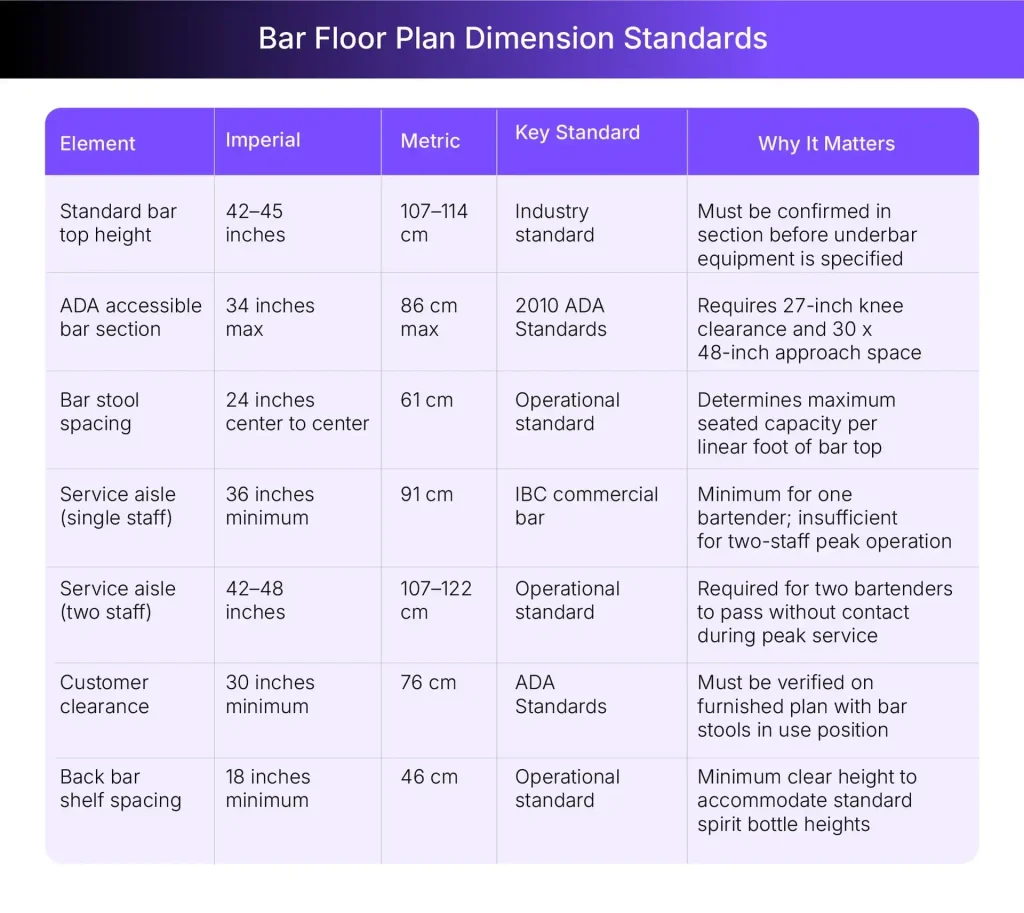
These five measurements govern every project for commercial bars submitted for US planning approval. Each one carries a design consequence you need to account for before the floor plan is finalized.
- Bar Height (42 to 45 Inches): Standard bar top height of 42 to 45 inches (107 to 114 cm) must be confirmed in the section view before any underbar equipment is specified for the project. The height selected governs the clear working depth between the bar top, underside, and the underbar drain assembly, which determines equipment compatibility.
- ADA Accessible Bar Height (34 Inches Maximum): The 2010 ADA Standards require one accessible bar counter section at 34 inches (86 cm) maximum with 27 inches of knee clearance below the surface. A 30 x 48-inch clear floor space at the approach position must appear as a verified dimension on the submitted bar floor plan.
- Bar Stool Spacing (24 Inches Center to Center): Standard bar stools require 24-inch (61 cm) center-to-center spacing along the bar top to maintain shoulder clearance between seated guests during service. This spacing figure directly calculates maximum seated capacity per linear foot and must be applied to the floor plan before any bar seating count is confirmed to the client.
- Service Aisle (36 Inches Minimum, 42 to 48 Inches Recommended): The IBC sets a 36-inch (91 cm) minimum service aisle for commercial bars, while the two-staff operational standard is 42 to 48 inches (107 to 122 cm). The minimum supports one bartender; the recommended width allows two staff to pass each other without contact at peak service.
- Customer Clearance (30 Inches Minimum): A minimum 30 inches (76 cm) of clear floor space between the front of bar stools and any fixed element is required for ADA accessibility compliance throughout the bar area. Verify this clearance on the furnished plan with bar stools in the occupied-use position, not pushed against the bar counter.
5 Bar Floor Plan Layout Examples
Here are the top bar floor plan ideas you can consider for your next project:
1. The Straight Bar Layout
Source: Pinterest
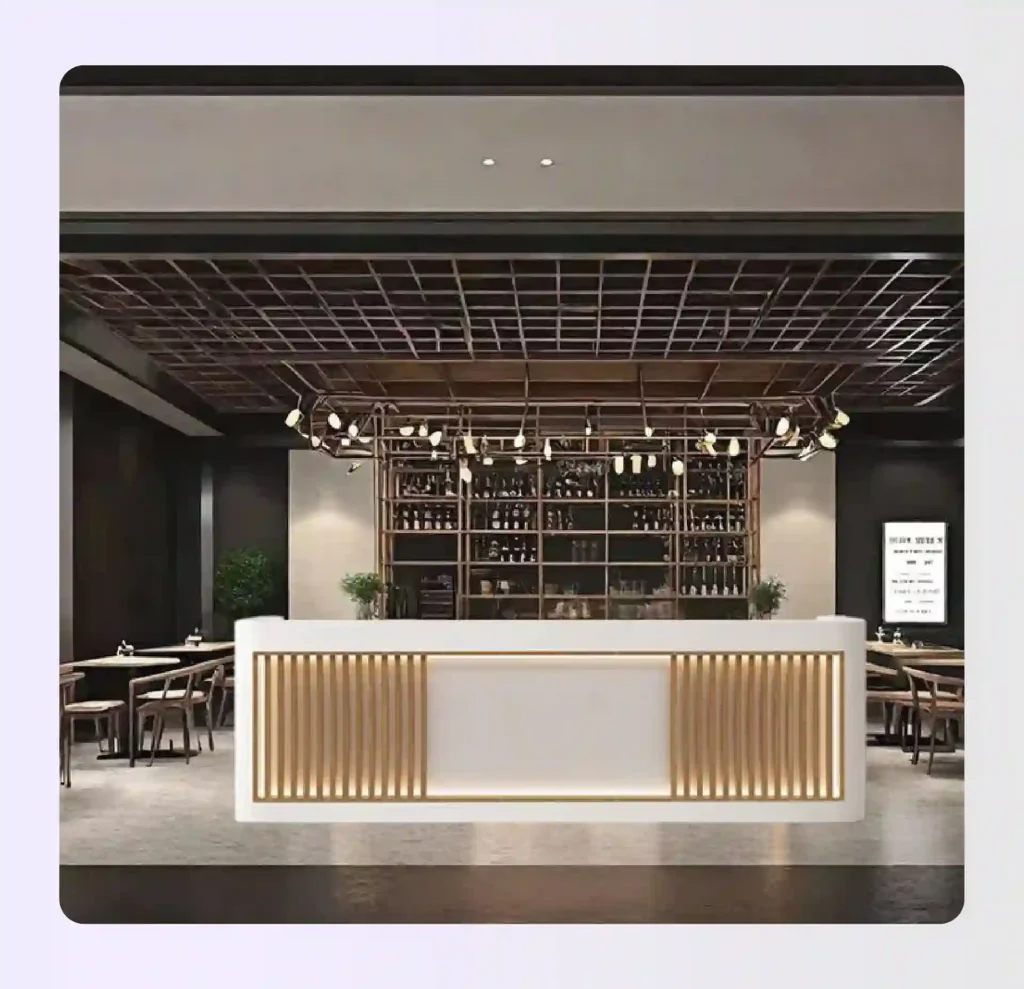
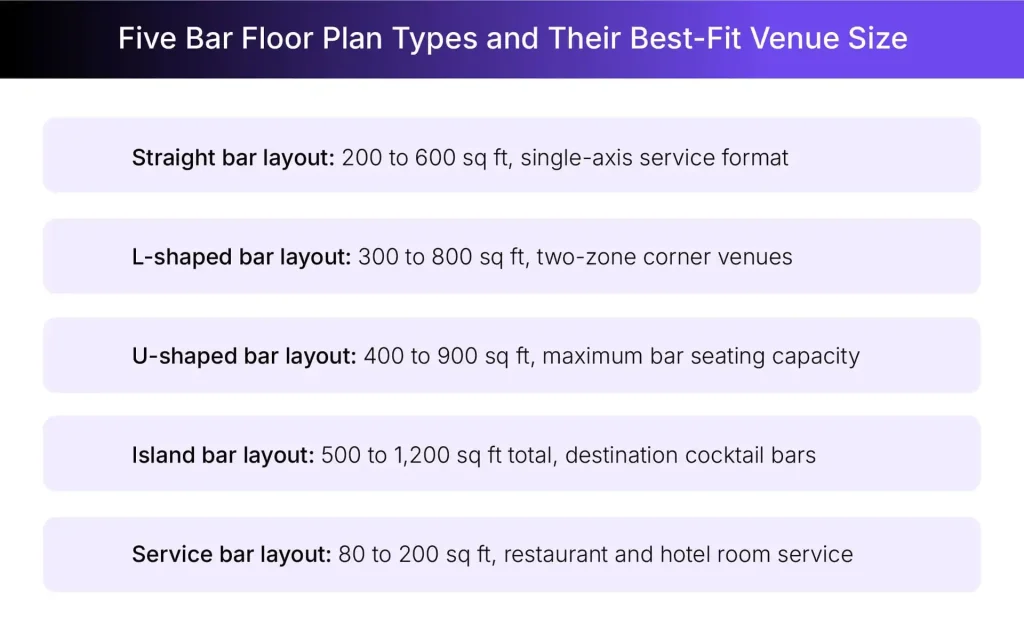
The straight bar layout places the bar counter along a single wall with the service aisle running parallel and the back bar directly behind, creating the simplest equipment-to-staff relationship in commercial bar design. It suits larger spaces with a rectangular footprint and delivers the lowest plumbing cost and most efficient underbar equipment sequence for a cozy neighborhood bar or specialized wine bar.
Recommended Size: 200 to 600 sq ft (18.6 to 55.7 sq m) bar footprint
Best For: Neighborhood bars, wine bars and venues where a single bar design axis covers the full-service requirement
Zone Breakdown:
- Linear bar top running the full wall length at 42 to 45 inches height.
- Service aisle at 42 inches minimum between bar counter and back bar.
- Back bar with 18-inch shelf spacing for glassware and spirit display.
- POS workstation positioned at end of the bar for clear sightlines.
Foyr Tip: Map equipment depth and service aisle width together as one combined cross-section measurement in the 2D plan before the service aisle dimension is committed to the construction drawing.
2. The L-Shaped Bar Layout
Source: Pinterest
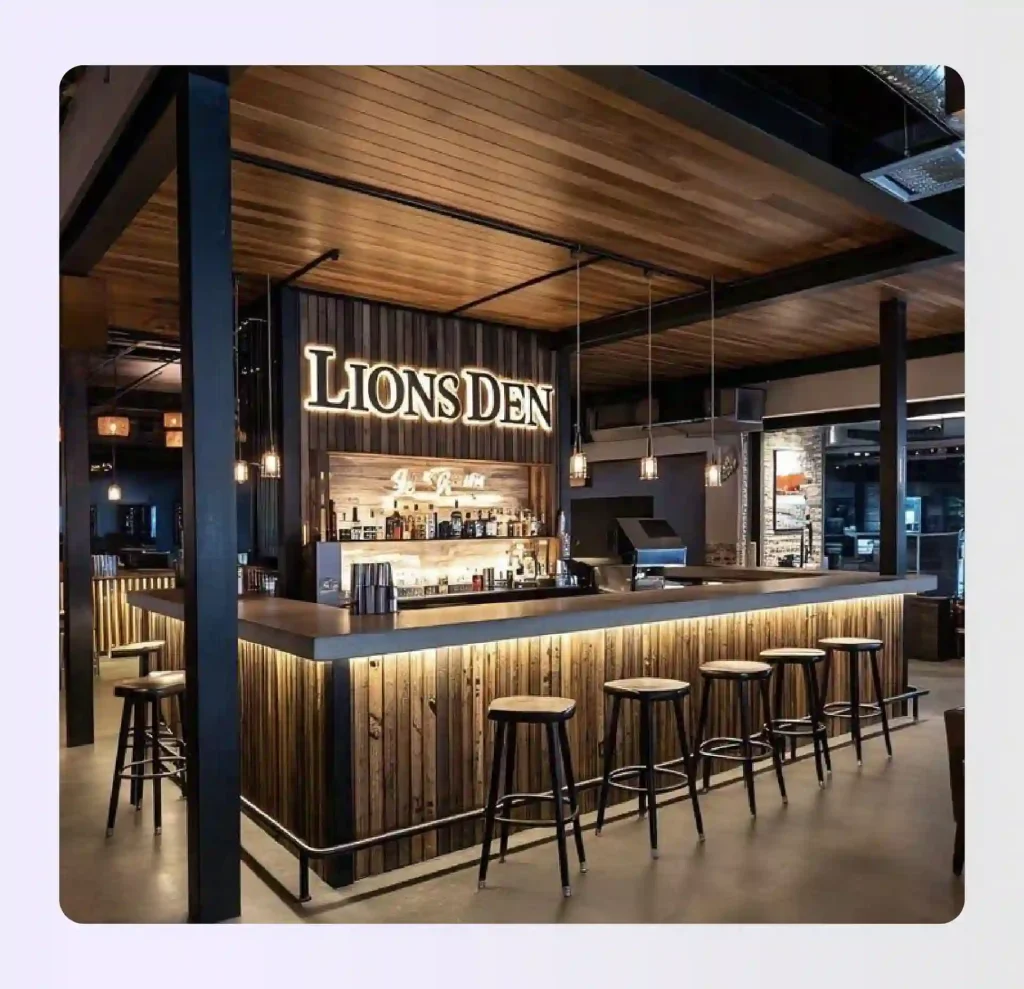
The L-shaped bar floor plan places two counter runs at a perpendicular junction, creating two distinct service zones from a single continuous bar structure that suits venues requiring separate bar seating areas. The corner junction is the operational risk point, since it concentrates both bartender movement paths at one position during peak service in a lively sports bar or high-volume venue.
Recommended Size: 300 to 800 sq ft (27.9 to 74.3 sq m) bar footprint
Best For: Corner venues, lively sports bar formats and bars requiring two visually distinct bar area zones within one structure
Zone Breakdown:
- Two perpendicular counter runs at standard height with bar stools on the guest-facing sides.
- Corner junction with a minimum 24-inch radius to accommodate bartender movement.
- Back bar positioned along the longest run for maximum storage areas capacity.
Foyr Tip: Verify the corner junction movement radius in the 3D model before finalizing. Since, the floor plan view does not reveal the actual physical clearance at the corner during two-bartender peak service operation.
| Pro Tip:
The U-shaped layout is the configuration where the interior working width is most commonly under-dimensioned on submitted floor plans. Verify the 6 ft minimum before finalizing any structural wall position in the design. |
To streamline the process of creating a 3D model of your next bar floor plan, have a look at this Foyr video:
3. The U-Shaped Bar Layout
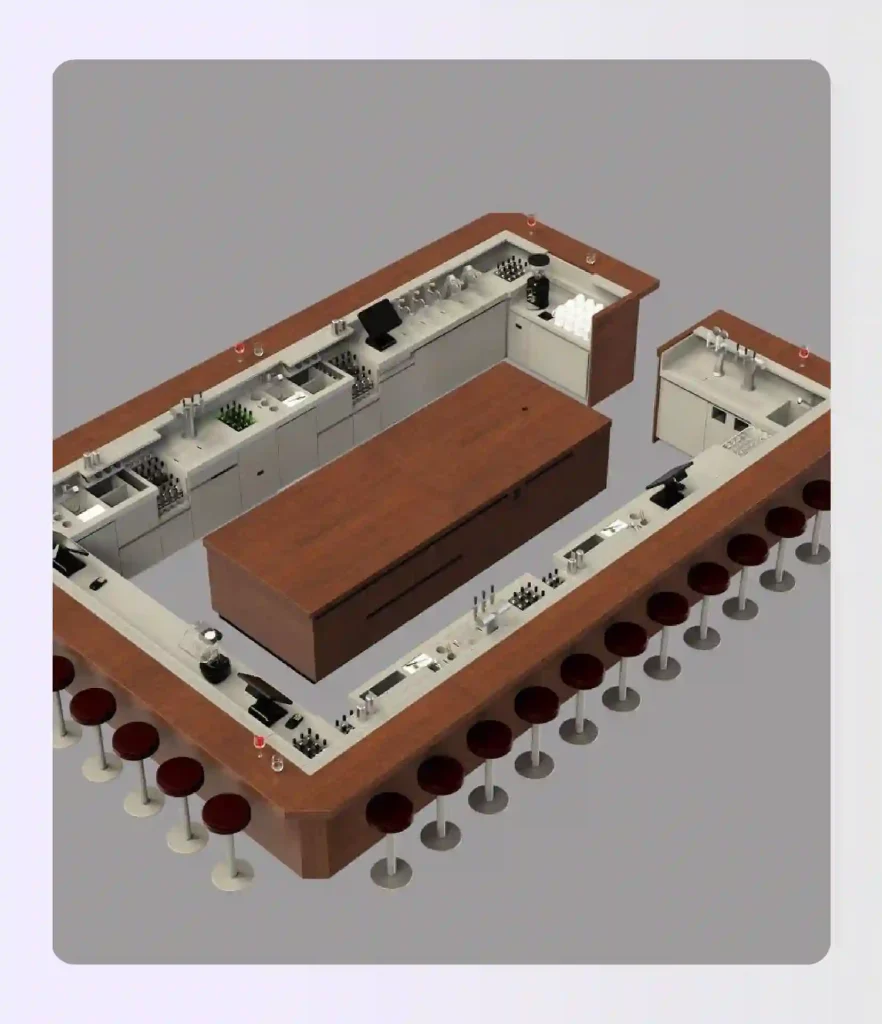
Source: Pinterest
The U-shaped bar floor plan wraps three counter runs around a central working zone. This maximizes bar seating capacity and creating high social interaction potential by placing guests on three sides of the bar area. The interior working width between the two parallel runs is the critical measurement that determines whether the layout delivers efficient space utilization or creates a confined working environment.
Recommended Size: 400 to 900 sq ft (37.2 to 83.6 sq m) bar footprint
Best For: Venue formats requiring maximum seating at the bar. This includes cocktail bar destinations and hotel lobby bars, where customer experience at the bar top is the primary revenue driver
Zone Breakdown:
- Three connected counter runs at 42 to 45 inches height with bar stools on all guest-facing sides.
- Underbar equipment distributed across all three runs based on the arrangement of a bar workstation logic.
- Single or double entry point to the bartender zone with no cross-traffic conflict.
Foyr Tip: Verify the interior working width between the two parallel runs in the 3D model to confirm the clearance supports two-bartender peak operation without creating a confined working zone.
4. The Island Bar Layout
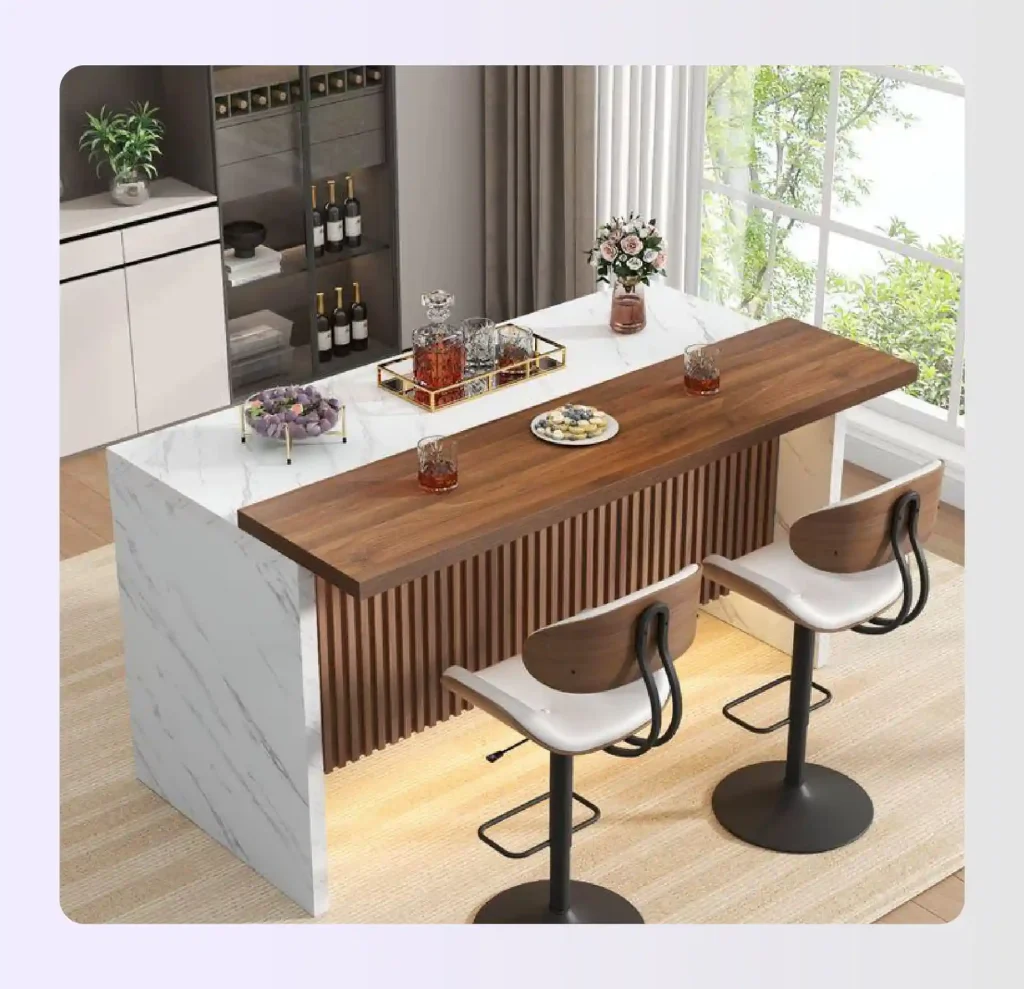
Source: Pinterest
The island bar floor plan positions a freestanding bar counter in open floor space with guest circulation paths on all four sides. The perimeter clearance on all four sides is the primary spatial challenge. The golden triangle principle of positioning the ice bin, the speed rail and the glass drop zone within a minimal movement arc becomes the critical underbar design logic.
Recommended Size: 500 to 1,200 sq ft (46.5 to 111.5 sq m) total floor area including circulation
Best For: Hotel lobby bars, destination cocktail bar venues and larger spaces where the bar structure is the primary architectural feature of the venue
Zone Breakdown:
- Freestanding bar structure at 42 to 45 inches with bar stools on all accessible guest sides
- Minimum 30-inch customer clearance on every face, verified on the furnished plan
- ADA accessible section on at least one face at 34 inches with compliant knee clearance
- Restrooms and service areas positioned to avoid crossing the island guest circulation path
Foyr Tip: Verify the 30-inch minimum clearance on all four faces of the island bar in the 2D plan before the layout is finalized. The plan view dimensioning typically confirms only the primary approach face.

5. The Service Bar Layout
The service bar floor plan is a staff-only format without any guest-facing bar seating, designed entirely around the drink build sequence from raw ingredients through to the server pass-through window as the sole output point. The arrangement of a bar in a service format follows an assembly-line logic. The workflow moves in one direction from ice to preparation to garnish to the pass window, with no reverse movement.
Recommended Size: 80 to 200 sq ft (7.4 to 18.6 sq m) dedicated service bar footprint
Best For: Full-service restaurants, hotel room service operations and any venue where the bar space serves the dining floor rather than seated bar guests
Zone Breakdown:
- Ice bin and speed rail at the workstation entry point for quick access at the start of every drink build
- Preparation zone with glassware access and garnish station in sequence along the build path
- POS terminal positioned for easy access without interrupting the build workflow or blocking the pass window
Foyr Tip: Position the pass-through window aligned directly to the server circulation path in the 2D plan. An offset window of even 18 inches creates a server pivot at every drink pickup, which compounds into measurable service-time loss across a full dining shift.
For hospitality designers presenting bar floor plan layouts to venue owners and investors, this video shows the end-to-end process to create designs in Foyr Neo:
Design Your Bar Floor Plan with Foyr Neo
Once zone allocation is confirmed and the section view has resolved the vertical dimensional logic, you need to validate the full bar floor plan in 3D and produce delivery assets for client and authority submission. Foyr Neo covers every stage of that professional delivery workflow from shell trace to final render.
Here is how the entire process works with our interior design software:
- Trace the Shell Plan and Build the 2D Bar Floor Plan: Upload the shell plan to Foyr Neo and trace walls using the auto-snapping tool to build an accurate dimensioned bar floor plan base. This removes the manual redrawing step that costs two to three billable hours on every new commercial bars project.
- Convert to 3D and Verify Cross-Section Relationships: One-click 2D-to-3D conversion validates the vertical relationship between the bar top, underbar equipment and service aisle at real scale in the 3D model. This confirms that the section-view logic translates correctly into the built configuration before any equipment is ordered for the venue.
- Mark ADA Clearances and IBC Egress Paths on the 2D Plan: Mark the 30-inch customer clearance, the 34-inch ADA accessible bar top height, and all IBC egress paths as verified dimensions on the 2D plan in Foyr Neo. Compliance verification at the plan stage costs a fraction of any physical correction made after the bar is built and operational.
- Test Lighting Across the Bar Top, Back Bar and Seating Zone: Use Foyr Neo’s AI lighting simulation to test ambient and task lighting across the bar top, back bar display and bar seating zone before the electrical specification is issued. This confirms the lighting ambience and decor atmosphere before any fixture is wired into the venue structure.
- Generate 12K Photorealistic Renders for Client Approval: Foyr Neo produces 12K renders of the full bar floor plan in minutes, delivering presentation-quality visuals for venue-owner and investor approval packages. Designers can complete a full bar design presentation, including renders and 3D walkthroughs, in a single working day.
Foyr Neo covers the complete bar floor plan workflow from shell trace through to render delivery in one platform without switching tools mid-project. Interior designers using Foyr Neo on hospitality projects report faster client approvals and fewer on-site clearance corrections per engagement.
Try Foyr Neo free for 14 days and design your bar floor plan before any construction brief is issued.
FAQs
What is the standard depth of a commercial bar?
A commercial bar has three distinct depth zones: front bar top at 18 to 24 inches, underbar at 20 to 24 inches, and back bar at 18 to 24 inches. These combine with the service aisle to set the total wall-to-wall bar design dimension. Confirm each zone in the section view before any measurement reaches the construction drawing.
How wide does a bar service aisle need to be for two bartenders?
The IBC sets a 36-inch minimum service aisle for commercial bars, but this supports only one bartender working at a time. The operational standard for two-staff bar layout is 42 to 48 inches, allowing both staff to pass without contact during peak service. A minimum-code aisle in a two-bartender venue produces measurable service slowdowns during every peak period.
What are the ADA requirements for a commercial bar?
The 2010 ADA Standards require one accessible bar counter at 34 inches maximum with 27 inches of knee clearance below the bar top surface. This section must be 60 inches wide minimum with a 30 x 48-inch approach space verified on the furnished bar floor plan. Bar top thickness and underbar drain depth both affect whether the knee clearance is achievable at the specified height.
What is the minimum clearance between bar stools in a commercial venue?
Standard commercial bar stool spacing is 24 inches center-to-center, providing shoulder clearance between seated guests during peak service. Spacing below 24 inches causes contact between guests when turning to order, reducing customer experience and increasing spills at the bar area. The 24-inch standard also determines the maximum legal seated capacity of the bar seating zone on the submitted floor plan.
How do you lay out a back bar for operational efficiency?
A back bar is organized by sequencing spirit categories from highest to lowest turnover, with the most-poured bottles at eye level on the primary display shelf. Shelf spacing must be 18 inches minimum to accommodate tall spirit bottles for whisky, rum and gin without the cap contacting the shelf above. Back bar depth and service aisle width share the same wall-to-wall allocation and must be confirmed together on the bar floor plan.