

Most home gym layouts fail at the planning stage, well before a single piece of fitness equipment ever arrives in the room. You order the squat rack without a floor plan, and the space ends up cluttered rather than a functional workout zone.
The principles behind a functional home gym layout stay consistent across spare bedrooms, garage gyms and basement setups of any size. Ceiling height, available floor space and clearance requirements apply the same way regardless of where the gym sits in your house plan.
This guide covers space planning fundamentals and clearance requirements along with six practical home gym floor plan configurations for different training goals. We will also discuss how a scaled floor plan with dimensions helps prevent costly purchasing mistakes before you order any piece of equipment.

Home Gym Size and Clearance Guidelines
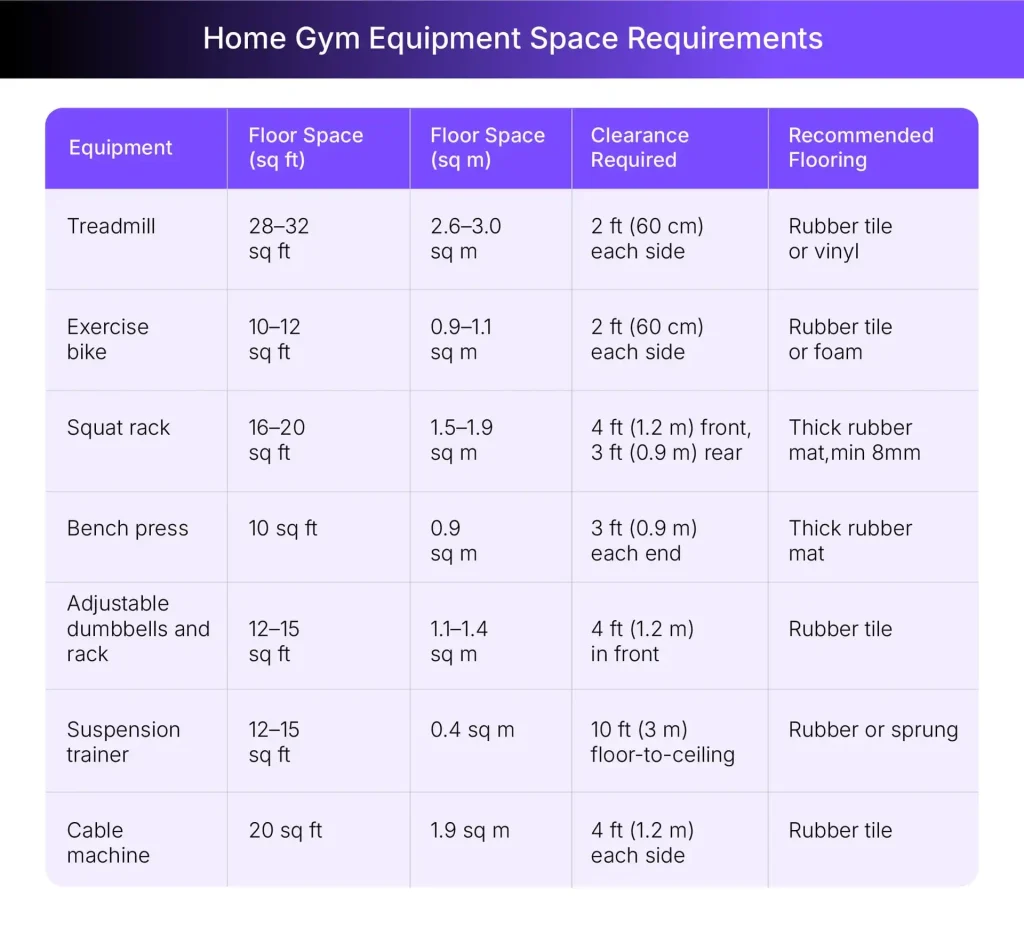
Every home gym layout decision you make, from squat rack placement to cardio zone sizing, starts with these six measurements.
- Minimum Gym Size: A compact home gym needs 100 sq ft (9.3 sq m) minimum for cardio and body weight training using compact workout equipment. Strength training with free weights and a bench press needs 150 sq ft (14 sq m) minimum for a safe range of motion.
- Equipment Clearance: Allow 2 ft (60 cm) clearance on all sides of cardio machines and 4 ft (1.2 m) in front of free weight stations. These minimums protect your range of motion during every set and allow safe loading of workout equipment between reps.
- Ceiling Height: A minimum ceiling height of 8 ft (2.4 m) covers most floor-based strength training and yoga on foam rollers and yoga mats. Overhead press and pull-up movements require at least 10 ft (3 m) above the finished floor, accounting for your standing height plus the barbell or pull-up bar.
- Equipment Footprints: A treadmill takes 30 sq ft (2.8 sq m), a squat rack occupies 16 to 20 sq ft (1.5 to 1.9 sq m) and a bench press takes 10 sq ft (0.9 sq m). An adjustable bench and adjustable dumbbells add 15 sq ft (1.4 sq m) of combined footprint to the home gym plan.
- Squat Rack Clearance: A squat rack needs 4 ft (1.2 m) in front and 3 ft (0.9 m) behind for safe barbell loading and unloading at full incline. Allow 2 ft (60 cm) on each side to avoid adjacent fitness equipment interrupting your movement path during a lift.
- Flooring Recommendations: Use rubber tiles in the free weight zone to absorb impact and protect the subfloor from barbell and adjustable kettlebell drops. Foam panels suit yoga and stretching areas, while sprung flooring supports cardio machines and lower body plyometric work.
6 Home Gym Floor Plans That Actually Work
A good home gym layout resolves clearance, zone logic and equipment footprint before you spend a dollar. Each of these six home gym design ideas addresses a different room type and training goal.
1. The Compact Single-Zone Gym
Source: Pinterest
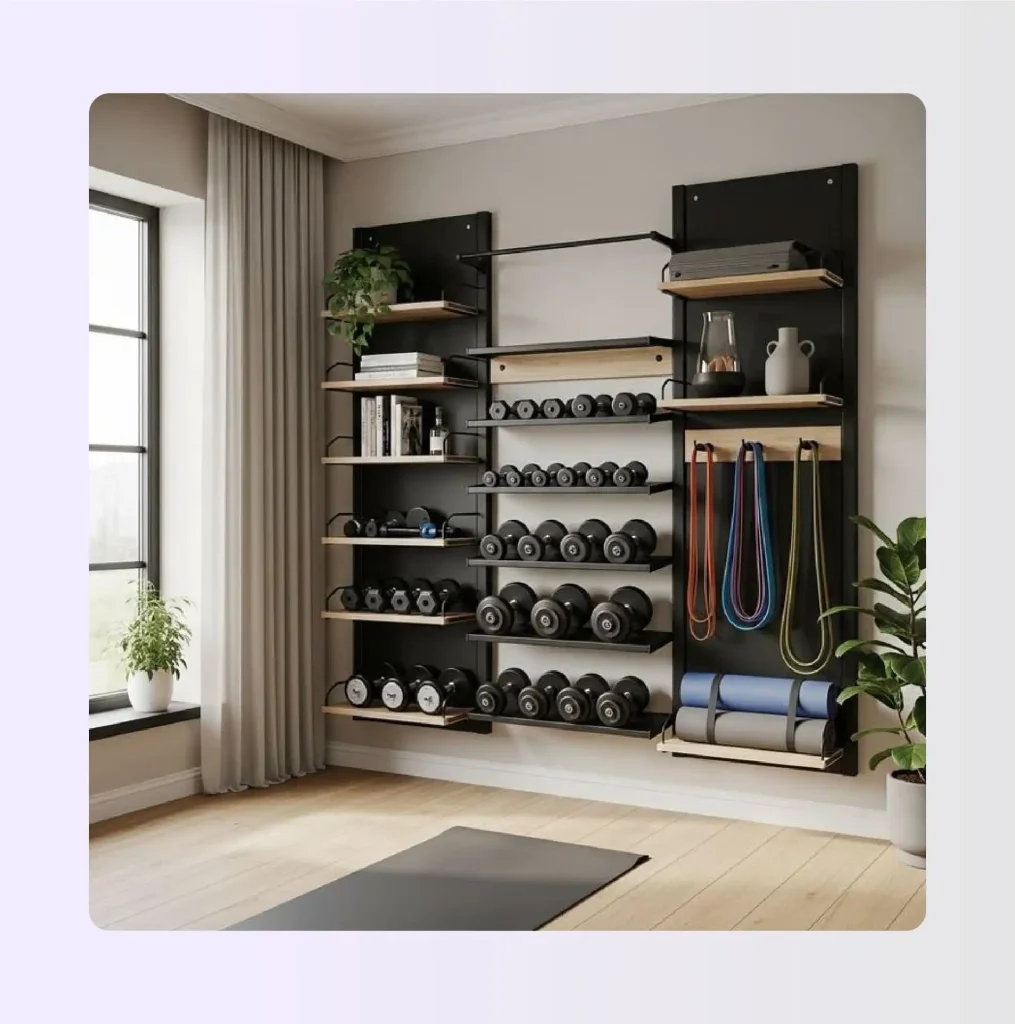
The compact home gym places all workout equipment flush against one wall, keeping the central floor open for body weight training, yoga and foam roller mobility work. This home gym layout suits any living space under 120 sq ft (11 sq m) where a compact setup and a smaller footprint per piece of equipment are non-negotiable.
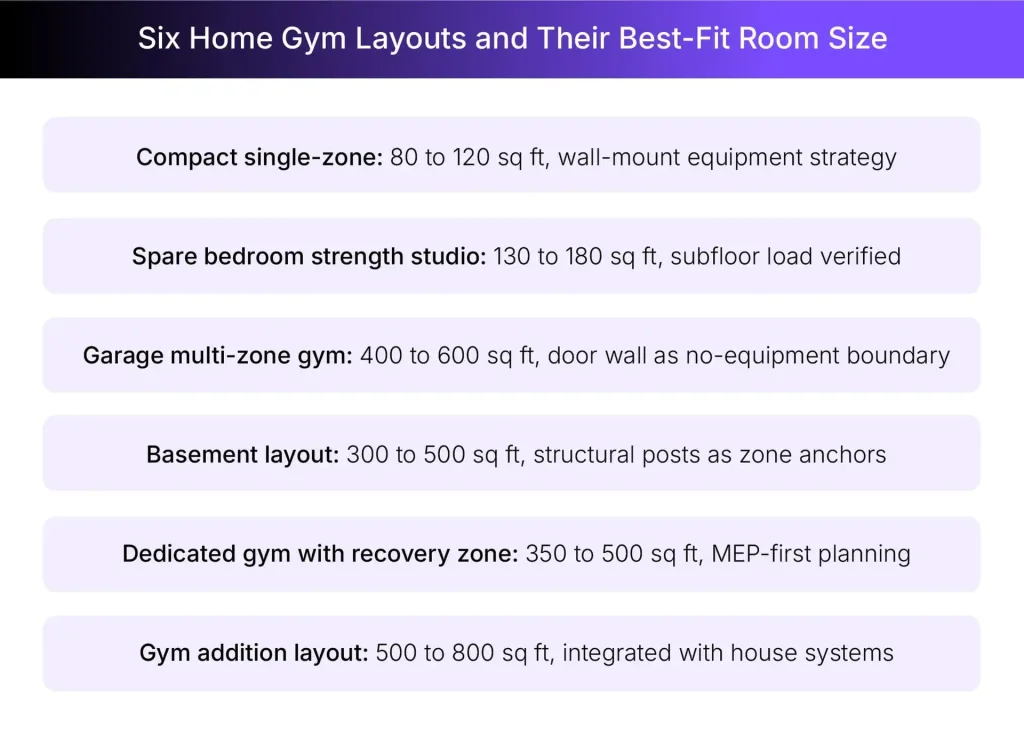
Recommended Size: 80 to 120 sq ft (7.4 to 11 sq m)
Zone Breakdown:
- Resistance bands and adjustable dumbbells mounted on the wall
- Compact workout equipment like an exercise bike positioned at one end
- Open central floor for yoga mats and body weight work
- Accessories like foam rollers stored in a wall-mounted basket
Foyr Tip: Map all equipment flush to the wall in the 2D floor plan first, then verify vertical wall storage height in Foyr Neo’s 3D view to confirm ceiling clearance above each piece is not lost.
2. Spare Bedroom Strength Studio
Source: Pinterest, DIY Garden
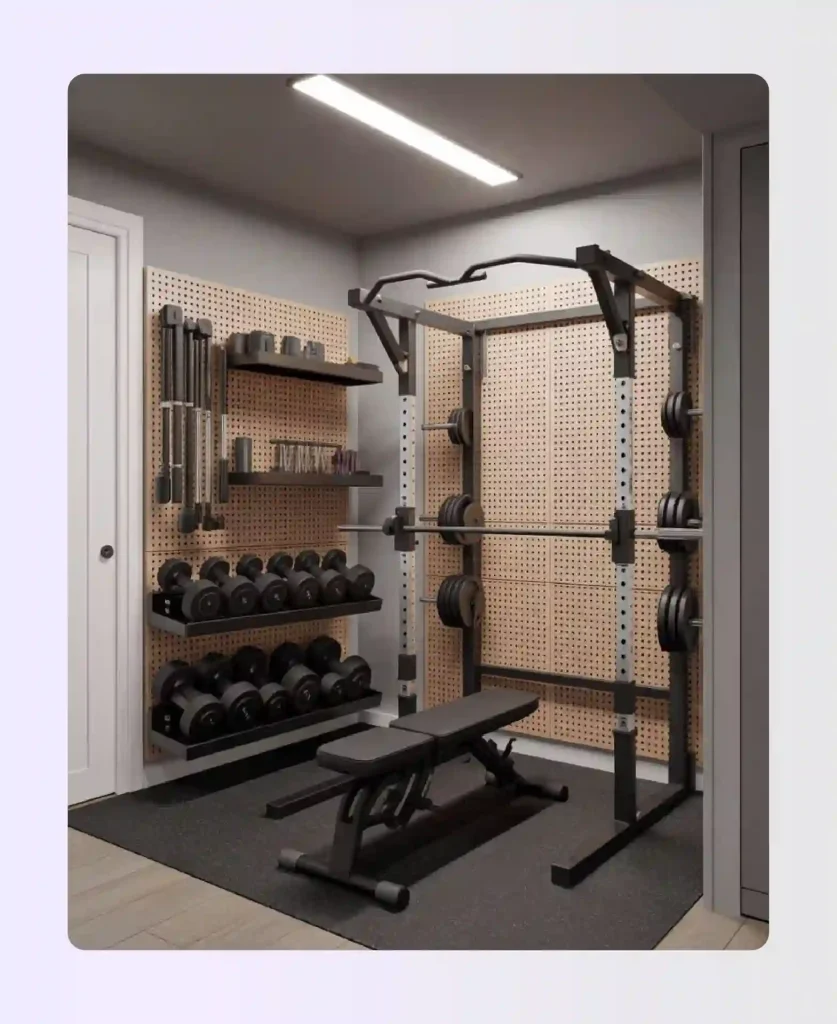
The spare bedroom strength studio converts a standard bedroom into a focused strength training zone built around a squat rack, a bench press and free weights. This home gym plan suits bedrooms between 130 and 180 sq ft (12 to 17 sq m) with verified subfloor load capacity.
Recommended Size: 130 to 180 sq ft (12 to 17 sq m)
Zone Breakdown:
- Squat rack anchored on the far wall with 4 ft (1.2 m) front clearance maintained
- Bench press positioned parallel to the rack with barbell storage on the same wall
- Adjustable dumbbells and adjustable kettlebells on a rack near the entry
Foyr Tip: Position power rack legs over structural joists in the 2D plan before ordering any fitness equipment. A loaded rack places 500 to 600 lbs (227 to 272 kg) on a floor rated for 40 lbs (195 kg) per square foot, and legs between spans need a structural engineer review.
If you want to learn how to create a 3D walkthrough of your home gym in minutes using Foyr Neo, have a look at this video:
3. Garage Multi-Zone Gym
Source: Pinterest
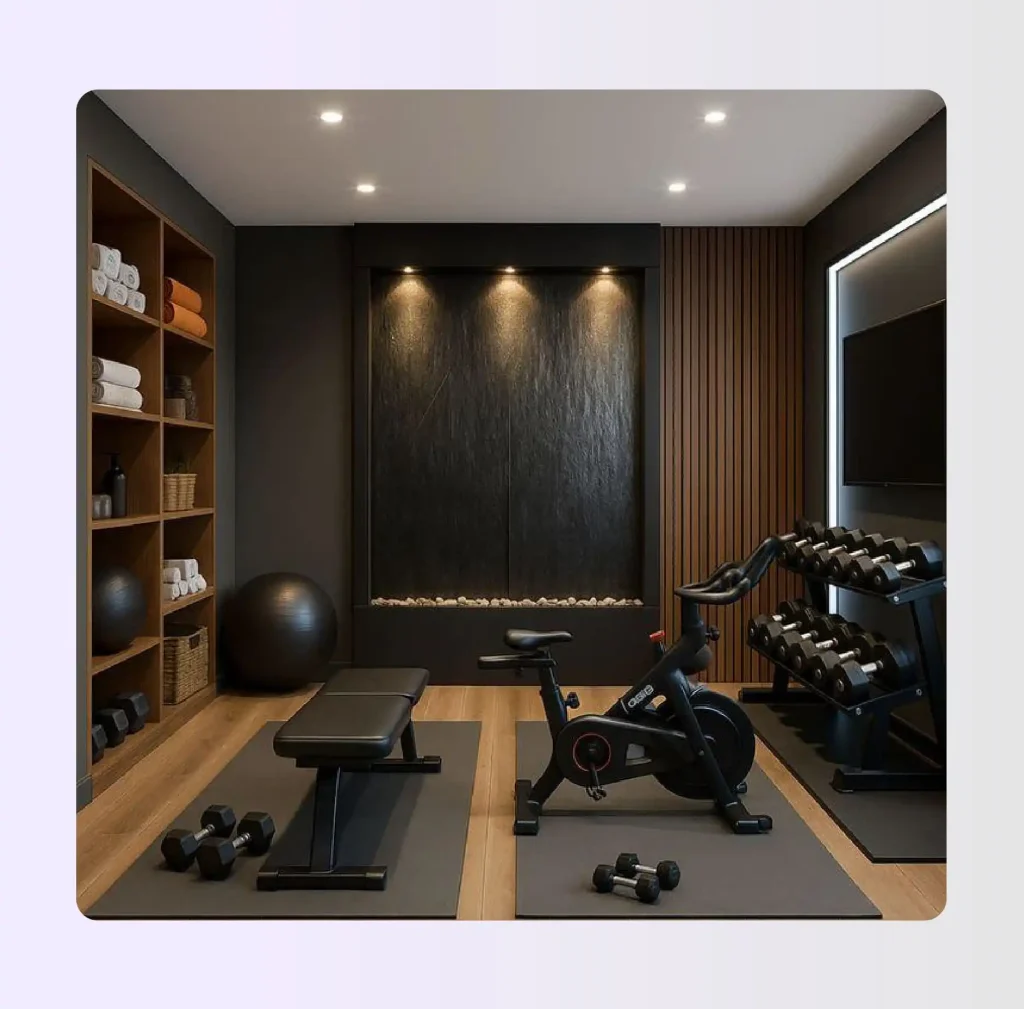
The garage gym multi-zone layout distributes cardio, strength training and functional training across separate areas of a full garage bay, using walls and flooring transitions to define each zone. This home gym layout suits house plans with gym space between 400 and 600 sq ft (37 to 56 sq m) where heavy fitness equipment and floor drains are feasible from the first thing you plan.
Recommended Size: 400 to 600 sq ft (37 to 56 sq m)
Zone Breakdown:
- Cardio zone with a treadmill and exercise bike positioned away from the door wall
- Strength training zone with squat rack and free weights along the side wall
- Functional training open area in the center for upper body and lower body circuits
- No-equipment buffer zone along the full garage door wall
Foyr Tip: Simulate the garage door open and closed in Foyr Neo’s 3D model before placing any piece of equipment, keeping the cardio zone away from the cold draft zone at the door threshold and treating the door wall as a permanent no-equipment boundary.
4. Basement Layout
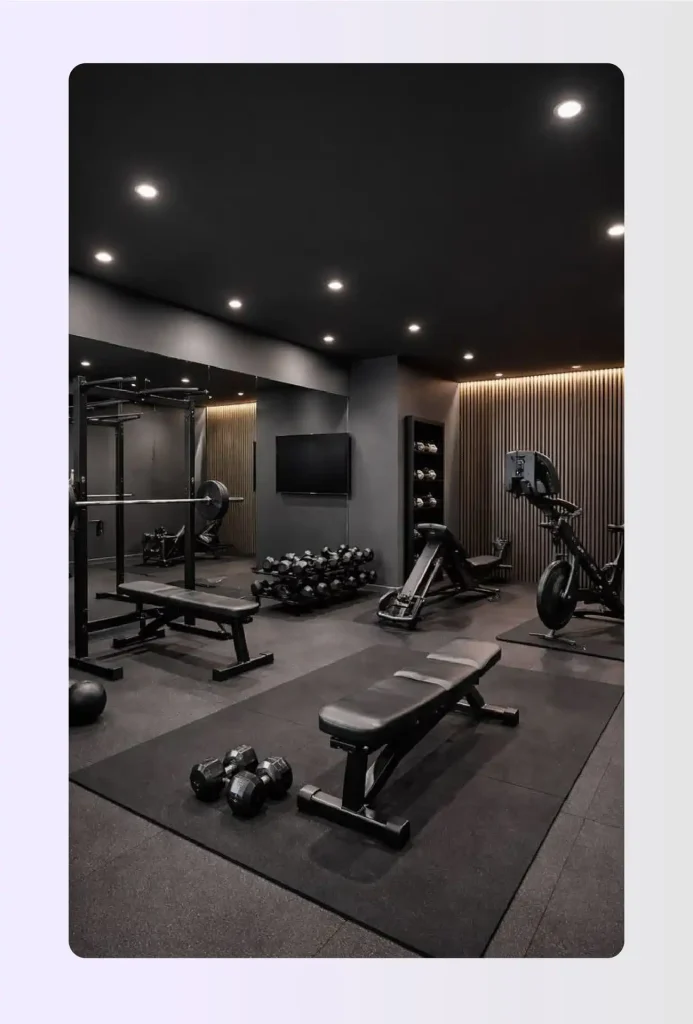
The basement home gym layout treats every structural post and beam as an immovable zone boundary before drawing a single training area on the floor plan. This home gym floor plan suits house plan with gym space between 300 and 500 sq ft (28 to 46 sq m) in a basement space where posts define the zone logic.
Recommended Size: 300 to 500 sq ft (28 to 46 sq m)
Zone Breakdown:
- Strength training zone positioned between posts with verified clearance on all sides
- Cardio zone in the most open section of the basement with the best ceiling height
- Stretching and yoga area on foam flooring panels in the widest clear zone
Foyr Tip: Mark every structural post in Foyr Neo’s 2D plan as a fixed constraint before drawing any zone boundary, since posts cannot be used as rig anchors or wall-mount anchor points without a structural engineer sign-off on the load.
5. Dedicated Gym with Recovery Zone
Source: Pinterest
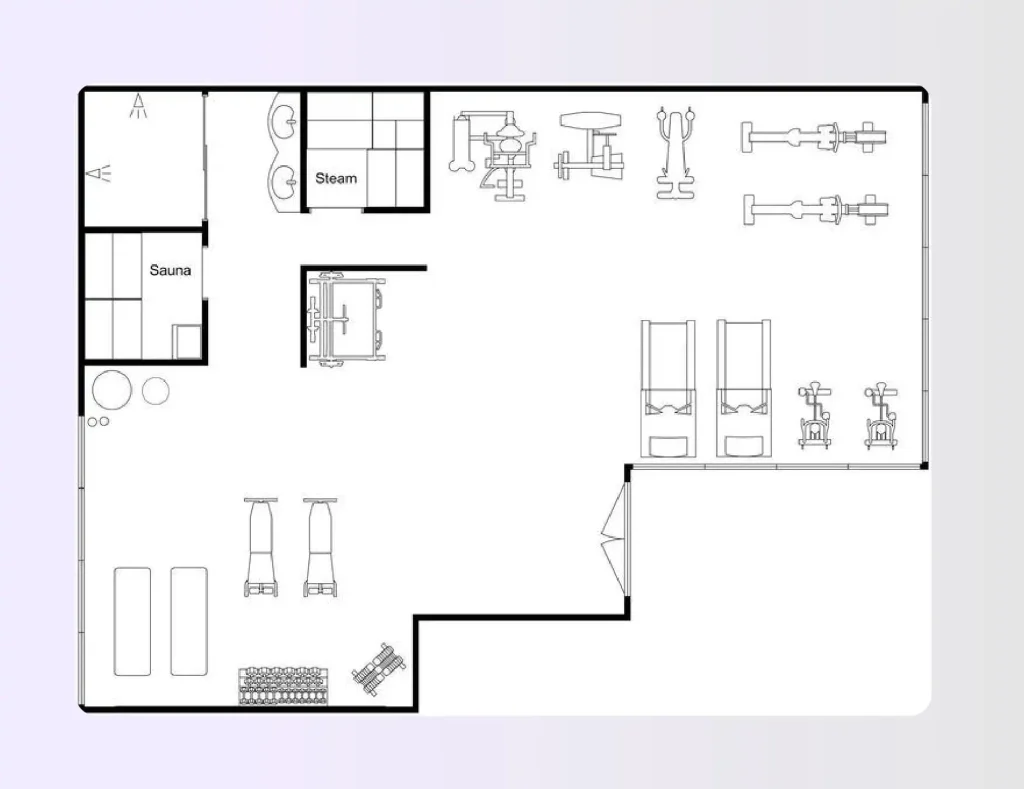
The dedicated gym with recovery zone separates the training floor from a dedicated recovery area housing a sauna, cold plunge and stretching space within the same room. This home gym layout suits house plans with gym space of 350 to 500 sq ft (32 to 46 sq m) in a purpose-built space where MEP infrastructure must be planned before the training floor is drawn.
Recommended Size: 350 to 500 sq ft (32 to 46 sq m)
Zone Breakdown:
- Sauna positioned on an exterior wall with a dedicated 240V circuit and 4 ft (1.2 m) clearance from combustibles
- Cold plunge adjacent to the sauna with a floor drain and waterproof membrane below the unit
- Strength training and cardio zone drawn last, around the MEP anchors already set
Pro Tip: Place the sauna and cold plunge on the 2D plan as fixed MEP anchors before drawing the training floor, since their 240V electrical requirement and drain positioning dictate where all other zones sit in the room.
Foyr Tip: Use Foyr Neo’s AI lighting simulation to test the ambient lighting mood in the recovery zone separately from the training zone. These two areas need different color temperatures and brightness levels to function well throughout the day.

6. Gym Addition Layout
Source: Pinterest
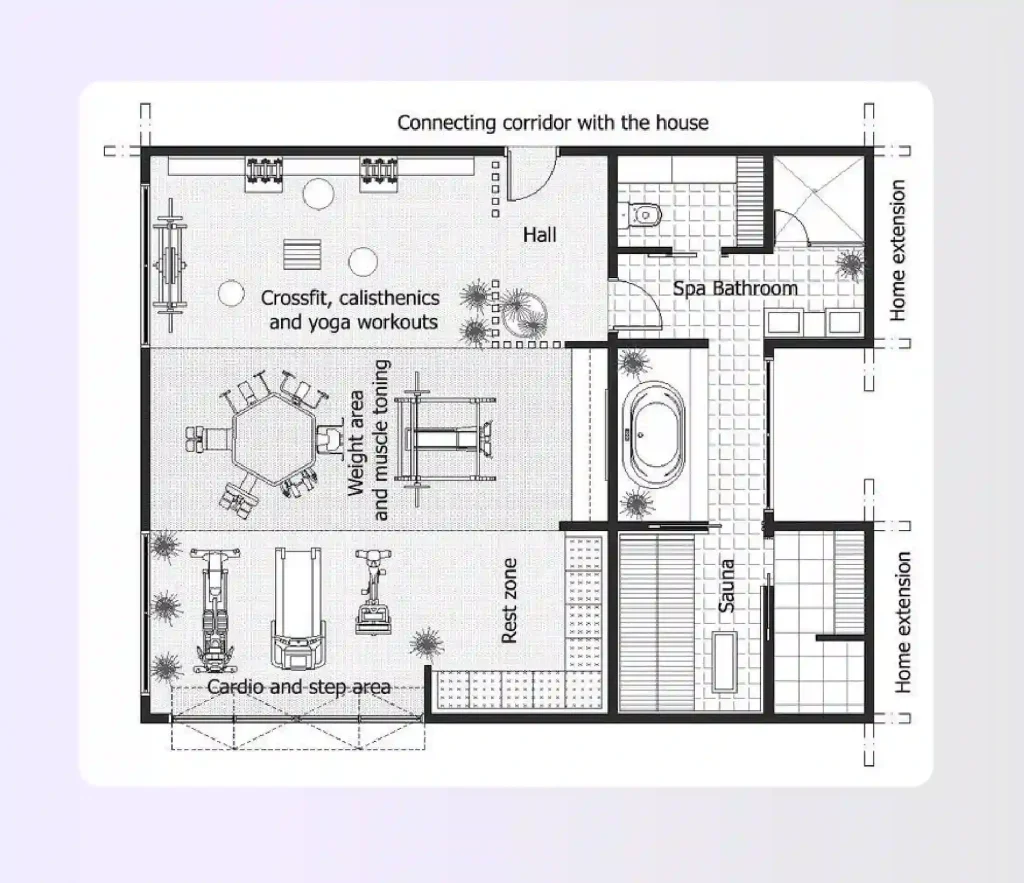
The gym addition layout is a purpose-built structure attached to or adjacent to the main house, designed from the structural drawings outward rather than retrofitted into an existing room. This home gym floor plan with dimensions suits house plan with gym space of 500 to 800 sq ft (46 to 74 sq m) where budget allows for full contractor coordination.
Recommended Size: 500 to 800 sq ft (46 to 74 sq m)
Zone Breakdown:
- Strength training zone with full squat rack and free weights at the far end from the house connection
- Cardio zone with treadmill, exercise bike and rowing machines near the addition entry point
- Bathroom adjacent to the changing area, planned into the structural drawings from the start
- HVAC zone boundary between the gym addition and the main house living room to prevent noise and humidity transfer
Foyr Tip: Use Foyr Neo’s Dome Lighting tool to simulate how natural light enters the gym addition at different times of day. This will help confirm that the window placement in the structural drawings maximizes natural light across the cardio and strength zones before the contractor is briefed.
Check out this video to understand how you can build your dream home gym designs quickly with Foyr Neo:
How To Design Your Home Gym Layout
Getting the home gym layout right before ordering any equipment saves money and prevents the storage-room outcome that defeats most home gym setups from the start.
- Step 1: Measure the room at floor level and again at 36 inches from the floor. Protrusions and baseboards reduce the workable depth from the nominal wall-to-wall figure you recorded first.
- Step 2: Define your training goals before choosing any piece of fitness equipment. A cardio-focused home gym plan looks nothing like a strength training studio even in the same square footage.
- Step 3: Map clearance zones around every planned equipment position before you finalize the equipment list. A home gym layout that passes the clearance test on paper is the first thing that confirms the plan is buildable.
- Step 4: Plan flooring by zone type rather than applying one material throughout. Rubber tiles, foam panels and sprung flooring each serve a different movement type and protect your wallet from avoidable damage over time.
- Step 5: Verify ceiling height against the tallest movement you plan to perform. Overhead press, pull-ups and incline barbell work all have different minimum clearance requirements above the finished floor.
- Step 6: Produce a scaled home gym floor plan with dimensions before purchasing any fitness equipment. Since seeing every footprint and clearance zone at real scale is the only reliable way to confirm the setup you want actually fits the space you have.
“I see a future where advanced visualization tools like highly realistic 3D renders, allow customers to clearly envision what their space will look like before a single piece of equipment is installed.”
— Kayleigh Stiles, Facility Design Manager, Life Fitness / Hammer Strength
Design Your Home Gym Floor Plan with Foyr Neo
Foyr Neo covers the full home gym layout workflow from the first room measurement to a photorealistic 12K render you can use to confirm every purchasing decision before spending anything.
Designers and homeowners use our interior design software for their home gym projects because it catches spatial errors at the floor plan stage rather than during equipment delivery.
- Map Accurate Equipment Footprints: Place every piece of workout equipment in the 2D floor plan at its exact manufacturer’s dimensions using Foyr’s render-ready 3D model library. This gives you a floor plan that reflects the actual home gym setup you are planning, not a rough approximation drawn from memory or a product page thumbnail.
- Generate 12K Photorealistic Renders: Foyr Neo produces 12K photorealistic renders of the full home gym layout in minutes, giving you a precise visual of the finished space before any fitness equipment is ordered or delivered.
- Switch Between 2D and 3D Views: One-click 2D to 3D conversion lets you move from the floor plan into a navigable 3D walkthrough at any stage of the home gym design process. This view catches ceiling clearance conflicts, equipment crowding, and dead-zone clutter that a flat-floor plan drawing will never reveal.
- Access the 60,000+ Model Library: Foyr Neo’s model library includes commercial and residential fitness equipment at accurate dimensions, covering every piece from a basic set of resistance bands through to a full squat rack setup. You can test different layouts using actual product footprints rather than generic blocks.
- Test Lighting and Ventilation Across Zones: Use Foyr Neo’s AI lighting simulation to test natural light and artificial lighting levels across each training zone in the home gym layout, confirming the spec before any electrical work begins. This is crucial for basement and garage gym setups where access to natural light is limited.
- Export 2D Plans and 3D Renders Together: Foyr Neo exports the 2D floor plan and 3D renders as a combined deliverable, giving you a professional document set that covers both the spatial logic and the visual outcome of the home gym layout in one package.
Try Foyr Neo free for 14 days and design your home gym floor plan before ordering any equipment.
FAQs
What is the minimum room size for a functional home gym?
A compact home gym needs at least 100 sq ft (9.3 sq m) for cardio-only training using compact workout equipment such as a set of resistance bands, adjustable dumbbells and an exercise bike. Strength training with a squat rack and bench press requires at least 150 sq ft (14 sq m) to maintain the clearance distances the NSCA recommends around loaded free-weight equipment for safe use.
How much floor clearance do you need around a squat rack?
A squat rack needs 4 ft (1.2 m) of clear floor space in front for barbell loading and safe unracking, and 3 ft (0.9 m) behind for emergency bailouts during a failed lift. The NSCA recommends a minimum 2 ft (60 cm) clearance on each side so no adjacent piece of workout equipment intrudes on the movement path during strength training.
Can a standard residential floor support a power rack and weights?
A standard timber-joisted residential floor carries a design load of approximately 40 lbs per square foot (195 kg per square meter), while a loaded power rack with plates and a barbell can reach 500 to 600 lbs (227 to 272 kg) concentrated on four small footpads. Always map the rack leg positions over structural joists in the floor plan and consult a structural engineer before ordering any heavy fitness equipment.
What ceiling height do you need for overhead lifts in a home gym?
A minimum ceiling height of 10 ft (3 m) above finished floor covers overhead press and incline barbell work for most users, factoring in standing reach height plus the barbell at full extension. Pull-up bars require at least 10 ft (3 m) of vertical clearance from the floor to the bar anchor, and suspension trainer movements like a full TRX row need at least 9 ft (2.7 m) to avoid contact with the ceiling during the full range of motion.
Do you need a permit to build a home gym addition?
Any purpose-built structure attached to or adjacent to the main house requires a building permit in most US jurisdictions, since the structural scope, electrical work for a 240V sauna circuit, and plumbing for a cold plunge all trigger local code review. Contact the local building department before drawing any additional floor plan, since the permitted structural scope will directly define what the home gym floor plan with dimensions can and cannot include.