

A gym floor plan is a professional decision that determines whether a fitness facility runs at peak efficiency or creates daily friction for its members. IHRSA recommends a minimum of 3 square meters per person in commercial fitness facilities, and that figure shrinks rapidly once gym equipment, storage, and circulation paths are taken into account.
For you as a designer or architect, gym floor plan design is a professional responsibility, not a layout preference. My take is that every compliance obligation must be resolved on the floor plan before any contractor receives a brief.
This guide covers the US code standards every designer must document for compliance submission, a seven-step professional workflow and gym floor plan layout examples with dimensions for different facility types. We will also cover how interior designers can deliver client-ready gym plan presentations using 3D models and photorealistic renders.

US Code Requirements and Spacing Standards Every Designer Must Know
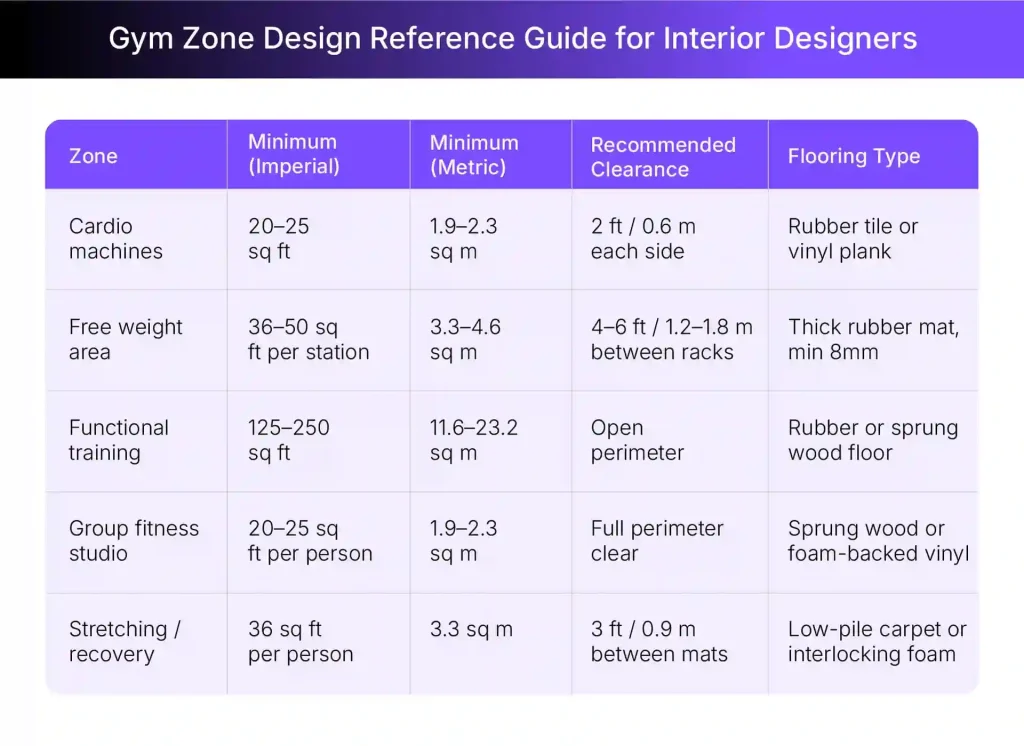
A gym floor plan submission carries compliance obligations that the designer must resolve and document before any planning authority reviews the project. These five standards govern every commercial fitness facility in the United States and form the core of every compliance package you must prepare for a client.
- NFPA 101 Occupancy Load: As per NFPA 101, exercise rooms with gym equipment calculate occupancy at 50 square feet per person. Rooms without equipment use a 15-square-foot-per-person calculation; you must document it in the compliance package before planning approval.
- ADA Clearance: According to ADA Standards, the facility must maintain a minimum 30 x 48-inch clear floor space between all aisles and fitness equipment. You should verify this clearance at every fixture position as a dimensioned note, not a general compliance annotation.
- Emergency Egress: OSHA 29 CFR 1910.36 specifies that exit corridors require a minimum 28-inch unobstructed clear width after all exercise equipment is placed. Emergency exits must appear on every version of the gym floor plan you submit to planning authorities.
- Ceiling Height: Cardio and strength training zones need a minimum ceiling height of 10 to 12 feet throughout the gym space. Functional training and group fitness studios require 14 to 20 feet, and you have to confirm both at the site audit stage.
- Ventilation Per WBDG federal design guidelines, fitness facilities need a 20% increase in cooling capacity above the standard building shell. A separate AHU for exercise areas is mandatory, and you need to include this requirement in the MEP brief from the start.
The Interior Designer’s Process: From Client Brief to Finalized Gym Floor Plan
A professional gym floor plan layout reflects a disciplined designer workflow, not exercise equipment rearranged by trial and error. Each step below shows how gym design consultants execute a fitness facility project on behalf of a client.
- Step 1 – Interpret the Client Brief: My first task is to extract, clarify, and validate the client’s business model before any spatial decisions are made. I ask about the target audience, peak load expectations and what types of workouts the fitness facility will prioritize for its members.
- Step 2 – Audit the Space and Map Constraints: A physical site audit must cover structural limitations, ceiling heights and utility positions before you commit to any zone allocation. Retrofitting a modern gym into an older building often reveals floor load and ceiling constraints that careful planning at the drawing stage must anticipate.
- Step 3 – Schematic Zoning: I use bubble diagrams and adjacency planning to map distinct zones before committing to any hard wall positions in the gym floor plan. This schematic zoning stage differentiates a professional gym design workflow from a DIY layout approach and prevents costly structural revisions.
- Step 4 – Traffic Flow Planning: A well-designed gym floor plan applies one-way circulation logic in high-volume zones to prevent dead-end routes and midfloor crossings. I present clear pathways as a client argument, noting that poor circulation increases injury risk during peak hours.
- Step 5 – Equipment Placement: You produce the gym plan in 2D first, placing all gym equipment at code-compliant clearances across every zone. Then you have to use an interior design software like Foyr Neo to convert the floor plan to 3D in one click. This will help validate clearances and open floor space before any equipment schedule is issued.
- Step 6 – Compliance and Egress Validation: Your compliance responsibility includes producing a documented clearance verification set for submission to the planning authority, along with the gym floor plan. This set includes the NFPA occupancy calculation, ADA clearance dimensions and egress route widths from the fully furnished gym floor plan with dimensions.
- Step 7 – 3D Model and Client Presentation: A finalized gym plan requires a 3D model, photorealistic renders and a walkthrough as professional deliverables, not optional additions at the end. I present the gym space at human scale before construction begins, and the 3D output secures client approval.
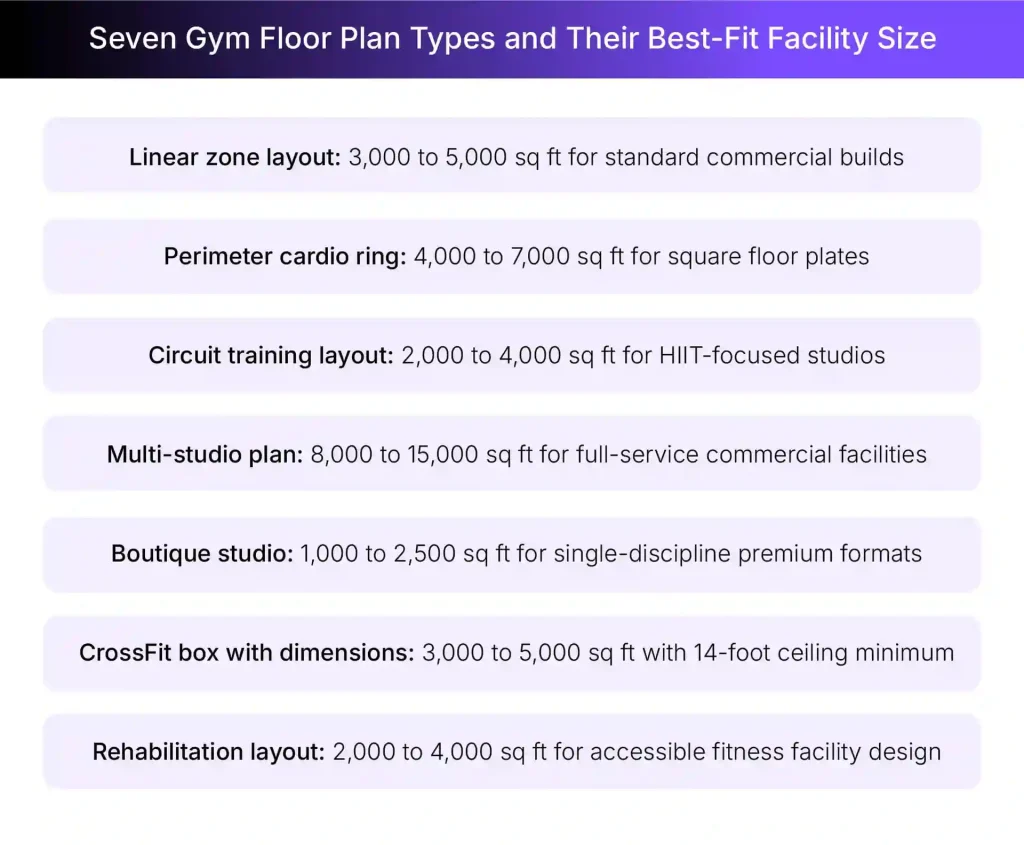
7 Gym Floor Plan Layouts for Different Facility Types
Every gym floor plan resolves into one of seven configurations depending on the client’s facility type and membership profile. Each layout below addresses a distinct spatial challenge I encounter across commercial and specialized fitness projects.
1. The Linear Zone Layout
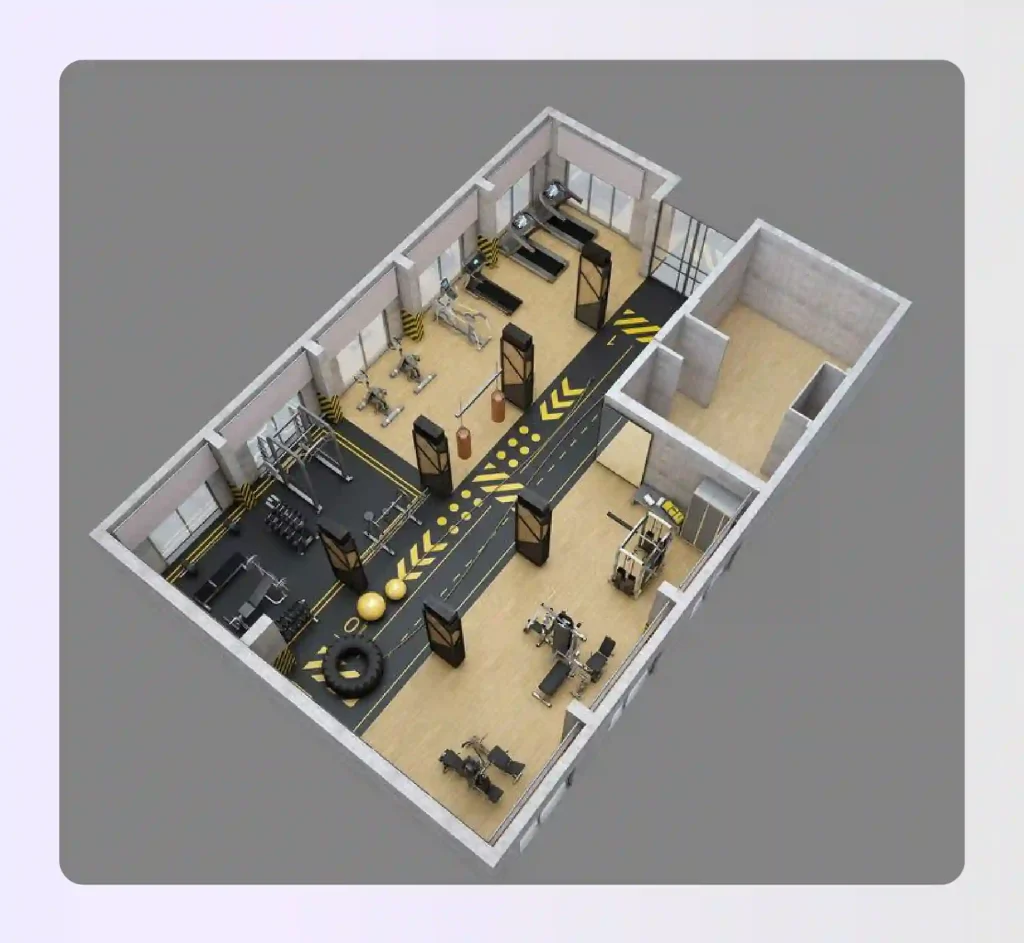
A linear gym floor plan runs cardio machines at the entry end and progresses through strength training to the rear zone. In my experience, this gym floor plan layout suits first-time commercial fitness center builds where natural light at the front and clear sightlines from reception matter most.
Recommended Size: 3,000 to 5,000 sq ft
Zone Breakdown:
- Cardio zone at front, stationary bikes and treadmills facing the entry
- Strength training mid-floor with 4 to 6-foot rack clearances maintained
- Open areas for functional training near the rear wall
- Smart storage solutions along the rear wall outside active workout zones
Foyr Tip: Use Foyr Neo’s Ruler Tool to verify reception desk sightlines to every zone before you finalize the gym floor plan for client approval.
| Pro Tip: Position stationary bikes to face a window or display screen, as this directly improves user experience and average session duration for the client’s members. |
2. The Perimeter Cardio Ring Plan
Source: Pinterest
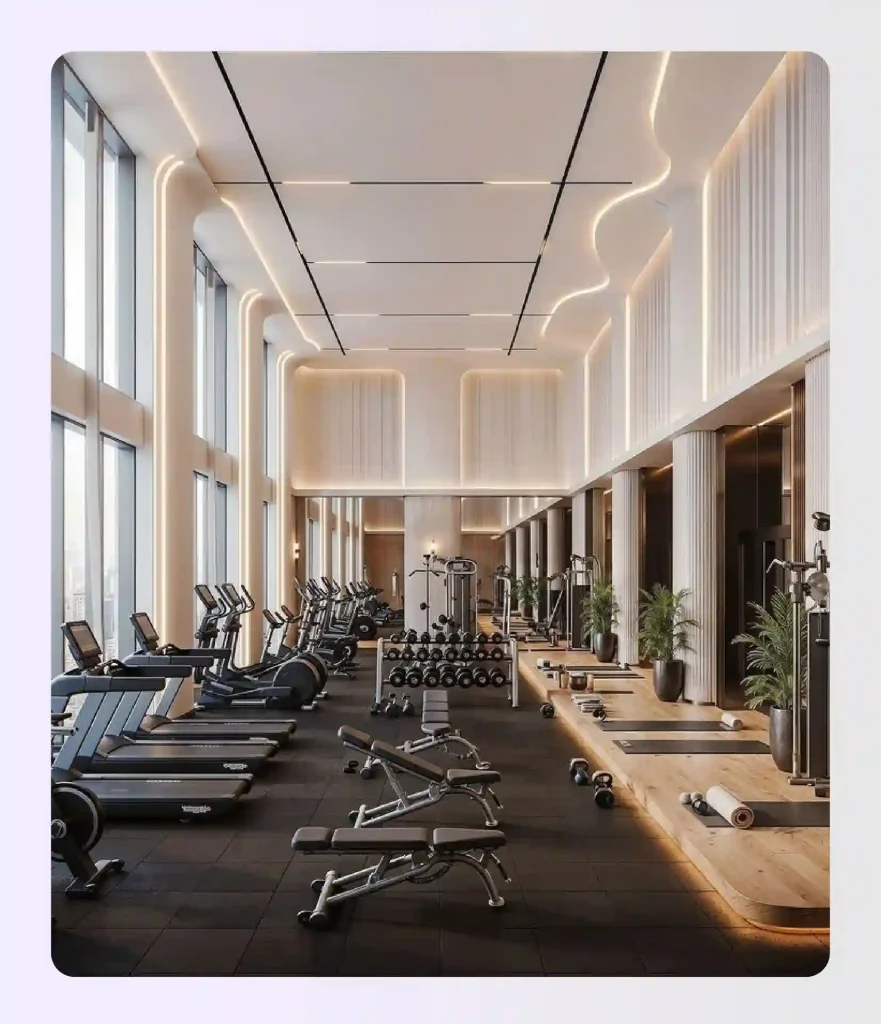
The perimeter cardio ring positions all cardio machines along the outer walls, freeing the central floor entirely for functional gym design and open floor space. I recommend this gym floor plan design for square floor plates where four perimeter walls carry an even cardio distribution.
Recommended Size: 4,000 to 7,000 sq ft
Zone Breakdown:
- Cardio machines along all perimeter walls with verified clearances throughout
- Central open floor reserved for functional training and group classes
- Corner reception desk with diagonal sightlines to the central zone
Foyr Tip: Use Foyr Neo’s Guidelines tool to set perimeter reference lines that lock cardio equipment at consistent spacing intervals before you issue the equipment schedule.
3. The Circuit Training Gym Floor Plan Layout
Source: Pinterest
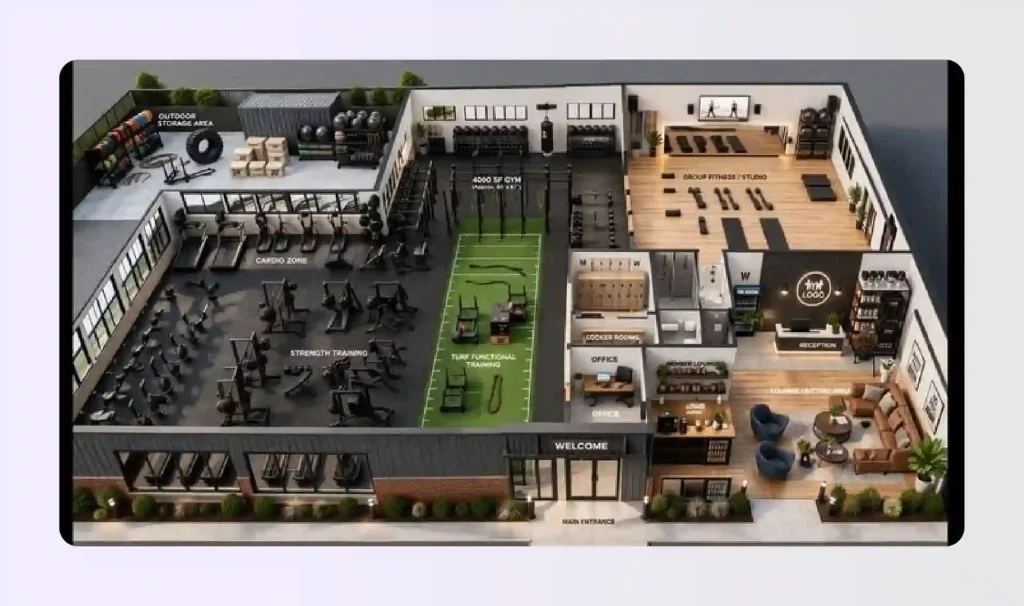
A circuit training gym floor plan with dimensions arranges exercise equipment stations in a clockwise loop for uninterrupted group classes and distinct zones for different activities. This layout maximizes fitness equipment utilization per square foot and suits HIIT-focused fitness centers where zone transitions matter most.
Recommended Size: 2,000 to 4,000 sq ft
Zone Breakdown:
- Four feet of clearance between stations for different activities
- Gym floor tiles with station numbers for easy member navigation
- Central open area for warm-up and instructor demonstrations
Foyr Tip: Use Foyr Neo’s AI Magik Bar to test flooring materials and station marker colors across the full circuit before the specification document is issued.
4. The Multi-Studio Commercial Plan
Source: Pinterest
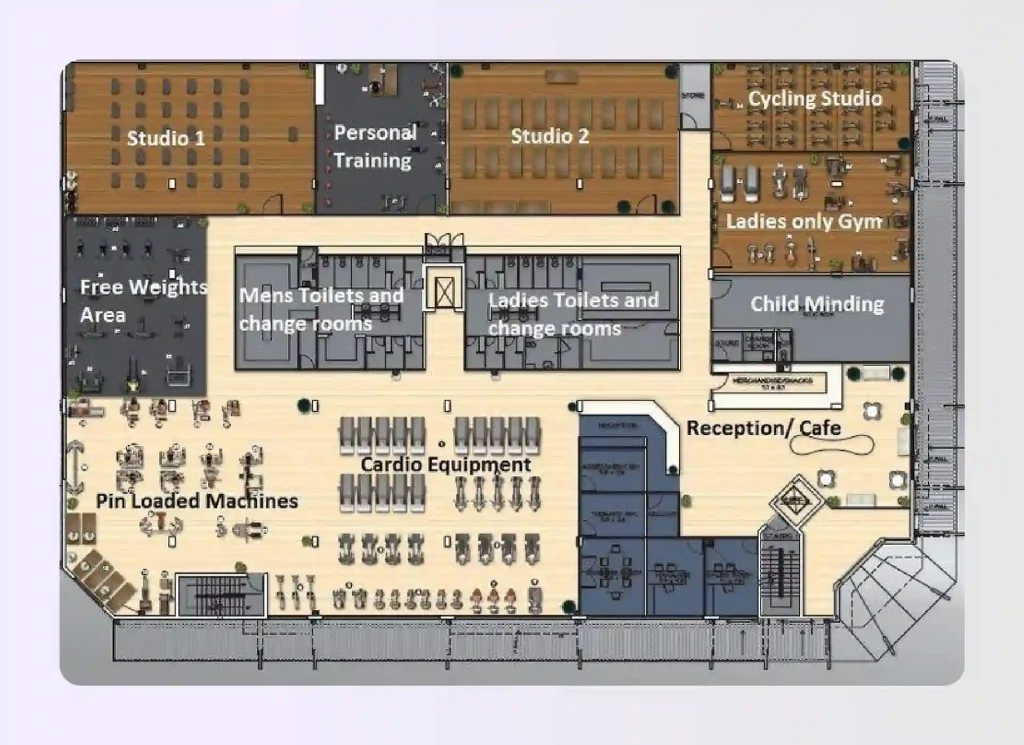
A multi-studio commercial gym plan dedicates enclosed rooms to specific disciplines and connects them via a central strength-training floor that serves all studios. I resolve acoustic isolation between studios and the central floor at the schematic stage, well before any structural brief reaches the engineer.
Recommended Size: 8,000 to 15,000 sq ft
Zone Breakdown:
- Central strength training floor with easy access from all studio entry points
- Enclosed yoga studio and cycling studio with acoustic isolation walls confirmed per the schematic
- Reception with sightlines to the central floor and all main studio corridors
Foyr Tip: Use Foyr Neo’s Pan Feature inside each studio in the 3D model to verify acoustic partition heights and glass panel positions before the structural brief is issued.
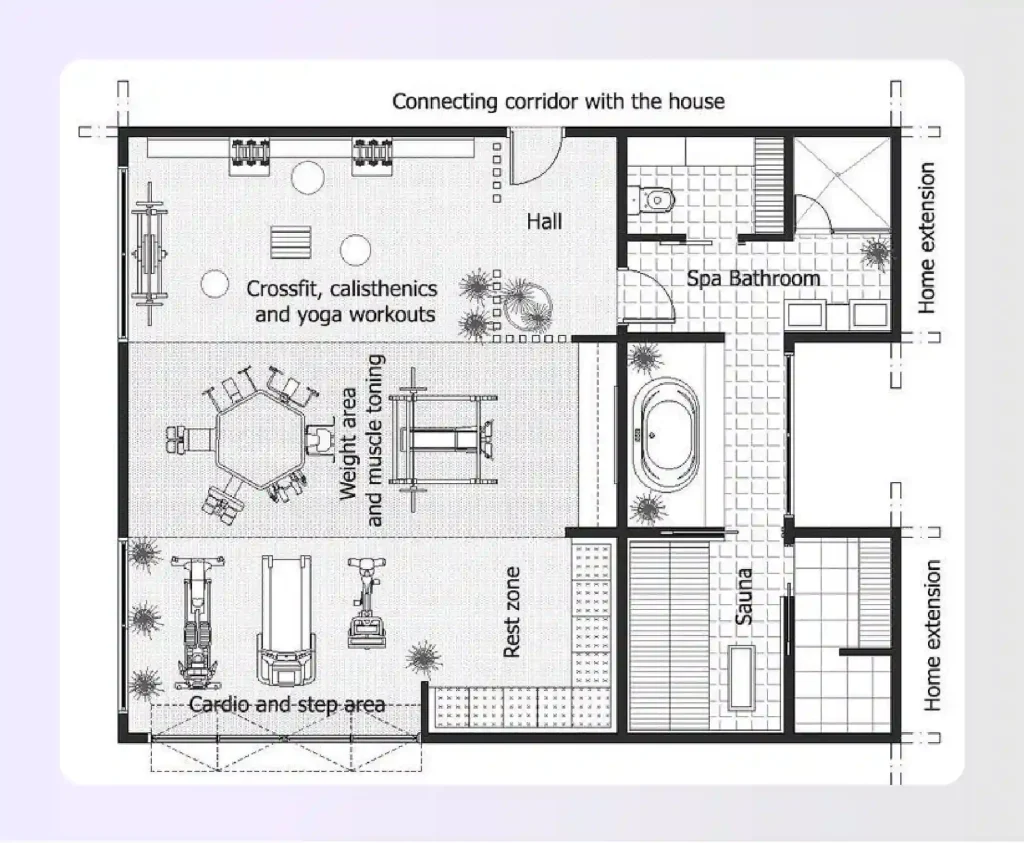
5. The Boutique Studio Floor Plan
Source: Pinterest
A boutique studio gym floor plan concentrates the full design brief into one training zone calibrated for 15 to 25 members per class. Brand identity and design elements are the primary levers of the fitness experience in this single-discipline format.
Recommended Size: 1,000 to 2,500 sq ft
Zone Breakdown:
- Single training zone occupying 70% of total floor area
- Reception with a direct sightline to the full training zone
- Compact changing facilities acoustically separated from the training floor
Foyr Tip: Use Foyr Neo to review the boutique studio in 3D on site and adjust material choices as per client requirements during the walk-through.
| Pro Tip: The boutique layout earns its membership premium through sensory design. So, resolve lighting and acoustics before specifying the right equipment for the fitness goals of the client’s members. |
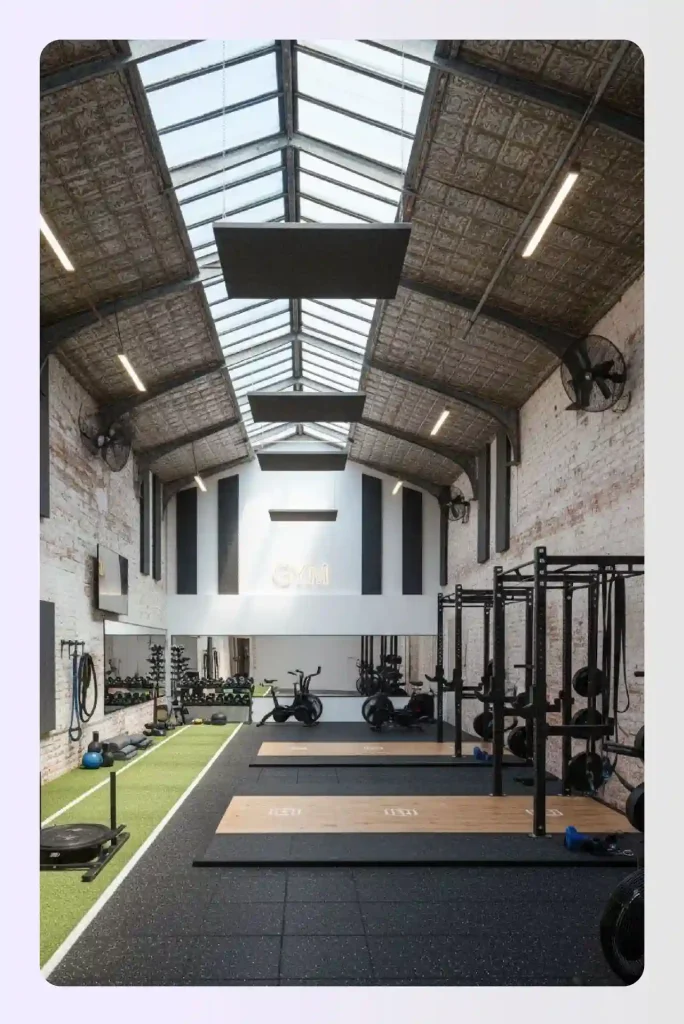
6. The CrossFit Box Gym Floor Plan with Dimensions
Source: Pinterest
A CrossFit box gym floor plan centers on a large open floor plate for functional training and free weights, with a structural rig wall and dedicated storage for barbells and plates. The ceiling height requirement creates more structural engineering dependency here than in any other gym floor plan I design.
Recommended Size: 3,000 to 5,000 sq ft
Zone Breakdown:
- Open WOD floor: 1,500 to 2,500 sq ft with 14-foot minimum ceiling
- Structural rig wall with six feet of base clearance throughout
- Barbell and plate storage on the opposing wall for balanced member traffic
Foyr Tip: Foyr Neo’s Create New Product Tool lets you model a custom rig wall at accurate structural dimensions before the engineer finalizes the load specification.

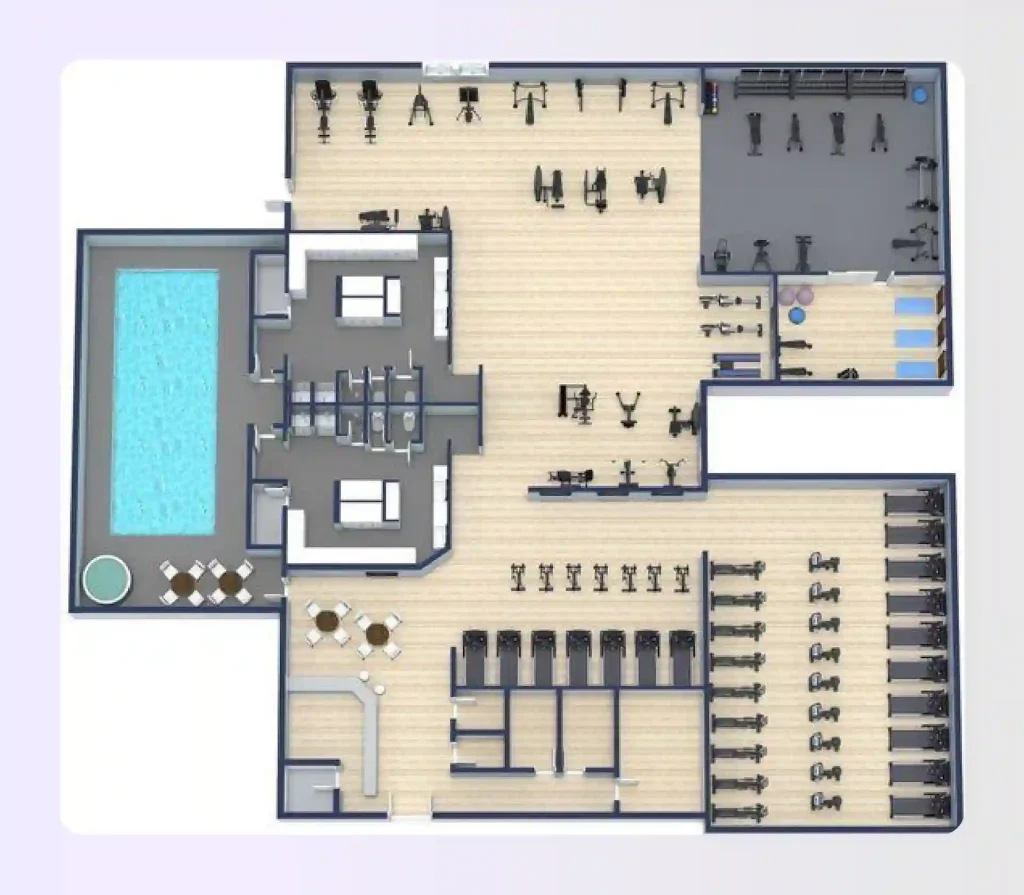
7. The Rehabilitation and Low-Impact Fitness Layout
Source: Pinterest
A rehabilitation and low-impact fitness layout applies ADA clearance standards as the governing spatial principle, not a compliance afterthought added at the end. I design this layout for health clubs prioritizing the needs of your users across all mobility levels, where enough room for wheelchair navigation is non-negotiable at every zone.
Recommended Size: 2,000 to 4,000 sq ft
Zone Breakdown:
- Therapy movement zone at 36 sq ft per person with full perimeter access
- Accessible locker rooms within 50 feet of the main training floor
- Wide aisles at 36 inches minimum for easy access throughout the facility
Foyr Tip: Foyr Neo’s Individual Product Lighting lets you test lighting at each accessible fixture position and verify the specification before the electrical brief is issued.
Check out this video from Foyr Neo to learn how you can quickly add and adjust lighting settings in your designs:
Design Decisions That Determine Long-Term Gym Performance
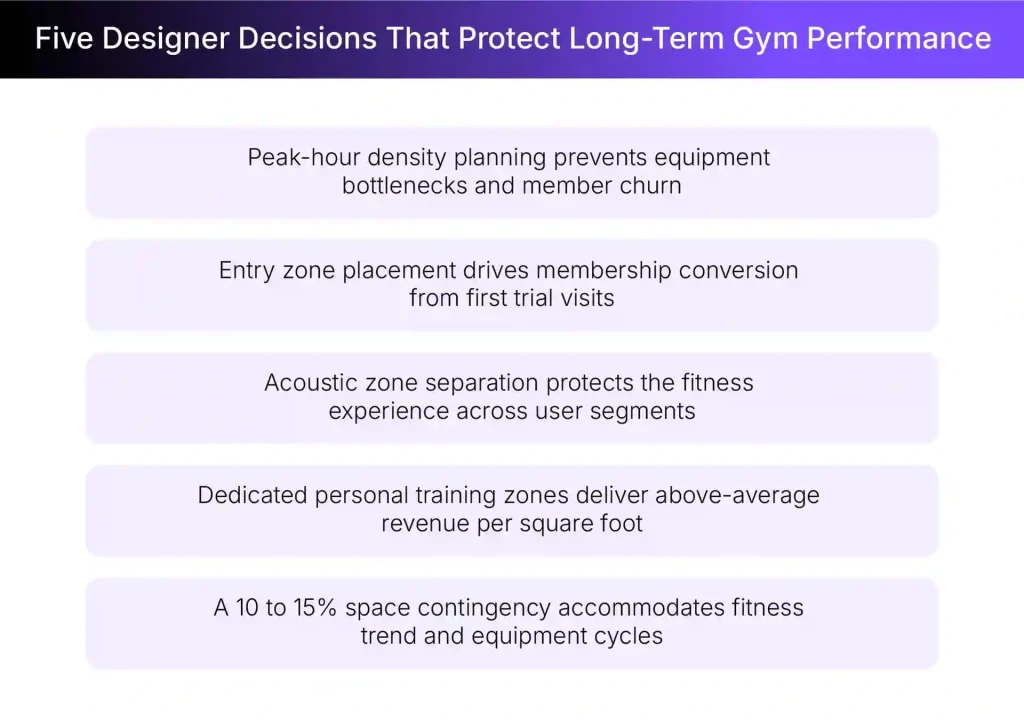
Every gym floor plan decision you make at the planning stage either supports or undermines the client’s long-term commercial performance. I frame each of the following recommendations to the client as a spatial investment with a measurable commercial return.
- Design for peak-hour density, not average occupancy. Equipment bottlenecks during peak periods generate member complaints and drive membership churn in the client’s facility.
- Place high-energy gym equipment at the entry zone to create a first-impression signal that drives membership conversion from trial visits. Present this as your design justification in the client discussion.
- Separate high-noise workout zones from recovery areas with a physical or acoustic barrier to protect the member experience. This will help reduce the risk of injury generated by a poor sensory environment between zones.
- A dedicated personal training zone generates a revenue-per-square-foot argument you present to the client at the planning stage. Personal training earns above-average returns while requiring a fraction of the floor area that a general equipment zone does.
- Recommend a 10 to 15% space contingency as best practice. New exercise equipment formats and functional gym design trends outpace most commercial lease cycles.
If you are delivering multi-zone gym floor plans to corporate or investor clients, this video explains how you can create 3D walkthroughs in minutes:
Delivering the Final Gym Design with Foyr Neo
Once you complete zoning, compliance documentation, and spatial planning, the gym floor plan project enters the professional delivery phase. I use Foyr Neo across all four delivery stages, each mapped directly to a step in the workflow above.
The following four Foyr Neo capabilities cover the full delivery workflow from site audit through to client approval for the gym floor plan design.
- Floor Plan Tracing: Upload the shell plan, and Foyr Neo’s $5 tracing service delivers a fully dimensioned gym plan within 24 hours. This removes the manual redrawing step that costs you two to four hours of billable time on every new gym project.
- 60,000+ Render-Ready 3D Models: Foyr Neo’s 60,000+ render-ready 3D models include commercial fitness equipment at accurate dimensions for every zone in the gym floor plan. This prevents the clearance conflicts that emerge when placeholder blocks replace accurate equipment footprints during the planning stage.
- AI Lighting Simulation: Foyr Neo’s AI lighting engine tests natural light and task lighting levels across every workout zone in the gym floor plan. This confirms your specification meets the WBDG fitness facility standard before any electrical rough-in is committed to the construction drawings.
- 12K Photorealistic Renders and Walkthroughs: Foyr Neo generates 12K photorealistic renders and walkthroughs in minutes, giving you board-quality approval assets based on the finalized gym floor plan. In my experience, presenting a navigable 3D walkthrough at the first client meeting cuts the number of revision rounds from four to one.
Foyr Neo covers the full gym floor plan workflow, from site audit to client approval, on one platform. Interior designers who use it for fitness facility projects report faster approval cycles and fewer revision rounds per gym layout planner engagement.
Try Foyr Neo free for 14 days and start your next gym floor plan project today.
FAQs
How do interior designers document ADA compliance for a gym floor plan submission?
Mark the 30 x 48-inch ADA clear floor space at every fixture position on the gym floor plan as a verified, dimensioned note. This clearance set accompanies the submission and confirms ADA compliance to the planning authority reviewing the project. You should also confirm local submission requirements with the Authority Having Jurisdiction before finalizing the compliance package.
What is the professional standard for zoning adjacency in a multi-discipline fitness facility?
The standard is to map adjacency requirements using a bubble diagram before committing to any hard wall positions, since acoustic isolation and egress logic both depend on zone placement at the schematic stage. A free weights zone adjacent to a yoga studio, with no acoustic isolation between them, generates member complaints from day one.
How does a designer validate egress capacity against IBC occupant load calculations for a gym?
Calculate the occupant load using 50 square feet per person for equipped exercise areas and 15 square feet per person for unequipped spaces, per IBC requirements. Run this calculation on the as-furnished gym floor plan, not the empty shell, because equipment placement can obstruct emergency exits in ways the empty plan does not reveal.
What accessibility provisions go beyond ADA minimum code requirements in premium gym design?
Premium functional gym design specifies 44 to 48 inches of clearance throughout the facility rather than the 36-inch ADA minimum, and adds audio-visual instructions at each equipment station for users with visual impairments. Frame these provisions to clients as a market differentiator, since accessible health clubs attract a broader demographic and reduce legal exposure.
At what project stage should a designer introduce 3D modeling into the gym floor plan workflow?
Introduce 3D modeling at Step 5, immediately after the 2D floor plan carries all gym equipment at code-compliant clearances, so sightline problems and feet of clearance violations are visible before the equipment schedule is issued. A gym floor planner who skips 3D validation at this stage typically discovers clearance errors during installation, when corrections carry full contractor costs.