

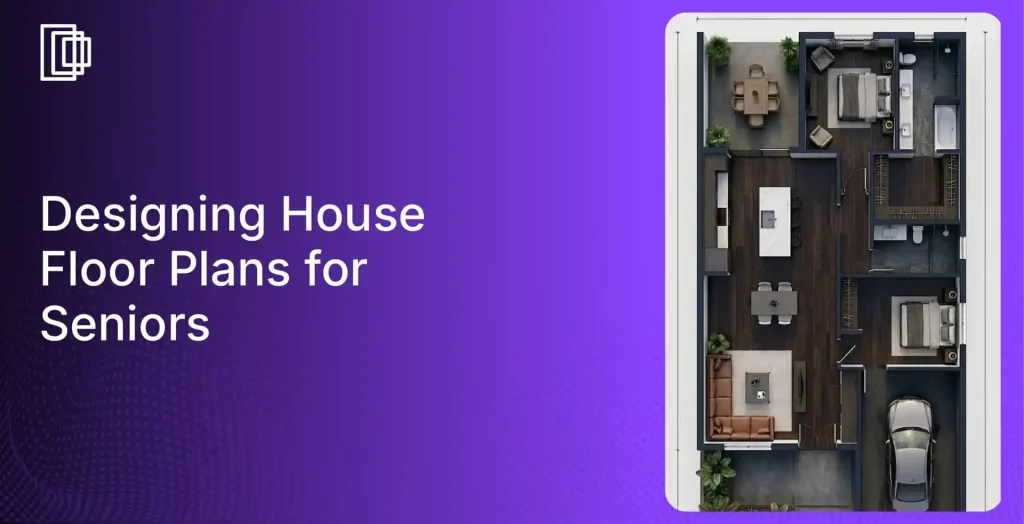
According to AARP, roughly 87% of adults (age 65+) say they want to remain in their own homes as they age. Yet most existing homes were never designed with aging in mind, which is why choosing the right house floor plans for seniors matters so much. Doorways are too narrow for walkers, bathrooms without grab bars, laundry rooms in the basement, and kitchens built around countertops at heights that assume full mobility.
I work with clients and homeowners every year who discover this mismatch too late, after a fall, after a diagnosis, or after a caregiver moves in, and the layout simply stops working. This guide is the resource I wish I could have handed to everyone earlier.
Whether you are designing new senior living floor plans from scratch or assessing what modifications an existing home needs, the examples and standards here give you a practical starting point.

What Makes a Floor Plan Truly Senior-Friendly?
Designing house floor plans for seniors is not about grab bars and ramps alone. Those are the visible symptoms of a deeper design philosophy: that the layout should work for a person’s changing mobility over time, not just their current condition.
Here is what actually distinguishes a senior floor plan from a conventional house plan:
- Traffic flow without obstacles: Every path between essential rooms (bedroom to bathroom, kitchen to living room) should be a minimum of 36 inches wide and completely free of level changes. Area rugs are one of the most common and underestimated contributors to accidents in an otherwise well-planned home.
- Sightlines between rooms: An open layout that allows a caregiver or family member in the living space to see into adjacent rooms reduces response time in a fall or emergency and provides peace of mind for the whole household.
- Lighting as a design decision: Seniors need significantly more light to navigate safely at night, and visibility in low-light transitions between rooms is directly linked to fall prevention. Layered lighting, including motion-activated nightlights along the path from bedroom to bathroom, is a standard to include in every senior floor plan design.
- Flooring continuity: A consistent flooring material across all rooms avoids transitions between surfaces that increase cognitive and physical friction, especially for seniors using mobility aids. Hardwood, vinyl plank, or low-pile carpet are far safer than mixed surfaces.
- Future-proofing over present needs: The best house floor plans for seniors are designed for where a person is going, not only where they are today.
Also Read: The Importance of Lighting in Interior Design

The 6 Core Design Pillars for Senior Housing Floor Plans
| Design Pillar | What It Means in Practice |
| Single-level living | All essential rooms on one floor with no steps between them |
| Wide clearances | Minimum 36-inch doorways, 40-inch hallways, and 60-inch turning radius in bathrooms |
| Wet zone safety | Zero-threshold showers, grab bars, non-slip flooring, fold-down bench seats, and handheld showerheads |
| Natural light and visibility | Larger windows, layered lighting, and clear sightlines between rooms to reduce the risk of accidents |
| Storage accessibility | Countertops at 34 inches, pull-out shelves, knee clearance under the sink, and reachable overhead storage |
| Emergency response readiness | Smart home features, monitored alert systems, clear pathways to exits, and caregiver bedroom proximity |
Key ADA and Universal Design Standards Every Senior Floor Plan Must Meet
This section is where I see the most credibility risk in the senior design space, so I want to be direct: ADA standards are legal requirements for commercial and public buildings. For private residential homes, they are not legally mandated but serve as the gold standard for accessible home design.
The distinction matters enormously for how you advise homeowners. A client retrofitting a 1960s ranch home in a historic district faces completely different constraints than a developer designing new independent living apartment homes. The non-negotiables below apply to both, but how you achieve them differs significantly.
ADA residential design non-negotiables
- Doorways minimum 36 inches wide, hallways minimum 40 inches unobstructed for walkers and wheelchairs
- 60 x 60 inch turning radius in bathrooms and open spaces for full wheelchair mobility
- Zero-threshold entries and curbless showers, no lips or steps at transitions
- Lever-style door handles throughout (twist knobs create significant ease-of-use problems for arthritic hands)
- All fixtures operable with less than 5 pounds of force
- Countertops adjustable or lowered to 34 inches from the standard 36 inches
| “When we design a home, we’re not just thinking about how it looks on day one. We’re thinking about who will live in it, how their lives will change, and whether those walls will still support them decades from now.”
– Sam, Interior Designer |
Retrofit vs. New Build: Why This Distinction Changes Everything
For retrofit projects, assessing the plumbing stack location before recommending any bathroom layout changes is essential, because moving a drain is a far bigger investment than replacing a fixture. Checking whether the existing stud bays will accommodate grab bar blocking is a critical early step
In period homes, widening a doorway can trigger a historic preservation review in some municipalities, which adds time, cost, and approvals to what seemed like a simple modification. For new builds, the calculus is entirely different: rough-in wider door framing, block walls for future grab bars, run conduit for a potential future stair lift, and spec lever handles from day one. These decisions cost almost nothing during construction and would be expensive to add after the fact.
If the existing home is single-story with a workable footprint, a retrofit is almost always the more cost-effective path. For multi-story homes or cases where structural changes are extensive, starting fresh with purpose-built house floor plans for seniors will deliver better long-term value with fewer compromises.
| Pro Tip: Document the plumbing stack first
On retrofit projects, while creating house floor plans for seniors, locate the main plumbing stack and all existing rough-ins before preparing a single layout option. Presenting a client with a layout that requires a $6,000 drain relocation as though it were a standard modification will damage trust faster than any design decision. |
10 Best House Floor Plan Examples for Seniors
The 10 house floor plans for seniors below cover the full spectrum of senior living contexts: new builds, retrofits, independent living apartment homes, multigenerational layouts, and luxury primary suite conversions. Each one addresses a specific combination of mobility, budget, and household structure.
| Layout | Ideal For | Size Range | Standout Feature |
| Single-Story Ranch | Most seniors, aging in place | 1,200 to 2,400 sq ft | No stairs, master suite on main floor |
| Open Concept 2-Bedroom | Active seniors, couples | 1,000 to 1,600 sq ft | Wide sightlines, easy navigation |
| Senior Studio Apartment | Independent living communities | 400 to 600 sq ft | Everything on one level, minimal upkeep |
| 1-Bedroom Independent Living Apt | Senior living communities | 600 to 900 sq ft | Community amenities access |
| Duplex for Multigenerational Living | Family caregiver households | 1,200 to 2,000 sq ft | Private units, shared entry |
| ADU / In-Law Suite | Homeowners adding senior space | 400 to 800 sq ft | Attached or detached accessibility |
| Aging-in-Place Retrofit | Existing home modifications | Varies by home | Lowest disruption, highest ROI |
| Tiny House for Seniors | Downsizers, low maintenance | 200 to 500 sq ft | Single-level, compact, efficient |
| Accessible Cottage | Retirement communities, ADUs | 600 to 1,100 sq ft | Patio, natural light, no steps |
| Fully Adapted Primary Suite Retrofit | Existing master suite conversion | Varies by room | Full mobility and care access |
1. The Single-Story Ranch
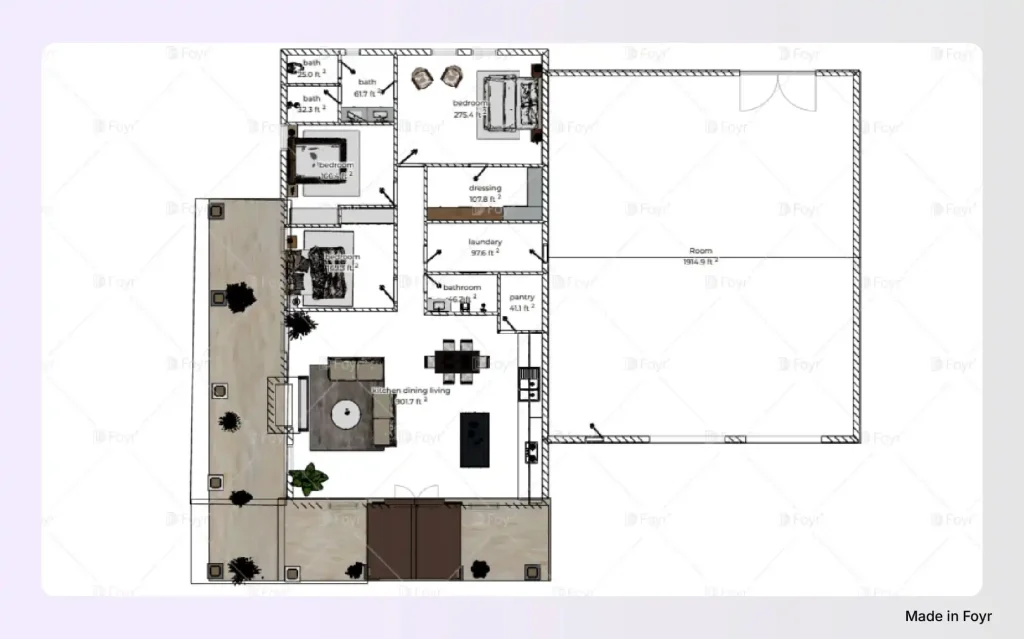
Check out the floor plan here
Dimensions: 1,200 to 2,400 sq ft
Typical Remodel Cost: $180,000 to $420,000 new build. Retrofit accessibility modifications ranges from $8,000 to $25,000.
The single-story ranch is the most popular floor plan for seniors in the United States, and for good reason. No stairs, a sprawling single-level layout, and the master suite positioned on the main floor all mean that a well-designed ranch home can serve its occupant from healthy retirement through significant mobility challenges without a single structural change.
The kitchen, living room, and bedroom all remain accessible, and modifications like grab bars, wider doorways, and a curbless shower in the master bath can typically be added during an initial remodel without touching the plumbing stack. This is the house plan I recommend most often as a long-term aging-in-place solution for homeowners who want to move once and stay.
Among all house floor plans for seniors, the ranch remains the easiest to future-proof with technology. Ranch homes also offer the most flexibility for smart home features integration: a single-level layout makes motion-activated lighting, smart locks, and remote thermostat control easier to wire and manage than a multi-story home, and those features alone meaningfully improve quality of life and caregiver peace of mind.
Key Features
- All essential rooms on one floor with no level changes between living spaces
- Master suite adjacent to the bathroom for minimum overnight travel distance
- Wide hallways (40 inches or more) accommodate walkers and mobility devices
- Attached garage with direct-entry access eliminates outdoor navigation in poor weather
- Enough space for a caregiver bedroom without converting the main living space
| Pros | Cons |
| Single-level living eliminates stairs entirely | Larger footprint requires more land than a two-story build of the same square footage |
| Master suite placement reduces nighttime fall risk | Single-story layout has higher cost per sq ft than two-story in new construction |
| Most popular floor plan with highest resale value for senior buyers | Sprawling layout can mean longer paths between rooms for some seniors |
| Easiest retrofit path for ADA modifications | Energy efficiency can be lower than a compact two-story design |
2. The Open Concept 2-Bedroom
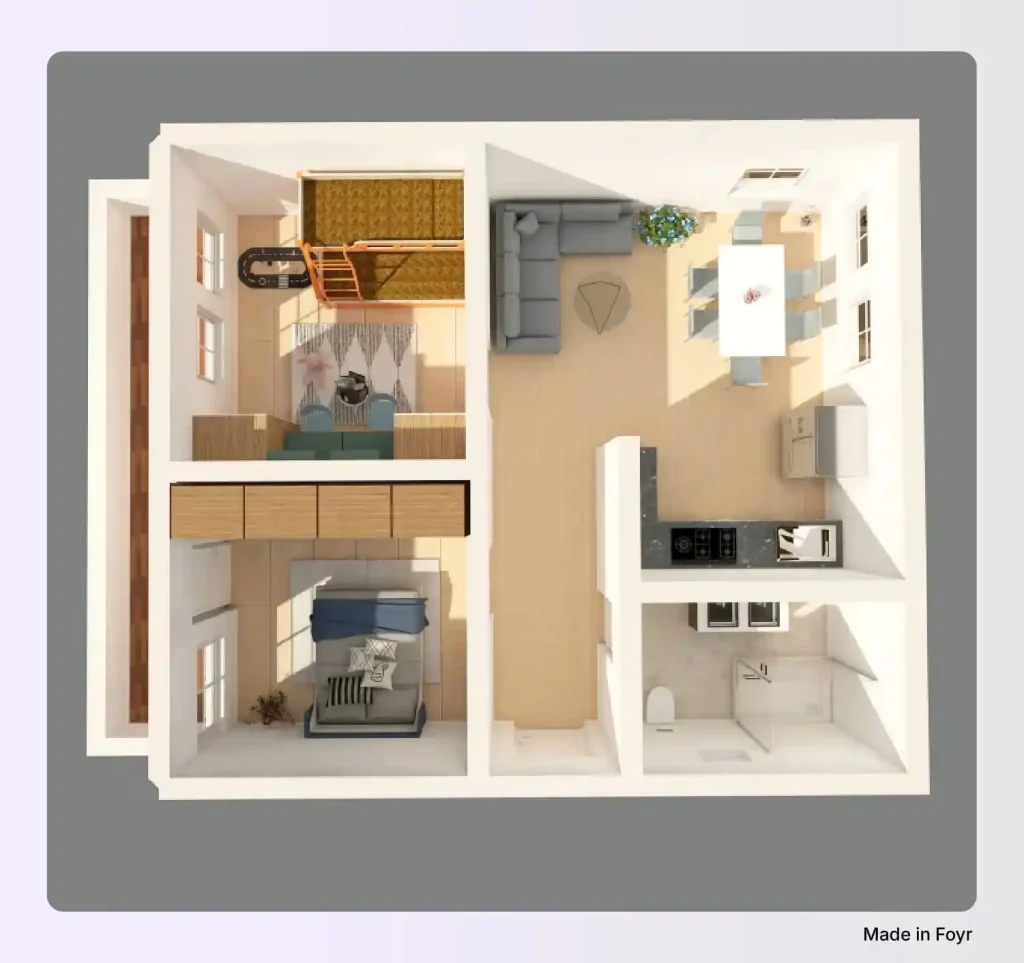
Dimensions: 1,000 to 1,600 sq ft
Typical Remodel Cost: $150,000 to $280,000 new build. Open concept retrofit from existing walls: $15,000 to $40,000.
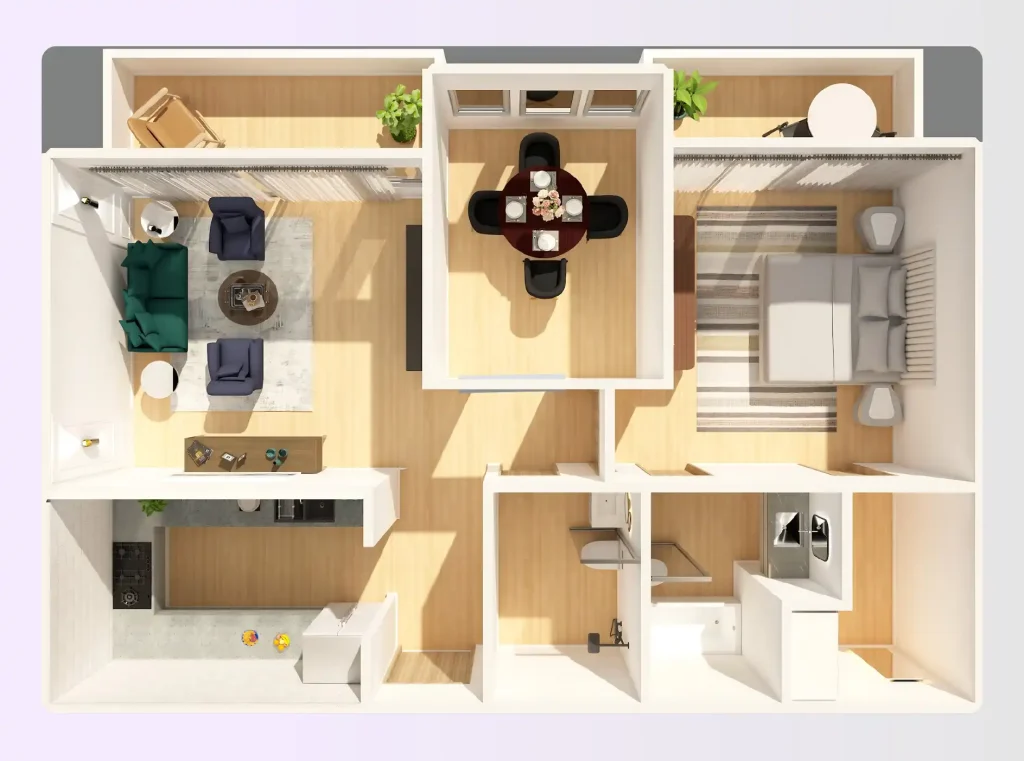
The open concept 2-bedroom floor plan removes the walls between the kitchen, dining area, and living room to create a single connected living space with clear pathways and unobstructed sightlines from one end to the other. For seniors, this layout solves several problems at once.
There are no doorways to navigate between the kitchen and the living room, no visual dead zones where a fall might go unnoticed, and the second bedroom is positioned for a caregiver or visiting family member without requiring a separate suite. Among house plans for elderly couple where one partner has greater mobility challenges, this open layout is one of the strongest options
Also Read: The Ultimate Guide to Open Floor Plan Homes
| Choose Open Concept 2-Bed when… | Switch to Single-Story Ranch when… |
| The household is a couple where one partner has mobility challenges and both want shared daily visibility | The household includes more than two people and additional private bedrooms are needed |
| The lot size is limited and a compact, efficient 2-bedroom footprint is the priority | Long-term aging in place over 20 or more years is the primary design goal |
| A caregiver bedroom is needed but a full in-law suite is outside the budget | Resale value to the widest possible senior buyer market is a priority |
| The client values the social and functional benefits of an open living space | The site has enough land for a full ranch footprint and budget supports the larger build |
3. The Senior Studio Apartment
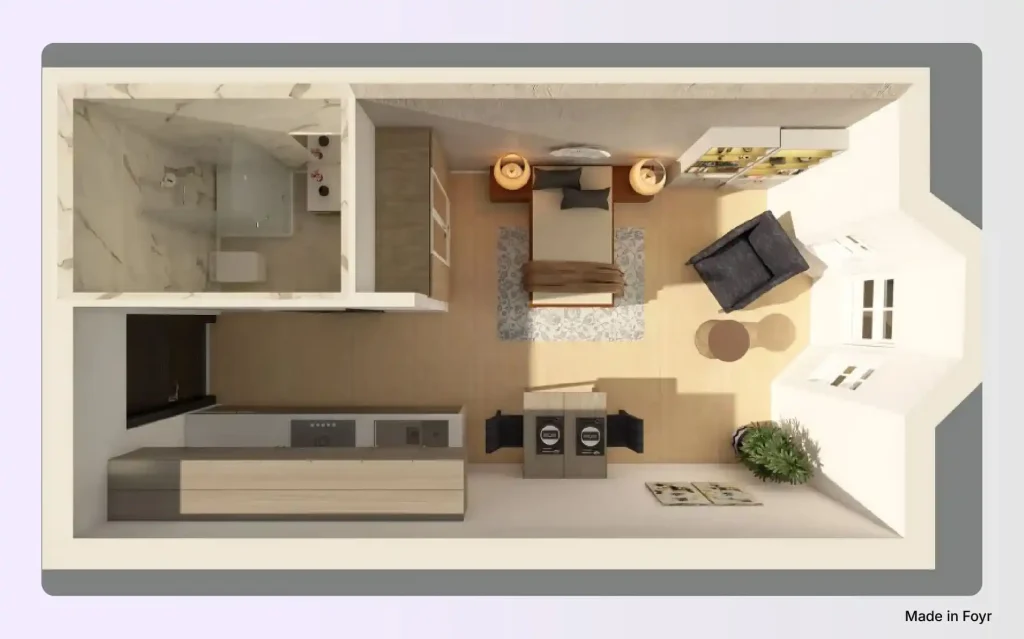
Dimensions: 400 to 600 sq ft
Typical Remodel Cost: $80,000 to $140,000 new build. Retrofitting an existing home for a caregiver guest space costs about $40,000 to $80,000.
The senior studio apartment is the most compact floor plan for senior living: a single open room combining sleeping, living, and dining functions, with a separate bathroom and a small but functional kitchen. At 400 to 600 sq ft, everything a senior needs for independent daily living is within 20 to 30 feet of every other essential item.
The layout is most common in independent living communities and senior apartment homes where community amenities (dining rooms, common lounges, activity spaces) supplement the limited private square footage. The studio works best for active, independent seniors who spend significant time in shared community spaces and use their personal apartment primarily for sleeping, personal care, and relaxation.
Key Features
- Single open living space with all personal items within easy reach and no room transitions to navigate
- Bathroom positioned immediately adjacent to the sleeping area for nighttime safety
- Spacious kitchen proportional to the unit with plenty of counter space for a compact footprint
- Zero-threshold shower standard in most senior-oriented studio designs
- Designed to complement community amenities rather than replace them
| Pros | Cons |
| Lowest maintenance and upkeep of any senior floor plan | Limited space for personal items, furniture, or a caregiver setup |
| Everything within reach with minimal mobility required | Not suited for seniors who need a second bedroom for a regular caregiver or partner |
| Cost-effective in both construction and ongoing energy use | Resale value limited to senior-specific housing markets |
| Ideal for senior living communities where shared spaces supplement private ones | Can feel isolating if not supported by robust community amenities |
4. The 1-Bedroom Independent Living Apartment with Community Amenities

Dimensions: 600 to 900 sq ft
Typical Remodel Cost: $120,000 to $200,000 per unit in a senior living community development
The 1-bedroom independent living apartment is the standard unit type in most senior living communities: enough space for independent daily living, a dedicated sleeping room separate from the living space, and a full bathroom designed to ADA clearances.
Senior apartment floor plans at this scale are the most common unit type in purpose-built senior living developments. At 600 to 900 sq ft, this floor plan accommodates most personal furniture, a small dining area, and a kitchen with enough counter space for everyday meal preparation.
The key design feature that distinguishes the independent living apartment from a standard 1-bedroom is the integration of community amenities: shared dining rooms, fitness spaces, social lounges, and activity rooms that reduce the functional burden on the private unit and support quality of life for residents who live alone.
| Choose 1-Bed Independent Living Apt when… | Switch to Senior Studio Apartment when… |
| The senior wants a dedicated bedroom separate from the living space for privacy and routine | The senior is highly active in community spaces and needs minimal private square footage |
| A regular overnight caregiver or visiting family member will use the apartment | Budget or development constraints favor the smallest viable unit for independent living |
| The kitchen is used daily for meal preparation and needs enough counter space to function well | The senior’s personal care routine is simple and the bathroom is the primary accessibility priority |
| The community offers strong amenities and the private unit supplements rather than replaces them | The development model prioritizes unit count over unit size |
5. The Duplex for Multigenerational Living
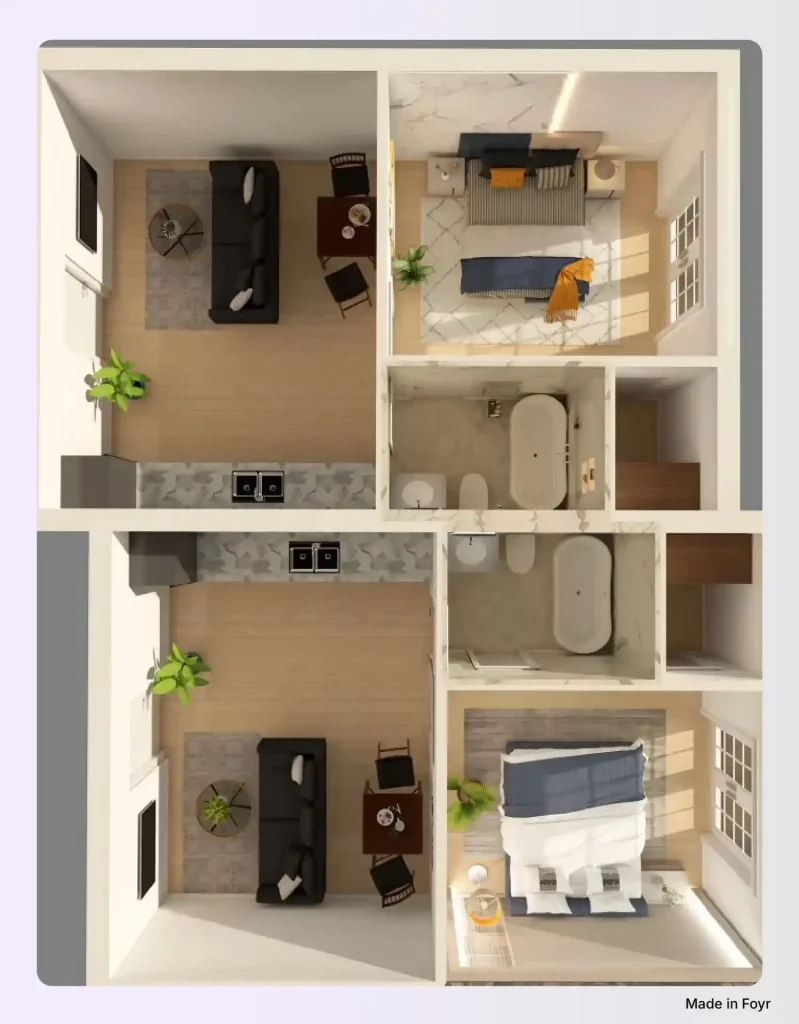
Dimensions: 1,200 to 2,000 sq ft total (both units)
Typical Remodel Cost: $220,000 to $400,000 new build. ADU conversion on existing property can cost anywhere from $80,000 to $180,000.
The multigenerational duplex places two fully self-contained living units within a single structure: typically a larger 2 or 3-bedroom unit for the primary family and a smaller 1-bedroom or studio unit for the senior family member, connected by a shared entry or a private interior door. This layout addresses one of the most common situations I encounter in aging-in-place design: an adult child who wants a parent nearby but not underfoot, and a senior who wants proximity to family without sacrificing independence.
The shared wall construction keeps build costs lower than two separate structures, and the independent living configuration on the senior unit means that modifications for accessibility can be applied to that unit without affecting the primary household. The duplex is one of the most practical house floor plans for seniors who want family proximity without shared living. For more on multigenerational floor plan design, see Foyr’s multifamily floor plans blog.
Designer checklist for the multigenerational duplex
- Confirm the senior unit has a private exterior entry independent of the main unit
- Position the connecting interior door (if included) with a locking mechanism on both sides
- The senior unit bathroom must meet full ADA clearances independent of the main unit bathroom
- Laundry access within the senior unit, not shared with the main unit
- Separate utility meters where possible to preserve financial independence for both households
- Clear pathways between units via a covered or accessible exterior path for weather protection
6. The ADU / In-Law Suite Layout
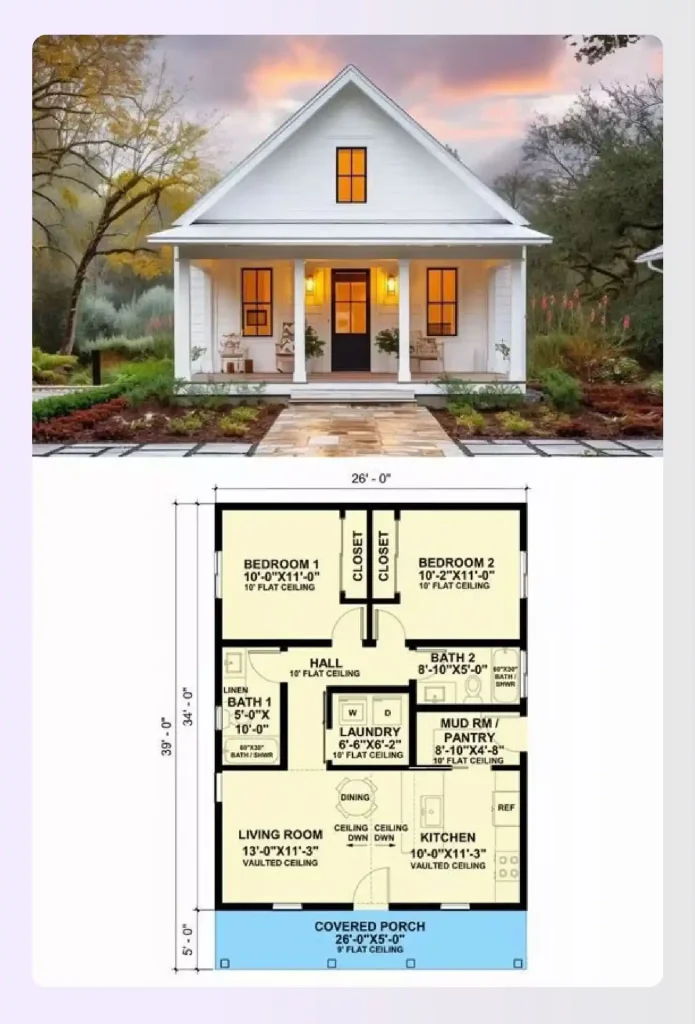
Dimensions: 400 to 800 sq ft
Typical Remodel Cost: $90,000 to $200,000 for a new detached ADU. Garage conversion to accessible suite: $50,000 to $120,000.
The accessory dwelling unit (ADU) or in-law suite is the most common new construction solution for families who want to add senior-accessible living space to an existing property. An ADU can be attached to the primary home (a converted garage, a side addition) or detached (a separate structure in the backyard), and it provides the senior with a fully independent living space while keeping them within close proximity to family caregivers.
ADUs have become one of the fastest-growing categories within house floor plans for seniors, particularly in metros where zoning reform has made them easier to permit. At 400 to 800 sq ft, the ADU is designed for single-level living, an accessible bathroom, and a small but functional kitchen. The layout is also increasingly popular in cities where zoning changes have made ADU construction easier and faster.
Key Features
- Fully self-contained unit with independent entry, kitchen, bathroom, and sleeping area
- Single-level living required, even for attached ADUs on a two-story primary home
- Zero-threshold entry and curbless shower standard for any senior-oriented ADU
- Patio or small outdoor space for relaxation and connection to the primary home yard
- Wider doorways (36 inches minimum) throughout to accommodate mobility aids
| Pros | Cons |
| Preserves full independence and privacy for the senior | Square footage is limited and personal items may need to be reduced significantly |
| Family caregiver proximity without shared living space | Zoning and permitting vary widely by municipality |
| ADU adds property value beyond senior care years | Detached ADU requires outdoor navigation between structures in poor weather |
| Lower build cost than a full ranch or duplex new build | Attached garage conversion can compromise primary home parking |
| “People love their communities and neighborhoods. Moving to a more affordable location can take them away from the people and places that enrich their lives. We have to rethink housing and find better solutions, like ADUs.” |
7. The Aging-in-Place Retrofit Plan and Key Modifications
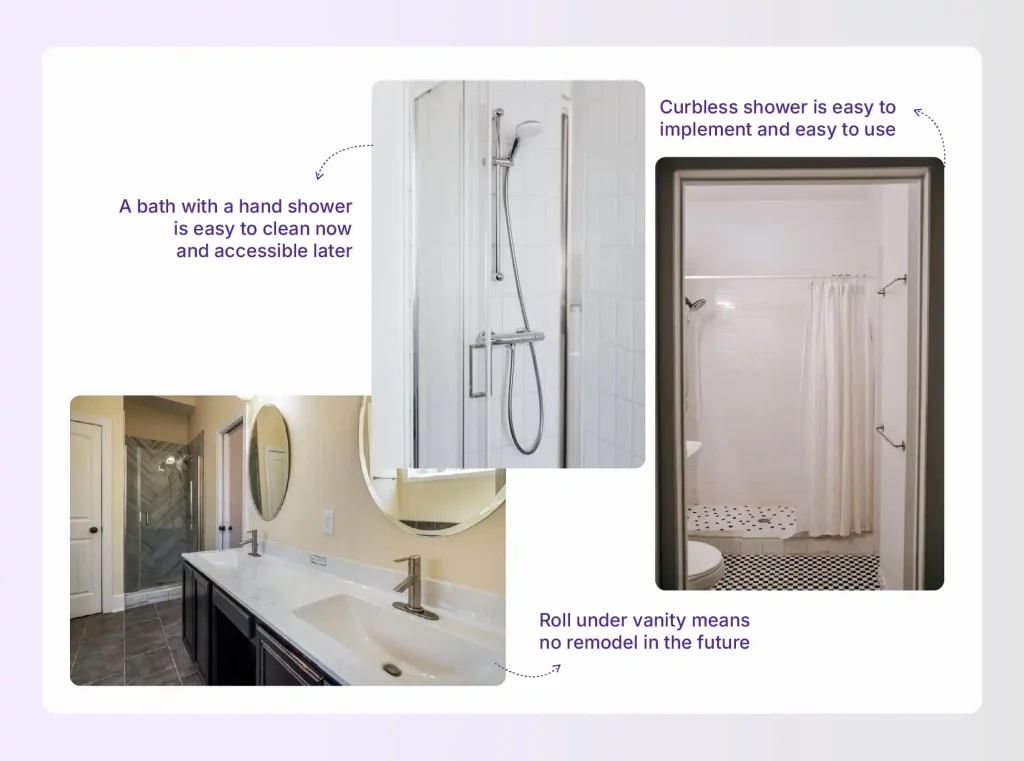
Dimensions: Varies by existing home and scope
Typical Remodel Cost: Grab bars and flooring: $2,000 to $8,000. Bathroom retrofit: $15,000 to $35,000. Full accessibility retrofit costs about $40,000 to $80,000+.
The aging-in-place retrofit is not a floor plan type in the same sense as the others on this list. It is a design process applied to an existing home, and it deserves its own category because it represents the majority of senior floor plan work in the United States. On any retrofit project, floor plans for senior homes must begin with locating the main plumbing stack, the load-bearing walls, and determining which modifications can be made within the existing footprint without triggering a full renovation. The answers to those three questions determine the entire scope and budget of the project.
For retrofit projects in period homes, an additional layer of complexity applies: historic preservation review in some US municipalities can make even a seemingly simple doorway widening a months-long permitting process. Always check local building codes and consult a CAPS-certified designer before committing to any retrofit scope that involves structural changes.
| Choose Aging-in-Place Retrofit when… | Switch to ADU / In-Law Suite when… |
| The existing home is a single-story ranch or bungalow that already meets most layout requirements | The existing home is a multi-story structure where single-level living cannot be achieved by retrofit |
| The senior has lived in the home for decades and moving is not emotionally or practically viable | The modifications needed are extensive enough that building new is more cost-effective than retrofitting |
| The primary modifications needed are bathroom, flooring, and hardware rather than structural changes | The senior and primary household want separate living spaces rather than a shared modified home |
| Budget is moderate and a phased approach to modifications is acceptable | The property has space and zoning permits for an ADU addition |
8. The Tiny House for Seniors
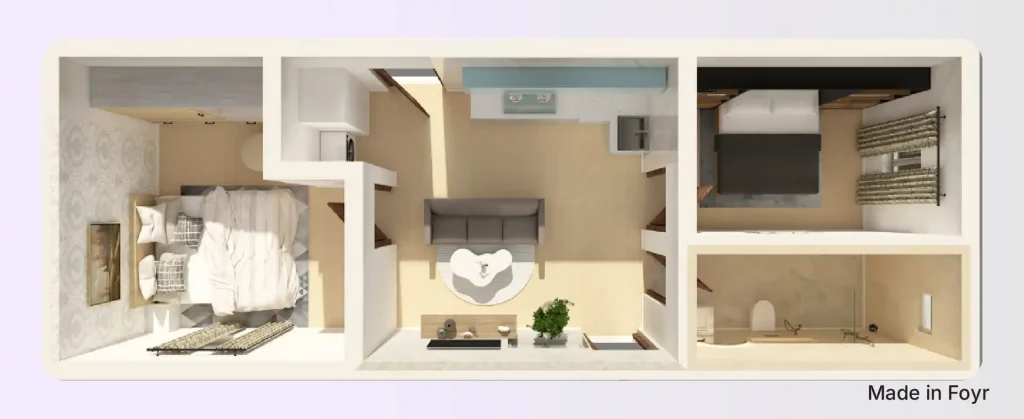
Dimensions: 200 to 500 sq ft
Typical Remodel Cost: $60,000 to $120,000 for a purpose-built senior tiny home. Prefab options: $40,000 to $90,000.
The senior tiny house (200 to 500 sq ft) is the most compact independent living option on this list and represents a small but growing segment of retirement house planning. The appeal is straightforward: lower maintenance, lower energy costs, fewer personal items to manage, and a simpler daily routine.
For a senior who has already downsized their lifestyle significantly and values ease of use over space, the tiny house can be a genuinely excellent fit. The design constraints are significant: every square foot must serve a clear function, the bathroom must achieve ADA clearances in a fraction of the space a standard bathroom uses, and storage must be built-in and accessible without requiring a stool or overhead reaching.
Key Features
- Single level with no room transitions or level changes anywhere in the structure
- Built-in storage throughout, positioned at accessible heights without overhead reaching
- Bathroom designed to full ADA clearances as the first and non-negotiable priority
- Open plan living space minimizes doorways and maximizes clear pathways
- Outdoor patios or covered deck extends the usable living space affordably
| Pros | Cons |
| Lowest maintenance and upkeep cost of any senior floor plan option | Extremely limited space for a caregiver or overnight family member |
| Forces a deliberate approach to personal items and daily essentials | ADA-compliant bathroom in under 500 sq ft requires expert design to achieve |
| Strong fit for seniors who have already embraced a simplified lifestyle | Not suitable for seniors with significant equipment or mobility device needs |
| Can be placed on an adult child’s property as an independent ADU | Resale market is narrow and highly location-dependent |
9. The Accessible Cottage
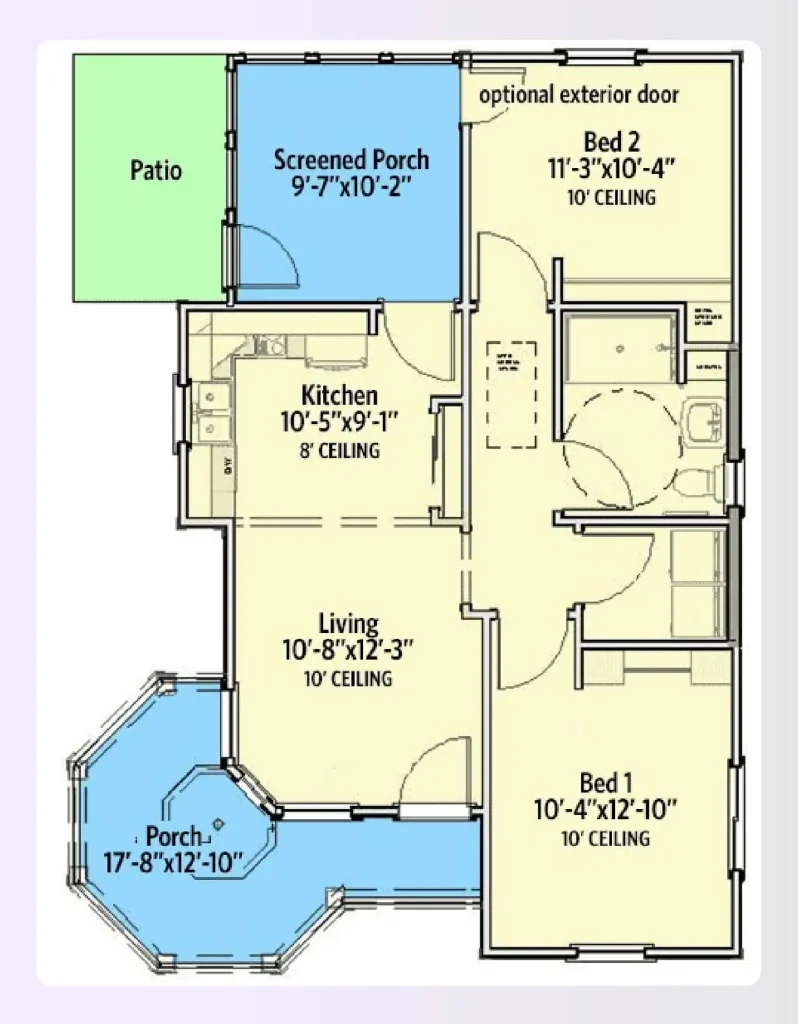
Dimensions: 600 to 1,100 sq ft
Typical Remodel Cost: $140,000 to $250,000 new build in a senior community. Individual site build costs about $160,000 to $290,000.
The accessible cottage sits between the ADU and the full ranch in size and ambition: typically 600 to 1,100 sq ft with one or two bedrooms, a full accessible bathroom, a functional kitchen, and a dedicated outdoor space. In retirement communities and purpose-built senior villages, the accessible cottage is often the most desirable housing type because it combines the independence and outdoor connection of a detached home with the manageable scale of an apartment. It is also one of the more underutilized house floor plans for seniors in private residential planning outside of formal retirement communities.
Patios are standard, designed at grade level with no steps and wide enough to navigate with a walker or wheelchair. The cottage layout positions all essential rooms on a single level with 36-inch doorways throughout, and natural light is a consistent design priority.
| Choose Accessible Cottage when… | Switch to ADU / In-Law Suite when… |
| The senior is purchasing or renting within a purpose-built retirement community | The senior needs to remain near an existing family caregiver on a shared property |
| Outdoor space and a sense of private home ownership are priorities | Budget favors a conversion or addition over a new build |
| The household is a single person or couple without a live-in caregiver requirement | The existing property is in a desirable location and moving to a retirement community is not preferred |
| A small but dedicated kitchen for daily cooking is a quality of life priority | The senior’s mobility challenges already require daily caregiver support |
10. The Fully Adapted Primary Suite Retrofit
Dimensions: Varies, typically 400 to 700 sq ft of existing space
Typical Remodel Cost: $30,000 to $75,000 for a full primary suite adaptation including bathroom rebuild and smart home features
This final example is deliberately a retrofit, not a standalone floor plan. The fully adapted primary suite retrofit converts an existing master bedroom and bathroom into a complete senior living zone within the home: a bedroom with adjustable lighting, smart home features for lock and thermostat control, a walk-in closet adapted to accessible heights, and a bathroom rebuilt to full ADA standards (curbless shower, grab bars, fold-down bench, handheld showerhead, and 60-inch turning radius).
The goal is to allow a senior to manage all personal care, sleeping, and daily routine functions within a single adapted zone without depending on the rest of the home for accessibility.
This layout is recommended for families where a senior parent is moving into an adult child’s home, and the primary suite is the most viable space to adapt. It is also the preferred approach for memory care at home, where limiting the accessible zone to a well-designed suite reduces confusion and supports a predictable daily routine. The rest of the home does not need to be fully adapted, which contains cost significantly.
Also Read – Designing for Dignity: The Ultimate Guide to Assisted Living Floor Plans
What a fully adapted primary suite retrofit must include
- Bathroom rebuilt to 60-inch ADA turning radius with curbless shower and grab bars at all fixtures
- Non-slip flooring throughout bedroom and bathroom with no transition strips between surfaces
- Smart home features: smart lock on bedroom and exterior doors, motion-activated lighting along all nighttime paths, smart thermostat within reach from the bed
- Adjustable or lower countertop height at the bathroom vanity (34 inches from finished floor)
- Fold-down bench in the shower and a handheld showerhead on a slide bar
- Caregiver call system or medical alert device integration into the room design
- Lever handles on all doors and closets within the suite
| “Every year more than one in four older adults reported falling and about 41,000 older adults die as a result of a fall — that’s 112 older adults every day.” |
Room-by-Room Best Practices for House Floor Plans for Seniors
The section-level principles above translate into specific room-by-room decisions that apply consistently across house floor plans for seniors. Here is how to approach each key space:
Bathroom
- Zero-threshold shower with non-slip flooring and a slope-to-drain floor throughout
- Grab bars at the toilet, shower entry, and tub. Walls must be blocked during rough-in, not after tiling.
- 60-inch turning radius for wheelchair and walker access, verified before tile is laid
- Fold-down bench and handheld showerhead on a slide bar for easy sitting and flexibility
- Use Foyr’s Magik Bar to test non-slip flooring textures and tile combinations virtually before ordering
Kitchen
- Countertops lowered to 34 inches from standard 36 inches for easier access from a seated position
- Pull-out shelving and lazy Susans in lower cabinets to eliminate deep reaching
- Open knee space under the sink for wheelchair access
- Induction cooktop at counter height rather than a drop-in range for safer cooking with mobility challenges
- A spacious kitchen layout with a minimum 42-inch clearance between countertop runs for walkers
Bedroom
- Ground floor only, with the master suite adjacent to the accessible bathroom
- Wider doorways (36 inches minimum) and lever handles on all bedroom doors and closets
- Adjustable or smart lighting controls reachable from the bed without requiring the occupant to get up
- Clearance of at least 36 inches on both sides of the bed for walker and caregiver access
Living Room and Common Areas
- Open sightlines with no level changes between the living room, kitchen, and dining area
- Furniture clearance of at least 36 inches on all primary circulation paths
- No area rugs. They are the single most preventable contributor to the risk of accidents in senior living.
- Patios and outdoor areas accessed at grade level with no steps and a non-slip surface
Entryways and Hallways
- Zero-step entry, either through grading, a ramped approach, or a no-threshold door design
- 40-inch minimum hallway width for all primary paths between essential rooms
- Motion-activated lighting at entries and all overnight paths between bedroom and bathroom
- Lever handles on all exterior doors and interior doors throughout the home
Practical Tips for Senior Floor Plans That Stand the Test of Time
These tips apply equally to new builds and retrofits, and reflect the longer-term thinking that separates a plan that works for five years from one that works for twenty.
- Design for where mobility is going, not where it is today. Choosing the best floor plan for seniors means building for a wheelchair in ten years, not just a walker in five. Build the clearances, blocking, and threshold-free transitions now, when the cost is minimal.
- Plan for a caregiver bedroom from the start. Whether it is used in year one or year fifteen, having a ground-floor bedroom adjacent to the primary suite that can serve a live-in caregiver is one of the highest-value decisions in any senior floor plan.
- Do not sacrifice aesthetics for function. The best accessible home design is invisible. Grab bars that match the tile finish, lever handles that look like designer hardware, and curbless showers that read as a luxury feature all achieve the same safety outcome while preserving quality of life and resale value.
- Invest in smart home features early. Smart locks, motion-activated lighting along the bedroom-to-bathroom path, a smart thermostat reachable from the bed, and a monitored medical alert system are relatively low-cost additions that provide enormous peace of mind for both the senior and their family.
- Prioritize natural light to reduce fall risk. Seniors fall most often during nighttime or low-light transitions between rooms. Larger windows, solar tubes in interior bathrooms, and motion-activated night lighting along clear pathways are all cost-effective additions that measurably reduce the risk of accidents.
- Keep laundry on the same floor as the bedrooms. This single decision eliminates one of the most common injury scenarios in senior households: carrying a laundry basket on stairs.
- Use 3D visualization before committing to any layout. Walking a client through a 3D model of their adapted home before a single wall is touched changes every subsequent conversation. Decisions that seemed abstract in a 2D floor plan become obvious in three dimensions.
| Pro Tip: Include smart technology in every senior floor plan conversation
Smart home features are no longer a luxury addition to senior floor plan design. A smart lock that a senior can operate from their phone or a caregiver can manage remotely, motion-activated lighting between the bedroom and bathroom, and a connected medical alert system are now standard recommendations in every aging-in-place project. The cost is low, the installation is simple in a new build, and the peace of mind for the entire family is significant. |
Design your Senior Floor Plan with Foyr Neo?
Testing house floor plans for seniors before committing to construction or renovation is where most projects either succeed or stall. Foyr Neo makes this stage practical for designers and accessible for homeowners who are making these decisions for the first time.
- The ruler tool in Foyr Neo allows you to verify ADA clearance dimensions directly on any floor plan before presenting it to a client or submitting it for permits.
- The 60,000-plus 3D model library includes accessible fixture options (grab bars, roll-in showers, lever handles, ADA-compliant toilets) so you can populate a senior floor plan with accurate-scale representations of the actual products under consideration.
- Sun path analysis helps with natural light planning, which matters especially in senior design, where visibility and fall prevention are directly connected to light quality.
- One-click 2D to 3D conversion lets you walk through the plan before committing to a layout direction.
- The AI Magik Bar allows you to test non-slip flooring textures and accessible material combinations virtually before ordering samples.
If you work in interior design and you’re still juggling multiple tools, Foyr Neo is worth trying. The 14-day free trial gives you enough time to run a full project from floor plan to final render and see the difference firsthand.
Try Foyr Neo free for 14 days and design your first room in 30 minutes.
FAQs
How much does it cost to build a senior living facility?
A purpose-built senior living community ranges from $150 to $300 per sq ft for construction, depending on the level of care, amenities, and location. A full independent living community in a major metro can run $30 million to $100 million or more for a multi-unit development. For private homeowners, a senior-accessible new build (single-story ranch, ADU, or cottage) ranges from $90,000 to $420,000, depending on size and site conditions.
What is the most user-friendly floor plan app for seniors?
Foyr Neo is among the most accessible floor plan tools for both designers and homeowners planning senior modifications. The drag-and-drop interface, ADA clearance verification via the ruler tool, and one-click 2D to 3D conversion make it practical for non-designers working through an aging-in-place project for the first time. The 14-day free trial allows for full exploration before committing to a subscription.
What type of housing is best for seniors?
The right floor plan for a senior depends on their current and projected mobility, their household structure (living alone, with a partner, or near family), and their preference for independence versus community. Single-story ranch homes offer the best long-term aging-in-place value. Independent living apartment homes within senior living communities suit seniors who want social engagement and managed amenities. ADUs and duplexes work best for multigenerational households.
How do you design a house for an elderly person?
Start with the six core design pillars: single-level living, wide clearances, wet zone safety, natural light and visibility, storage accessibility, and emergency response readiness. Then apply the ADA clearance standards to the bathroom and primary circulation paths. Design for projected mobility rather than current ability, plan a caregiver bedroom, and use 3D visualization to verify every decision before construction begins. For retrofit projects, locate the plumbing stack and structural elements before preparing any layout options.
What is the 80/20 rule for 55+ aged communities?
The 80/20 rule for 55-plus housing communities (under the Housing for Older Persons Act, or HOPA) requires that at least 80 percent of occupied units have at least one resident aged 55 or older. The remaining 20 percent of units can be occupied by residents under 55 without affecting the community’s status as age-restricted housing. This applies to senior living communities, retirement house plan developments, and age-restricted apartment homes, and it affects how developers and designers approach unit mix and community amenities planning.