



Most schedule overruns on interior design projects start before installation, long before trades arrive or products miss delivery windows. They begin when an interior design project schedule template ignores dependencies, vendor confirmations, and approval dates. That gap turns a project plan into a hopeful calendar.
A working interior design project schedule needs dates that account for what must happen before each task can start. The client’s vision matters, yet timing depends on approvals, sourcing, procurement, site access, and contractor readiness. My take is that schedule control protects both creativity and trust.
This guide breaks down timelines by project type, lead-time benchmarks, dependency logic, and client review checkpoints. You will also get a free interior design schedule template that can become a live working document for your next interior design project.

Why Most Interior Design Project Schedules Fail Before They Start
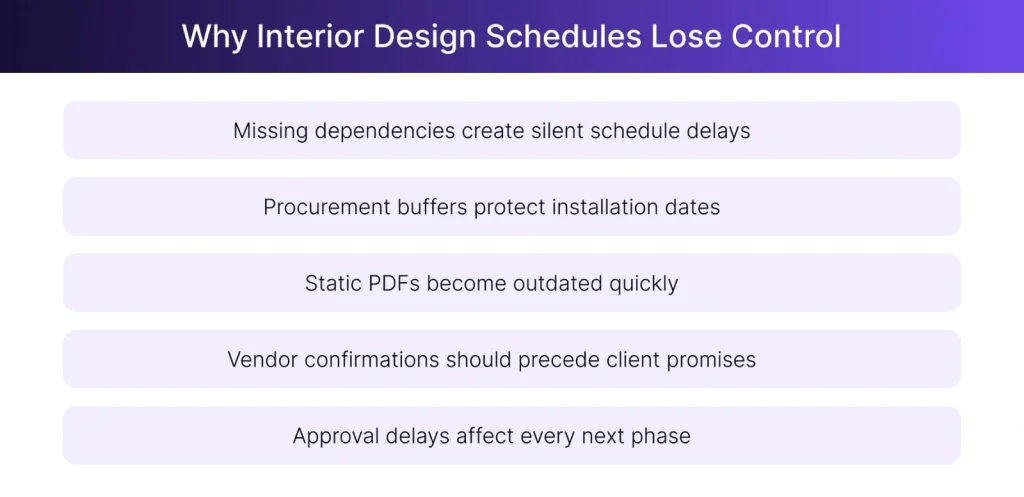
A weak schedule usually fails because it ignores dependency logic, then treats every task as though it can move independently.
- Missing Dependencies: Tasks get listed with dates, yet the schedule shows no logic for what must finish first. Tile cannot be ordered until the layout is approved, so delays quietly cascade through procurement, installation, and the final design presentation.
- No Procurement Buffer: Designers often schedule from the lead time quoted during the first vendor conversation. In my experience, custom orders need extra room for freight delays, damaged items, stock changes, and warehouse holds.
- Schedules Built Before Lead Times Are Confirmed: The timeline sometimes goes to the client before vendors confirm availability, pricing, and delivery windows. That makes the schedule feel official, even when every major date still depends on an unanswered email.
- Static Schedules: A schedule sent once as a PDF becomes outdated as soon as one vendor shifts a delivery date. Without updates, the client works from an outdated document while the team operates under a different reality.
Charles Eames once said, “The details are not details. They make the product.” I think that applies perfectly to scheduling because overlooked details can lead to costly errors later.
US Scheduling Guidelines Designers Should Keep in Mind
An interior design project schedule template should reflect how approvals, contracts, procurement, site access, and change orders operate in real projects.
- Approval Windows: Add formal approval dates for layouts, finishes, FF&E, and final budgets. Without written checkpoints, clients can delay one stage of the project while the designer still carries the schedule pressure.
- Contract Linkage: Match schedule milestones with the signed contract, project scope, fees, payment terms, and change order process. This protects the interior design business when clients ask why procurement or installation cannot move earlier.
- Procurement Lead Times: Add buffers for custom furniture, freight, backorders, substitutions, and warehouse release dates. I’d recommend documenting these assumptions before sharing the schedule, because vendor delays are easier to explain when they were flagged early.
- Change Orders: Freeze procurement after final approval unless the client signs a written change order. A late change can restart sourcing, revise complete purchase orders, and push the completion date beyond the original interior design timeline.
- Site Access: Confirm contractor access, elevator reservations, HOA rules, building hours, loading dock schedules, and delivery restrictions early. Local permits, building rules, and site access policies vary by city, property type, and management team.
Realistic Interior Design Project Timelines by Project Type
Project type changes schedule expectations more than most clients realize, because each scope creates a different approval and sourcing pattern.
Use these example timelines as planning ranges, not as fixed promises for every interior design project. The estimated time depends on project size, client response speed, product availability, permit needs, and contractor coordination. Experienced designers usually adjust the schedule after the initial consultation and discovery call.
| Project Type | Design Phase | Procurement | Installation | Total Timeline |
| Single room refresh | 2 to 3 weeks | 4 to 8 weeks | 1 to 2 weeks | 6 to 10 weeks |
| Full room renovation | 3 to 5 weeks | 8 to 14 weeks | 2 to 4 weeks | 3 to 5 months |
| Full home renovation | 6 to 10 weeks | 12 to 20 weeks | 8 to 16 weeks | 6 to 9 months |
| Commercial project | 8 to 12 weeks | 12 to 24 weeks | 8 to 20 weeks | 9 to 15 months |
I’d treat this interior design timeline template as a planning baseline rather than a client promise. A good window of time should account for client approvals, vendor response delays, contractor availability, and site readiness before any dates become firm.
Procurement Lead Times Every Designer Should Build Into Their Schedule
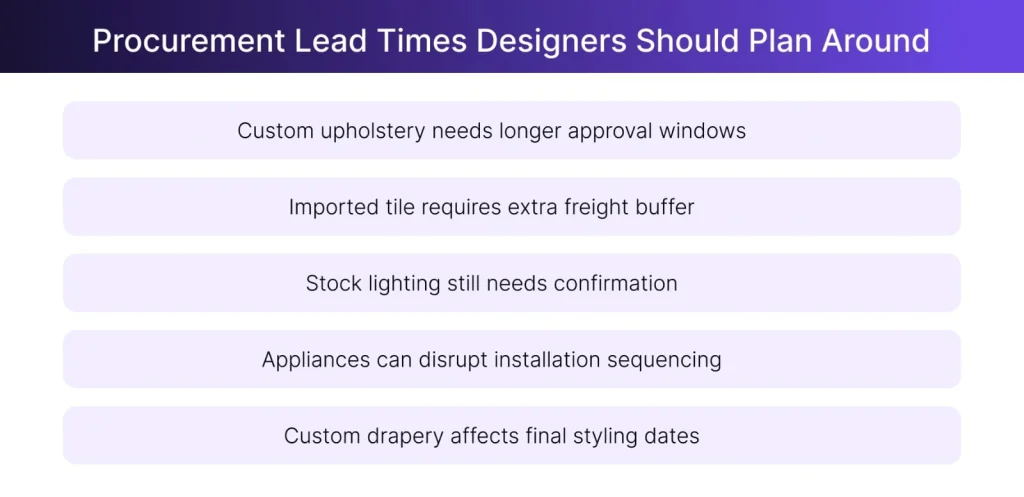
Procurement deserves its own schedule section because product availability often changes after the client has already approved the design concept.
| Category | Typical US Lead Time |
| Custom upholstery | 8 to 16 weeks |
| Case goods / custom cabinetry | 10 to 16 weeks |
| Lighting fixtures, stock | 4 to 8 weeks |
| Lighting fixtures, custom | 12 to 20 weeks |
| Window treatments / drapery | 6 to 10 weeks |
| Tile and stone, domestic | 4 to 8 weeks |
| Tile and stone, imported | 10 to 16 weeks |
| Area rugs, custom | 8 to 12 weeks |
| Major appliances | 4 to 12 weeks |
These ranges are planning benchmarks, so confirm current lead times directly with vendors before sharing dates with clients. A vendor’s quote during the consultation phase of your timeline can change once finishes, quantities, freight routes, and payment terms are confirmed.
Designer note: Build these lead times into the interior design project schedule template before the mood board and sourcing list are final. Reversing a specification after ordering begins adds the full lead time again, plus the time already lost.
How to Build an Interior Design Project Schedule Step by Step
A useful interior design project schedule template should show what happens next, who owns it, what depends on approval, and what can delay delivery.
- Step 1: List every task by phase: Start with concept, design development, procurement, installation, styling, and closeout. This gives your interior design project plan a practical structure before you assign dates.
- Step 2: Sequence dependencies before assigning dates: Note what must finish before each task can begin. An interior design project management schedule template should show whether sourcing depends on layout approval or vendor confirmation.
- Step 3: Add procurement lead times to every sourced item: Pull from the benchmark table as your first planning layer. Then confirm the current delivery dates before sharing any project timeline with the client.
- Step 4: Build in a 10 to 15 percent buffer per phase: Apply the buffer on top of vendor-quoted lead times. I’d rather explain a cautious date early than defend a missed date later.
- Step 5: Assign one owner per task: Every task needs a designer, procurement lead, contractor, vendor, or client owner. A schedule without ownership becomes a wish list, not project management.
- Step 6: Set client review checkpoints at each phase gate: Add concept approval, final sourcing approval, pre-installation walkthrough, and handover review. These checkpoints provide designers with a shared method for ensuring your project’s success.
A project plan template works best when it includes dependencies, not only date columns. For business owners, the bottom line is that great project planning strategies reduce avoidable chaos and protect business efficiency.
Albert Hadley once said, “Design is about discipline and reality, not about fantasy beyond reality.” I think schedule discipline belongs inside that reality, because good timing protects how people experience the finished space.

Free Interior Design Project Schedule Template
Use this free timeline template as an interior design project management tool in your own process. It also works as an interior design work schedule template when the team needs practical handoff visibility.
Download this template to plan phases, dependencies, owners, lead times, buffers, and client review checkpoints in one editable format.
Click here to download: Free Interior Design Project Schedule Template
Track Your Project Schedule with Foyr Manage
A spreadsheet schedule stops working the moment a vendor changes a date and nobody updates the file immediately. Foyr Manage keeps the schedule connected to the project record, so delayed deliveries can be reviewed against tasks, approvals, files, estimates, invoices, and client communication.
This is where Foyr Manage is a good fit for studios running multiple design projects simultaneously. Instead of using multiple online tools, designers can keep scheduling, project management, client notes, and files in a single workspace.
- AI Project Plan Generation: Upload your brief and Foyr Manage can draft a phased project plan with tasks and rough durations. You review the structure before it becomes part of the live schedule.
- Task Ownership and Due Dates: Each task has one owner and one due date, reducing ambiguity between design and procurement. These task management features matter most when several people share one interior design project timeline template.
- Project Health Checkpoints: Foyr Manage can help teams review phases that are running behind schedule by tracking task completion status. That kind of support helps managers catch slippage before clients start chasing updates.
- Gantt-Style Timeline View: Use Gantt charts to see dependencies and durations across the full project in one place. This helps teams group segments by phase, room, vendor, contractor, or approval status.
- Connected Files and Client Dashboards: Keep estimates, invoices, files, messages, and updates attached to the project record. For interior design project management, this is far more useful than a detached PDF schedule.
- AI Search and Follow-Ups: Use AI search to find old details faster, then create follow-up tasks when approvals or documents are missing. This supports work efficiency without removing designer review from important decisions.
Some studios try to manage schedules through spreadsheets, shared folders, email threads, and separate reminder tools. That may work for one small project, yet it starts breaking once approvals, procurement, invoices, and vendor updates move at different speeds.
This is where designers learn how software programs differ once real dependencies, approvals, procurement, and installation tasks come into play. A schedule tool should serve interior design work, rather than forcing teams to redesign their operations around software.
Foyr Neo supports the design layer by providing floor plans, 3D models, and client-ready renders for approval milestones. Foyr Manage supports the schedule layer once the visuals are approved, moving them into tasks, procurement, estimates, invoices, and client updates.
Try Foyr Manage to build, track, and update your interior design schedule from one connected workspace. For design teams, the right project management software should reduce schedule drift while keeping designers in control.
Start your free 14-day trial of Foyr Manage today.
FAQs
How far in advance should interior designers order furniture and materials?
Interior designers should order custom upholstery, case goods, lighting, and specialty materials 12 to 16 weeks before installation. Add these dates to your interior design project plan template after the client discovery call, client questionnaire, and final design concept are approved. Stock items still need four to eight weeks for confirmation, freight, and delivery scheduling.
What causes the most common delays in interior design project schedules?
Late approvals, vendor backorders, freight delays, and unclear contractor availability cause most delays on interior design projects. An interior design schedule of work template helps teams connect each task with its owner, dependency, and deadline. Digital tools make this easier when teams need to complete projects without chasing updates manually.
How much buffer time should be built into an interior design timeline?
Add a 10 to 15 percent buffer per phase above vendor-quoted lead times, especially for custom or imported items. An interior design finish schedule template helps track materials, approvals, and interior design project finishes before procurement begins. Buffers protect the client’s vision, completion date, and fee discussion when products slip.
Should the project schedule be shared with the client or kept internal?
Share a client-facing schedule that shows key phases, approval gates, review windows, and the target completion date. Keep the detailed internal version for task owners, vendor dependencies, procurement buffers, and site coordination notes. Free collaboration tools and a lot of online tools can help early, though full needs require connected project control.
How do you update a project schedule when a vendor delay occurs mid-project?
Update the delayed task first, then check every dependent task linked to procurement, installation, styling, and client review. Foyr Manage helps teams adjust timelines, task owners, files, and client communication from one project record. Static spreadsheets often miss downstream impact, especially when several deliveries and approvals move together.