


Most interior designers undercharge, over-explain, or miss line items that protect them financially. If you are learning how to make interior design quotation documents, start with commercial clarity before presentation style. A quotation is where scope, payment expectations, exclusions, and client approval begin taking written shape.
In my experience, the weakest quotations try to sound polite rather than protect the work. They give a total cost, then leave design fees, procurement responsibilities, revision limits, and additional costs open to interpretation. That uncertainty becomes expensive once drawings, site visits, and sourcing work begin.
This blog explains how to make interior design documents that clients can approve without confusion. You will learn what to include, how to prepare a quotation for interior design, which fee models work, and how Foyr Manage helps move approved quotations into invoices with less time and less fuss.

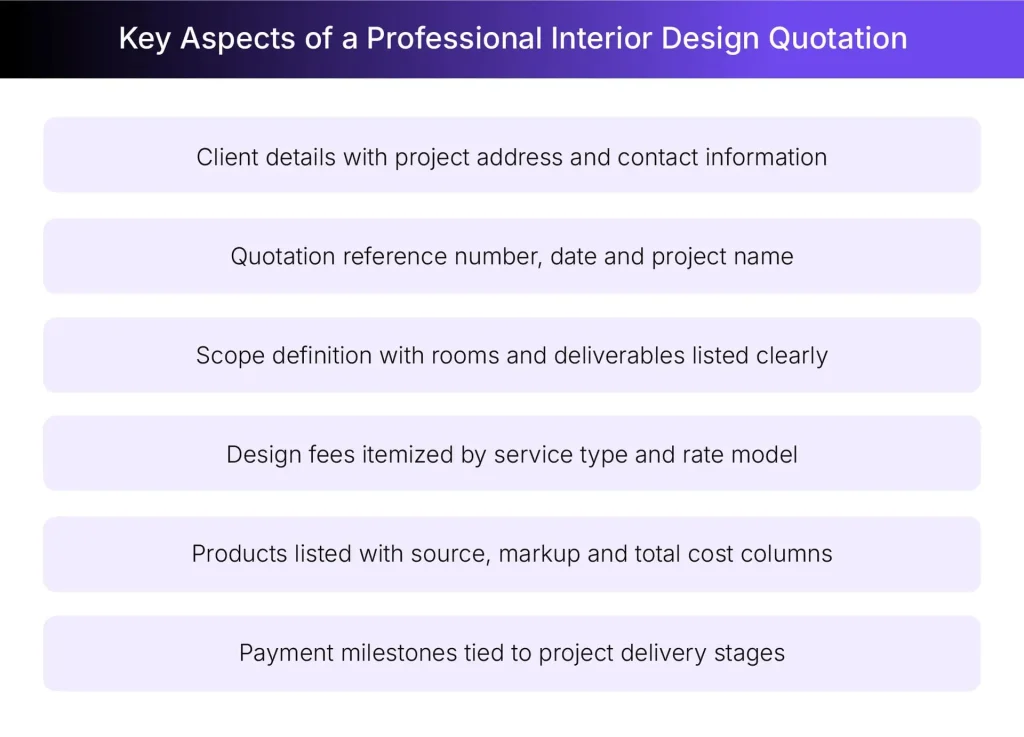
What to Include in an Interior Design Quotation
Learning how to make interior design quotation documents starts with itemization, because clients need to see what they are approving.
| Section | What to Include |
| Client Details | Client name, client’s address, phone number, contact details and address of the job site |
| Quotation Reference | Quotation number (a unique number per quote), date issued, name of the project and interior design firm’s name |
| Scope | Rooms covered, design services included, deliverables such as floor plans and renders, and a clear scope definition |
| Design Fees | Flat fee, hourly rate or hybrid model with the associated cost per line item for each service provider role |
| Products | Furniture, finishes, lighting and decor listed with source, quantity, unit cost and markup in the second column and total cost in the third column |
| Timeline | Start date, approval milestones, delivery stages and material availability lead times |
| Payment Terms | Retainer amount, milestone payments and final payment with payment terms and due dates stated clearly |
| Exclusions | Civil work, permits, taxes, freight, additional costs for extra revisions and procurement changes not in original scope |
| Validity | Quote expiry date (14 to 30 days) and price-change conditions tied to vendor or labor cost increases |
If you are deciding how to make a quotation for interior design professional, start by separating services, products, exclusions, payment terms, and validity. This format of an interior design quotation should help clients see every line item without feeling overwhelmed. I’d recommend adding a unique number to every quote, because version confusion is common during interior design projects.
My take is that exclusions deserve the same attention as inclusions. Permits, freight, civil works, supplier price changes, extra revisions, and procurement changes can distort the project’s total cost if left vague.
Interior Design Fee Models Explained
A designer learning how to make interior design quotation documents must choose the fee model before building the pricing table.
- Flat project fee: A flat project fee sets one price for a defined scope of work and agreed deliverables. It works well when floor plans, material boards, revisions, and presentation rounds are predictable. I’d use the side of caution here, because vague scope can erase your profit.
- Hourly rate: An hourly rate works when client’s needs are still evolving or the work is advisory. It suits consultations, styling guidance, site visit support, and smaller projects with uncertain time requirements. The honest answer is that clients need a cap, estimate, or reporting rhythm.
- Cost-plus procurement: This model adds a markup to the cost of sourced products, materials, furniture, lighting, and accessories. It works well when product volume is high and the designer handles a multitude of other tasks. Procurement disclosure must be written, because clients compare retail pricing online.
- Percentage of total project cost: This model calculates design fees as a percentage of the project’s total cost. It can suit larger homes, commercial work, and complex renovation scopes. My take is that it needs a thorough cost breakdown, or clients may misunderstand fee movements.
US Standards Designers Should Know Before Sending a Quotation
Knowing how to make interior design quotation proposal also means understanding disclosures, tax rules, contracts, and approval records.
Trade Discount Disclosure
The FTC’s endorsement guidance addresses disclosure of material connections that may affect consumer understanding. If an interior design firm receives vendor rebates, trade discounts, or referral benefits, the safest route is written disclosure before procurement begins. Clear communication protects trust before product selections create questions.
State Sales Tax on Design Fees
Sales tax rules for design services vary by state, and the treatment can differ across services, products, installations, and procurements. New York’s tax guidance, for example, separates certain interior decorating and design services by taxable treatment. Ask a CPA before quoting tax treatment.
Contract Linkage
ASID contract resources include schedules covering design concept services, designer compensation, purchasing services, administration, termination, and dispute resolution. Your quotation should reference the accompanying agreement, because approval of a quote should never replace a signed contract. A quotation confirms pricing, while the contract governs responsibilities.
Albert Hadley once said, “The essence of interior design will always be about people and how they live.” This insight matters in pricing, because quotations should protect the human value of design work. They shouldn’t reduce interior design to furniture totals.
(Source)
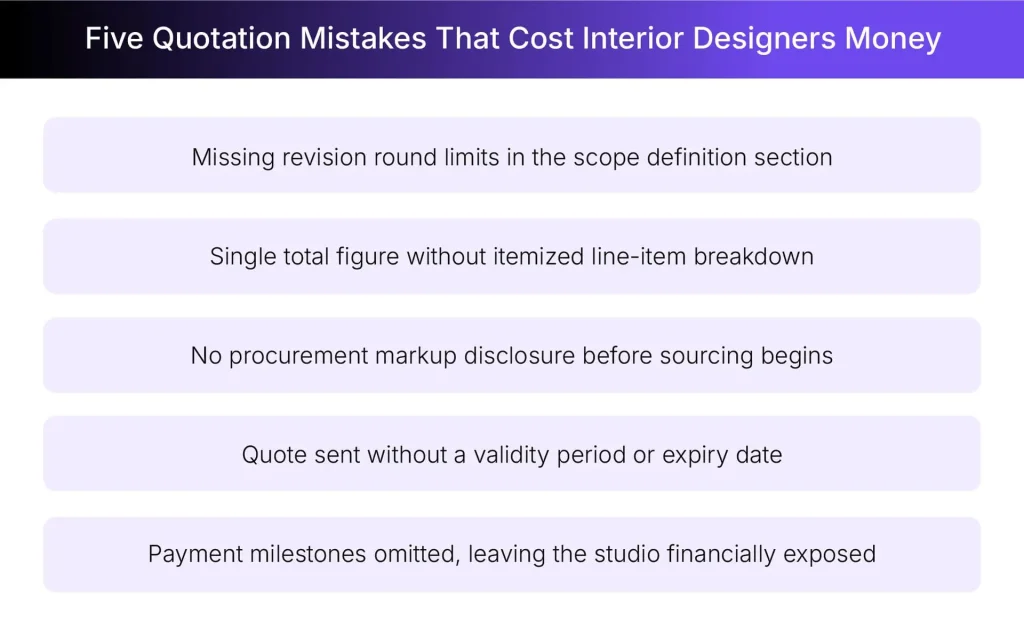
The Most Common Quotation Mistakes Interior Designers Make
Most designers learning how to make interior design quotation proposals focus on pricing, while scope boundaries often create bigger problems.
- Omitting revision rounds from scope definition, which turns every client change into a fee dispute later.
- Presenting one total figure without itemization, which increases rejection risk and blocks selective approval.
- Missing procurement markup disclosure, which creates trust issues when clients compare online retail prices.
- Sending a quotation without validity, which lets clients accept pricing after supplier costs change.
- Omitting payment milestones, which means major work happens before meaningful payment protection exists.
- Forgetting contact details, which makes approval routing messy across homeowners, assistants, and contractors.
- Sending a Word doc without version control, which creates confusion about the right version.
The least favorite thing for most designers is chasing payment after delivering value. A stronger quotation prevents that uncomfortable moment by making payment expectations visible before design work begins.
Free Interior Design Quotation Template
This free interior design quotation template is designed to save quoting time while making the scope, exclusions, approvals and payment terms easier for the client to review and approve in one document.
Download this template and customize it with your studio branding, rate card and standard payment terms before your next client’s project begins.
Interior Design Quotation: Page 1
[Your Interior Design Firm’s Name]
[Studio Address]
[Phone Number]
[Email]
[Website]
| Quotation Number: | [QTN-XXXX] |
| Date Issued: | [DD/MM/YYYY] |
| Valid Until: | [DD/MM/YYYY — 30 days from issue] |
| Name of the Project: | [Project Title] |
Client Details
| Client Name: | [Full Name] |
| Client’s Address: | [Residential/Billing Address] |
| Address of the Job Site: | [Project Site Address] |
| Phone Number: | [Contact Number] |
| Email: | [Client Email] |
Project Scope Summary
[One paragraph describing the rooms covered, the design services included, the deliverables such as floor plans, 3D renders and material specifications, and any site-specific constraints. This paragraph serves as the scope definition for the client’s project and should match the linked contract.]
Itemized Design Services
| # | Service | Description | Unit | Rate | Total |
| 1 | Initial Consultation | Site visit and brief capture | 1 session | $XXX | $XXX |
| 2 | Concept Development | Mood boards, space planning, material direction | 1 package | $XXX | $XXX |
| 3 | Design Development | Floor plans, 3D renders, detailed specifications | Per room | $XXX | $XXX |
| 4 | Procurement Coordination | Vendor sourcing, PO management, delivery tracking | Per project | $XXX | $XXX |
| 5 | Site Supervision | Regular site visits during installation phase | Per visit | $XXX | $XXX |
| 6 | Styling and Handover | Final styling, care instructions, photography | 1 session | $XXX | $XXX |
| Design Fees Subtotal: | $X,XXX |
Itemized Products and Materials
| # | Product | Source | Qty | Unit Cost | Markup (%) | Total |
| 1 | [Sofa — Brand/Model] | [Vendor Name] | 1 | $XXX | XX% | $XXX |
| 2 | [Dining Table — Brand/Model] | [Vendor Name] | 1 | $XXX | XX% | $XXX |
| 3 | [Pendant Light — Brand/Model] | [Vendor Name] | 2 | $XXX | XX% | $XXX |
| 4 | [Fabric — Material/Colour] | [Vendor Name] | X m | $XX/m | XX% | $XXX |
| Products Subtotal: | $X,XXX |
Interior Design Quotation: Page 2
Cost Summary
| Design Fees Subtotal | $X,XXX |
| Products and Materials Subtotal | $X,XXX |
| Additional Costs (delivery, installation) | $XXX |
| Total Cost of the Project (excl. tax) | $XX,XXX |
| Applicable Tax (if any, per state) | $XXX |
| Final Cost | $XX,XXX |
Payment Milestone Schedule
| Milestone | % of Total | Amount | Due Date |
| Retainer (on signing) | 30% | $X,XXX | [Date] |
| Concept Approval | 25% | $X,XXX | [Date] |
| Procurement Start | 25% | $X,XXX | [Date] |
| Project Completion | 20% | $X,XXX | [Date] |
Procurement Disclosure
Products sourced through [Interior Design Firm’s Name] carry a [XX%] trade markup applied to the wholesale cost. This markup covers vendor coordination, quality verification, delivery management and returns processing. The markup percentage is disclosed here per FTC guidelines and applies uniformly to all items sourced through the studio.
Exclusions
This quotation does not include civil or structural work, building permits, freight charges beyond the delivery address, sales tax (unless stated above), additional costs arising from client-requested changes to the approved scope, or procurement modifications after purchase orders have been placed with vendors.
Terms Summary
- This quotation is valid for 30 days from the date of issue
- Approval of this quotation does not replace the signed project agreement
- Revision rounds included in this scope: [X rounds per phase]
- Additional revisions beyond the included rounds will be billed at $[XX] per hour
Approval
I have reviewed and approve this quotation as described above.
| Client Name: | _________________________ |
| Signature: | _________________________ |
| Date: | _________________________ |
Create and Send Quotations with Foyr Manage
Once a client brief is confirmed, moving from a scope description to a fully itemized quotation is where most designers lose the most time across multiple tasks competing for attention. Knowing how to make interior design quotation documents is one thing, but producing them fast enough to keep the sales pipeline moving is the operational challenge every growing interior design firm faces.
Foyr Manage connects the quotation process directly to the project record so estimates, approvals, invoices and payment tracking all live in one workflow rather than scattered across email, spreadsheets and separate invoicing tools. It is an entire suite of tools built for the interior design industry from the ground up.
If the quotation includes visual deliverables such as floor plans, 3D renders, or design concepts, those assets can be created separately through Foyr Neo. Foyr Manage is where the approved scope, estimate, invoice, payment milestones, and client approval trail should live.
- Estimate builder: Create itemized estimates using products and services stored in your Library, including standard rates and sourced items. This helps designers avoid rebuilding every line item from scratch. It also gives each client’s project a cleaner pricing trail.
- AI estimate assistance: Ask Foyr Manage to draft or modify an estimate through the chat interface, then review details before sending anything. The AI can help with structure, while the designer keeps control. That balance matters when pricing affects trust.
- Client approval workflow: Send estimates to the client dashboard, where clients can review, comment, approve, or reject items. Their decisions stay logged inside the project record. This reduces approval confusion and gives designers better evidence if questions appear later.
- Estimate-to-invoice conversion: Convert an approved estimate into an invoice with payment milestones and due dates already attached. This helps reduce manual billing work after approval. It also keeps the approved quotation connected to invoice creation without duplicate entry.
- Library and price book: Store standard services, hourly rates, products, vendor details, and frequently used selections inside your Library. Every new quotation can start from your rate card. This is useful when a single studio handles beautiful spaces, procurement, and billing.
Learn more about Foyr Manage and start your free trial to build your first quotation in the same workspace where you manage the client’s project from brief to final payment.
FAQs
How much does it cost to hire an interior designer in the US?
Interior design costs in the US vary by project size, location, experience, and fee model. Many designers charge hourly rates, flat fees, or procurement-based markups depending on the scope. The honest answer is that a strong quotation should separate design fees from products and additional costs.
How are interior design fees structured using flat fee, hourly, or cost-plus?
A flat fee works for defined scopes, while hourly pricing suits advisory work or changing requirements. Cost-plus works when the designer handles sourcing and procurement. I’d recommend explaining each model inside the quotation, because clients need to understand both the service cost and associated cost.
Is it cheaper to manage interiors yourself rather than hiring a designer?
Managing interiors yourself may reduce design fees, but mistakes can quickly increase the final cost. Wrong measurements, poor material choices, delayed orders, and weak contractor coordination often result in costs exceeding expectations. An interior designer helps with planning, sourcing, drawings, and decision control.
What typically increases the cost of a home interior project?
Costs usually increase due to scope expansion, custom furniture, premium materials, freight, contractor delays, and change requests after approval. Material availability can also affect pricing when products shift during procurement. A strong interior design quotation should show exclusions, validity, and rules for changes.
How long does an interior design project take from quotation to delivery?
Smaller projects may take weeks, while larger interior design projects may take several months from quotation to completion. Timeline depends on scope, approvals, product lead times, contractor availability, and procurement complexity. Foyr Manage helps teams keep quotations, approvals, invoices, and tasks connected throughout the delivery process.