

Interior design is an art form that not only introduces colors and light to a house but also adds personality, comfort, and good energy. While there are several Feng Shui design principles to choose from, as an interior designer, you must always pay attention to the flow of energy in your design plans.
Everything in this universe is comprised of energy; from life force to earth element, everything operates on an energy map. These energy forces can be manipulated into positive energy or negative one. Today, let us discuss this incredible Chinese practice and how to manipulate Feng Shui principles to improve your quality of life.

What Is Feng Shui? Understanding the Basics of Interior Energy
Before we talk about the elements and how you can manipulate them, let us first understand what it really is. Feng Shui literally translates to ‘wind and water.’ The Chinese practice of manipulating the life force is embedded in controlling ‘chi’ which is the flow of energy.
Simply put, wind and water can flow freely. The elements are arranged such that these natural elements flow through the living space. The positive energy generated by the proper use of feng shui design principles affects the temperament, vitality, and overall well-being of the inhabitants.
The History And Basics
Before we talk about the elements and how you can manipulate them, let us first understand what it really is. Feng Shui literally translates to ‘wind and water.’ The ancient Chinese philosophy of manipulating the life force energy is embedded in controlling the ‘flow of chi’.
Simply put, wind and water can flow freely. The elements are arranged such that these natural elements flow through the living space. The positive energy generated by the power of feng shui design principles affects the temperament, vitality, and overall well-being of the inhabitants.
The Philosophy of Qi
Qi (pronounced “chee”) is the vital life force pulsing through every living thing and your physical environment. In Feng Shui design principles, your goal is to guide this energy gently through your home. You want to avoid stagnant Qi, which feels heavy, or rushing Qi, which feels chaotic; instead, aim for a smooth, nourishing flow.
The Bagua Map
Think of the Bagua Map as your energy blueprint. It is an octagonal grid containing eight areas of life, such as wealth, love, and career, centered around health. By overlaying this map on your floor plan, you can apply specific Feng Shui rules to enhance corresponding areas of your life through decor and placement.

The Core Feng Shui House Design Principles
To truly harmonize your space, you need to move beyond decoration and look at the structural energy of your home. Here are the core pillars you need to know.
The Command Position: Why where you place your bed or desk matters most
You never want to have your back to the door. The command position puts you in visual control of the room’s entry without being directly in line with it. This creates a sense of safety and allows you to spot opportunities—or threats—coming your way.
The Five Elements: Wood, Fire, Earth, Metal, and Water, and how to balance them
These elements interact to create cycles of growth or destruction. Using Feng Shui design principles, you balance them: Wood for growth, Fire for passion, Earth for stability, Metal for precision, and Water for emotion. Too much or too little of one throws off the room’s vibe.
Yin and Yang: Creating balance between active and restful spaces
Yin is passive, soft, and dark (perfect for bedrooms), while Yang is active, bright, and loud (ideal for kitchens). A great home balances these opposing forces. You don’t want a chaotic Yang bedroom or a sleepy Yin office; the mix must suit the room’s function.

Essential Feng Shui House Design Rules for Your Layout
When planning a renovation or a new build, adhering to specific Feng Shui house design rules ensures the structure supports your well-being rather than draining it.
- The Entryway (The Mouth of Qi): This is where energy enters your life. If your foyer is blocked or dark, opportunities cannot find you. Keep this area bright, inviting, and impeccably clean. A welcoming “Mouth of Qi” ensures that fresh, positive energy circulates throughout the rest of your home constantly.
- The Flow of Traffic: Just as you hate traffic jams, so does energy. Blocked pathways or furniture obstacles cause Qi to stagnate, leading to frustration. Open up your walking paths. If you can walk through your home with your eyes closed without bumping into things, your energy flow is likely healthy.
- The Position of the House: Your home doesn’t exist in a bubble. Feng shui house design principles dictate that you consider the land. Is the back of the house supported by a hill (good feng shui)? Is it facing a T-junction or a sharp roofline (bad feng shui)? Environmental energy impacts your internal harmony significantly.
6 Practices for Fengshui Design
Aside from the basic Feng Shui design principles, there are general practices that are followed around the Chinese household to incorporate the effects of good energy. These practices mostly focus on clean living which promotes positivity in the living spaces.
1. Decluttering
According to Feng Shui, clutter brings negative energy into the household. Not only does it look unappealing, but clutter can be hazardous to the health of the inhabitants. It is important to remove all unnecessary objects. They may be things that do not serve a purpose or incomplete design plans.
Anything that doesn’t fit into the natural flow of the living space, must be removed so the positive energy can flow freely through the house.
2. Removing the shoes
Chinese philosophers believed that one must always remove all negative energy at the door when entering the house. As per Feng Shui design principles, you must remove your shoes before you enter the household. This prevents outside negative energy from tracking across your floors.
3. Playing with colors
Color psychology not only affects a person’s mood, but also the overall energy forces in the house. Feng Shui experts suggest using the combination of three natural colors to instigate serenity and positive energy indoors. It is best to use light shades of lavender, blue, green, and peach because they have calming effects. Although white has positive effects on the mind, it is best to use it sparingly as it emits a cold atmosphere.
4. Incorporating the sounds of Feng Shui
As per Feng Shui design principles, there are different elements of sound that invoke positive energy into the atmosphere. The elements of Feng Shui are combined with these metal elements or earth elements for positive sound effects. You can place wind chimes at the front door or in open spaces for serene sounds. You can also use Tibetan singing bowls or large bells around the living space where the wind elements can interact with the other elements of the environment to create a positive effect.
5. Introducing natural elements
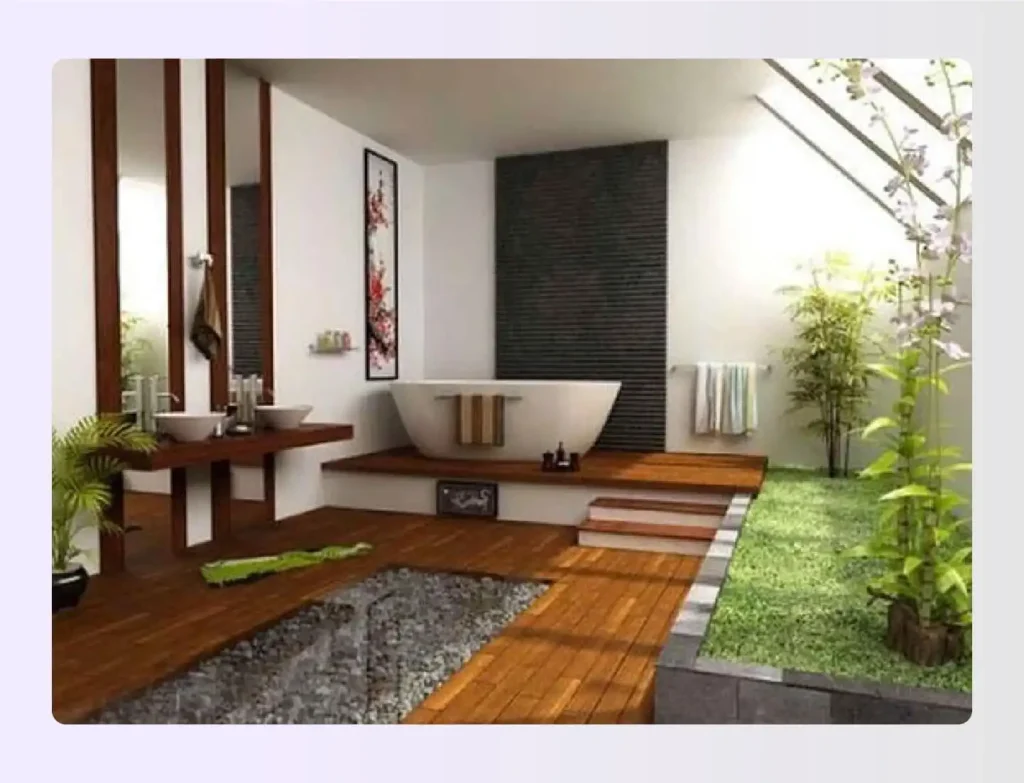
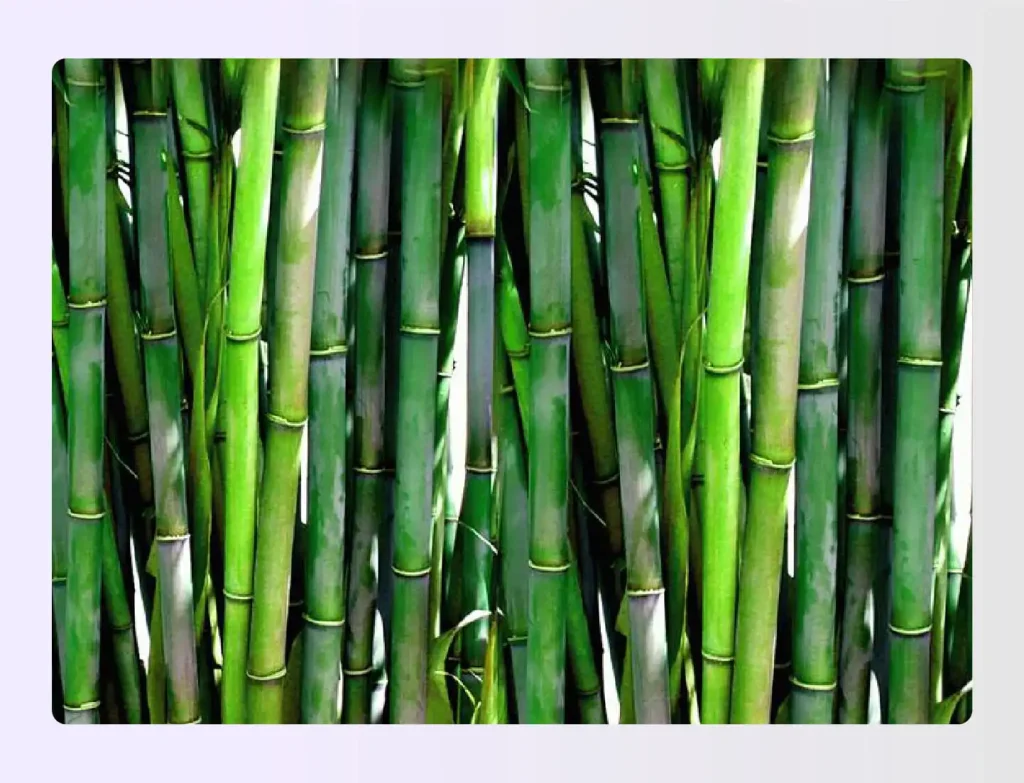
It is important that a house receives abundant natural light in all its corners. Dark and desolate spaces breed negativity. This is why the basic principles of Feng Shui recommend introducing natural light and cross-ventilation. It also suggests using house plants and bamboo, to further instill the elements of nature so the flow of energy remains uninterrupted.
6. Using Feng Shui enhancers
In today’s evolved stage of life, every individual has objects that they hold dear. Feng Shui experts recommend placing these objects in appropriate Bagua zones. This makes the inhabitants of the household feel more comfortable and serene, thereby improving the positive energy around the household.
Principles for Fengshui Design
Here are the key Feng Shui design principles that you need to follow:
1. Overall arrangement of the house
Feng Shui employs principles of engineering, interior design, and astronomy to create a positive impact in the home, without catering to superstition.
It is pivotal that the house is designed with either symmetrical or asymmetrical balance. It should have a well-designed exterior that encourages the growth of natural elements without harming the environment. Feng Shui design principles stress cultivating as many natural energy forces as possible to maintain the balance of Yin and Yang in a household.
2. Arrangements in the rooms
To create positive energy in room arrangements, it is best to remove all slanted structures. Slants tend to attract utter mayhem as per the principles of ‘chi’ and Feng Shui. This is not due to any superstitious belief, but rather the hazard posed by slanting structures.
If it is impossible to remove these negatively-impacting structures around the house, Feng Shui experts suggest using Bagua reflector in the exteriors of the house to keep out the negative flow of energy.
3. Position of the House
Feng Shui experts suggest that a house should not be placed near graveyards, landfills, or garbage dumps. These locations breed negative energy which is harmful to the inhabitants.
According to the basic principles of Feng Shui, it is best if the house is located on a clear path, with adequate distance from the street. Garages and should be created without penetrating the perimeter of the house, to keep away the negativity from outside.
The positioning of the house plays a major role in balancing the negative and positive energy within the household.
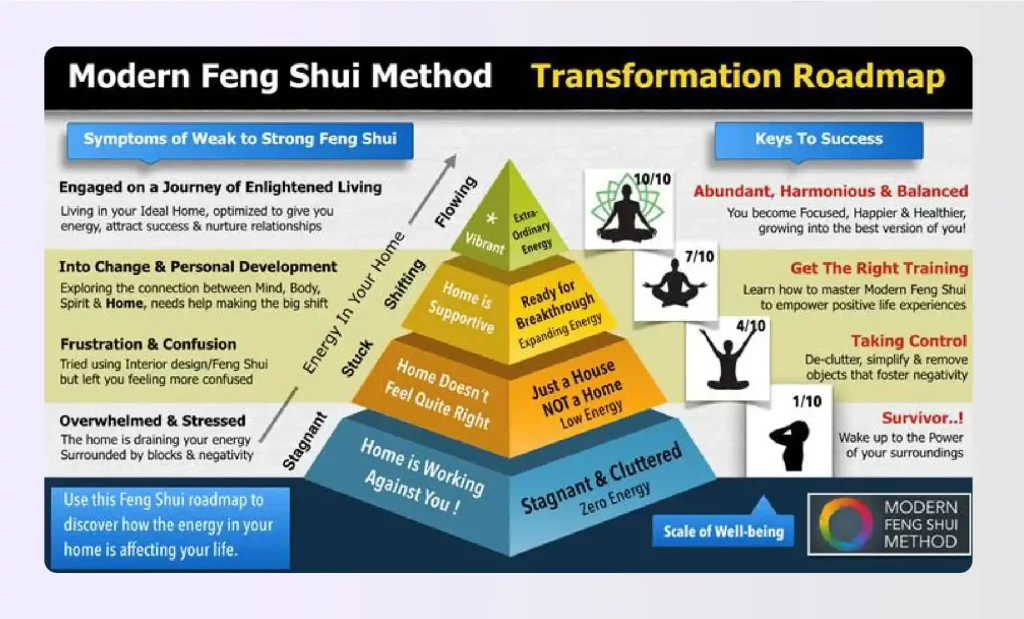
Source:- https://openspacesfengshui.com/feng-shui-tips/tag/relationship-area/, Image credits: enolivier.com
How to Implement Feng Shui in Home Design?
Here is how you can implement Feng Shui design principles in your home design projects:
1. The front entrance
The entrance to the house is believed to be the gateway for Feng Shui energy. Whether you have a foyer or just a doorway, the front entrance should always be clean and well maintained.
Start by decluttering the space and replace any blown lights or dead plants. Oil the door and ensure that it is clean and soundless. Keep the entryway clear. There should be no blocking furniture or stairways that prevent the ‘chi’ from flowing freely into the house.
2. The kitchen
The kitchen should be located afar from the front entrance and it shouldn’t face any room. Keep the kitchen clean and fresh to improve the positive energy around it. Try not to place any stoves or broilers in the North-West side as it is believed to disrupt the ‘chi’ in the house.
3. The bathrooms
Mirrors are believed to disrupt negative energy. You can strategically place a mirror in the washroom to maintain the flow of energy forces.
Always keep the lid closed on the toilet when it is not in use. As we have said before Feng Shui is focused on clean living. Therefore, to keep the bathroom clean and hygienic, you must control the contamination. Closing the lid helps contain any germs that might exist.
Feng Shui also suggests that you keep the bathroom door closed at all times. Aside from being in poor taste, it is also highly unhealthy. Make sure to install a working lock or latch so the door remains closed.
4. The Rooms
In the bedroom, it is best not to place the bed in front of a door or window. Try to place it in the center where it doesn’t face any of the exteriors directly. This also applies to the living room where the seating area should not face any door or window directly. You can use crystal balls in the center of the room to absorb any negative energy and propel the positive energy forces into the room.
5. The Stairs
When it comes to stairways, Feng Shui design principles advise not to have winding staircases in the house. They also advise that no room should open onto a staircase. It is pivotal to have a proper landing area in order to avoid any accidental hazards.
The looming danger of toppling down the stairs creates constant negative energy. Therefore, it is best to design stairways in unrestricted, open areas where the imminent threat is visible and can be easily avoided.
6. The Windows and Doorways
According to Feng Shui design principles, windows and doors are the inlet and outlet for all energy forces. Therefore, they should not be constricted with furniture or clutter. Keep the window frames and glasses clean. Maintain that the doors are properly hinged and oiled. There should be no dirt or dust on these surfaces as it hinders the flow of positive energy.
Feng Shui is a delicate art of balancing ying and yang to maintain the ‘chi’ in the household. You can use customized design plans or follow the teachings of the Form school or compass school to introduce positive energy forces in your home. We hope you find the Feng Shui tips in this article useful to eliminate all negativity and fill your home with positive energy.
Explore Feng Shui Design Principles with Foyr
Implementing Feng Shui design principles is easier when you can see the energy flow before you move a single sofa. Foyr Neo is a powerful interior design platform designed specifically for you, the designer.
With our interior design software, you can create Feng Shui compliant designs in minutes and enjoy benefits like:
- Visualize clutter-free layouts instantly using smart drag-and-drop tools to ensure smooth Qi flow.
- Balance Yin and Yang energies with AI-driven lighting controls that simulate natural ambience perfectly.
- Access 60,000+ 3D models to easily incorporate essential Wood, Fire, Earth, Metal, and Water elements.
- Use the Ruler Tool to precisely place furniture in the ‘Command Position’ for optimal security.
- Experience the energy flow firsthand with immersive 3D walkthroughs to verify harmonious spatial arrangement.
We enable designers to spend less time with software and more time with their clients by merging the capabilities of various tools into one platform. Sign-up for a 14-day free trial of Foyr Neo and start creating designs that meet the Feng Shui design principles.
Frequently Asked Questions
What is the rule of 3 in Feng Shui?
The rule of 3 typically refers to balance and gratitude. In design, it often relates to grouping objects (like accessories or artwork) in odd numbers to create dynamic energy. It can also refer to the three core areas to protect: your kitchen (wealth), bathroom (drainage), and bedroom (health).
What are the 5 elements of Feng Shui?
The five elements are Wood (growth/vitality), Fire (passion/visibility), Earth (stability/grounding), Metal (focus/clarity), and Water (wisdom/flow). Effective feng shui design principles require you to balance these materials, shapes, and colors within a room so no single element overpowers the others, creating harmony.
What colors should be avoided in feng shui?
While no color is strictly “banned,” you should avoid using too much Black (heavy, depressive energy) or excessive Red (aggression, over-stimulation) in restful spaces like bedrooms. Also, avoid disjointed, chaotic color schemes that lack a unifying undertone, as this creates visual and energetic clutter.
What are common Feng Shui mistakes?
Common mistakes include placing the bed in line with the door, keeping broken items (which symbolize broken life areas), leaving the toilet seat up, and having a cluttered entryway. Ignoring Feng Shui design principles regarding light and living in dark or stagnant rooms is also a major error that lowers household vibration.