

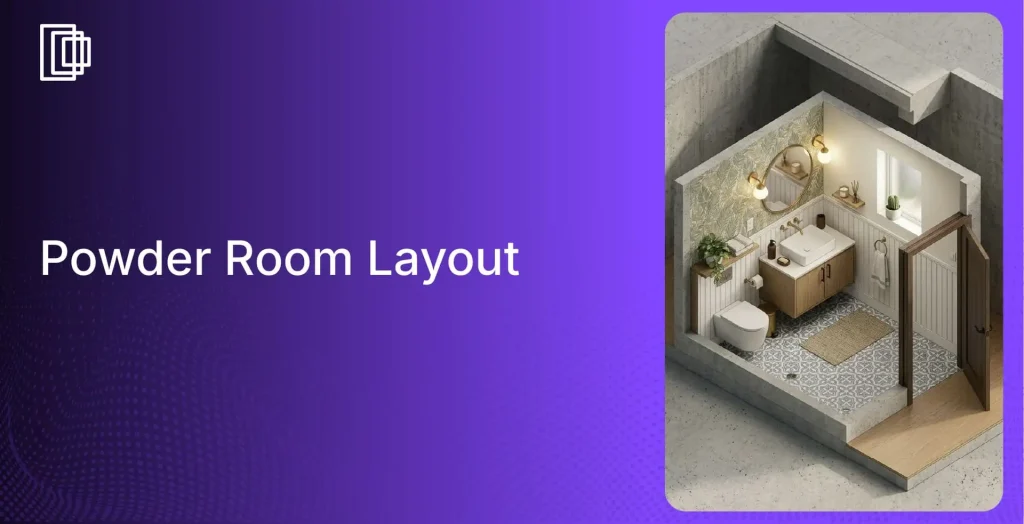
Powder rooms are small, which is exactly why most people underestimate them.
Like, what could go wrong with one toilet, one sink, and four walls? But squeeze a bad layout into a tight space, and there’s nowhere to hide it.
The smaller the space, the higher the stakes.
That’s why world-class designers prioritize clearances, flow, and proportions right from the start.
In this blog, you’ll find practical powder room floor plans and layout ideas with recommended dimensions and practical examples.

What Even Is a Powder Room? (And Why It’s Trickier Than It Looks)
A powder room is a half bath. Just a toilet and a sink, no shower, no tub. That’s it. It’s meant for guests and is usually tucked near the main living area or entryway.
Note: This is not the bathroom your family uses every morning. It’s the one that gets judged every time someone comes over for dinner.
That’s important, because this small space has to perform two roles at once:
- It must function smoothly
- It must look good, since it reflects the overall design of the home
The challenge? Powder rooms are very small, which means every design decision matters.
Now, many people also confuse powder rooms with other bathroom types. So, here’s a simple comparison between them.
| Bathroom Type | Toilet | Sink | Shower | Tub |
| Powder Room / Half Bath | ✓ | ✓ | ✗ | ✗ |
| Three-Quarter Bath | ✓ | ✓ | ✓ | ✗ |
| Full Bath | ✓ | ✓ | ✓ | ✓ |
Now here comes the tricky part.
Most bathroom layout advice you’ll find online is written for full bathrooms. The clearance rules, fixture spacing, and door placement strategies assume you have plenty of space to work with.
But powder rooms operate under much tighter constraints.
When the entire room may only be 3 to 5 feet wide, even a small mistake can make the room uncomfortable or awkward to use.
That’s exactly why powder room layout planning requires a slightly different approach, and that’s what we’ll walk through in this guide.
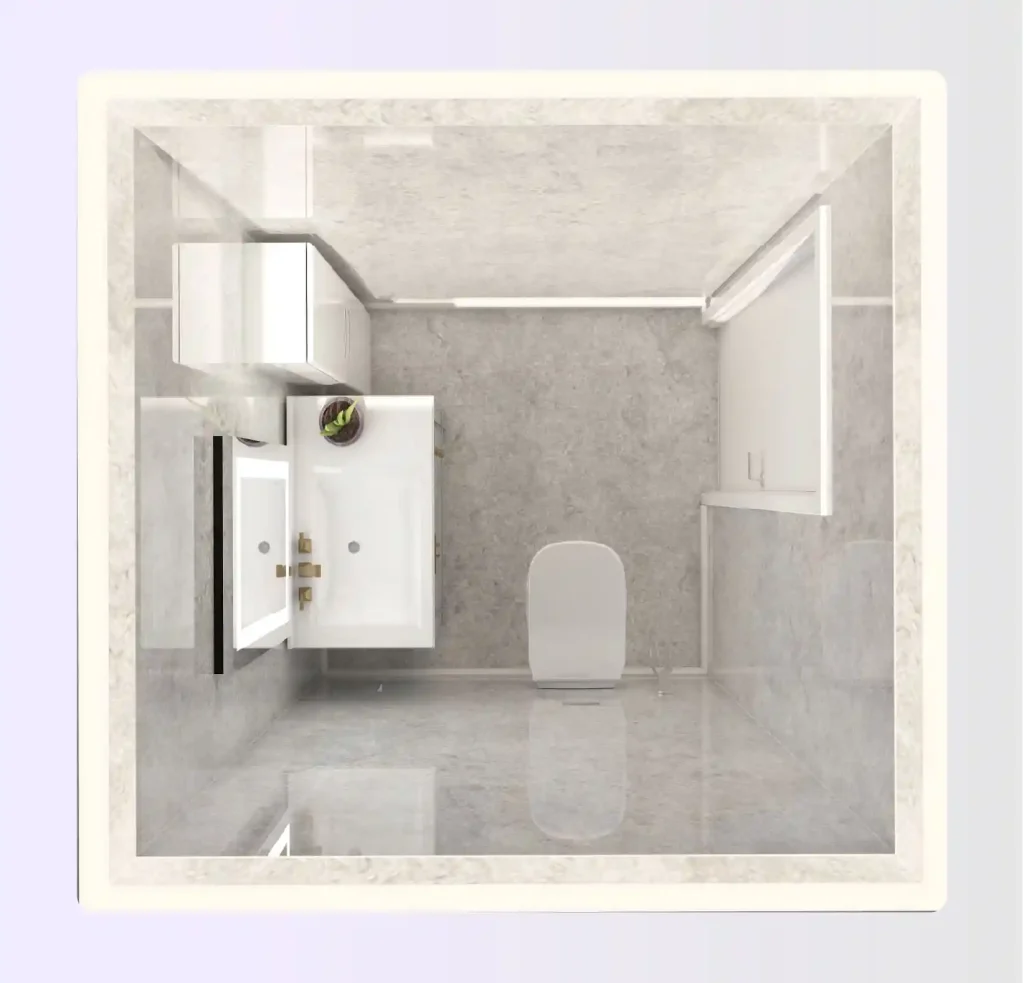

Powder Room Layout Dimensions – The Minimum vs. Comfortable Sizes
The minimum size for a powder room is around 20 square feet. The ideal dimensions are 4′ x 5′ or sometimes 3′ x 6′ is also possible in a hallway setup.
However, that’s the absolute minimum. Most designers aim for slightly larger dimensions to make the space more comfortable and easier to use.
A powder room layout starts to feel noticeably better when it has a space of 25-35 square feet with proper clearances. The dimensions can go around 5′ x 5′ or 5′ x 6′.
This extra space makes it easier to position fixtures comfortably and improves circulation inside the room, especially when guests are using it.
The key thing to remember is that powder rooms operate on very tight margins. Even a few extra inches can make the difference between a layout that works smoothly and one that feels cramped.
That’s why understanding the clearance rules for toilets, sinks, and door placement is just as important as the overall room size.
Powder Room Clearance Rules (The Non-Negotiables)
The minimum clearance for a powder room toilet is 15″ from the centerline to any side wall, with at least 21–24″ of open space in front.
Note: I have shared the minimum requirements based on the following considerations.
- IRC 2021 Minimum: The baseline code requirement. Legally compliant, but just barely.
- ADA Requirement: For accessibility-compliant builds. A separate tier because the numbers are significantly different. Refer this blog to know more about ADA-compliant bathroom.
- Designer’s Comfortable Minimum: What experienced designers actually recommend beyond code. This is the tier that makes a powder room feel right, not just pass inspection.
Toilet Clearances
The toilet centerline needs to sit at least 15″ from any side wall or obstruction per IRC 2021. ADA bumps that to 18″ on one side to accommodate wheelchair transfers.
Designers usually push this to 18″ on both sides. And it’s not because the code demands it, but because 15″ genuinely feels cramped in daily use.
For front clearance, IRC requires 21″. ADA requires 48″ (yes, significantly more but it is needed for a wheelchair to pull up). Designers generally recommend 24–30″ as the comfortable minimum for a standard build.
Sink Clearances
IRC sets the sink centerline at 15″ from the nearest side wall and 18″ of separation from the toilet centerline. ADA requires the sink to be mounted at a maximum of 34″ height with knee clearance underneath for wheelchair access.
For this, designers prefer to keep 18–20″ from the side wall and a 24″ separation from the toilet.
Door Swing Clearance
In this case, IRC doesn’t prescribe a specific door swing clearance, but the front clearance rules make it implicit. A standard inward-swinging door needs roughly 14–18″ of clear floor space to open without hitting a fixture.
And ADA requires a minimum 18″ clearance on the latch side of the door for wheelchair approach. Designers (almost universally) recommend a pocket door or outward swing in any powder room under 5′ x 7′. This is not a workaround, but a smarter default choice.
Ventilation
IRC 2021 requires either a window with at least 1.5 square feet of openable area or a mechanical exhaust fan pulling a minimum of 50 CFM.
ADA doesn’t add specific ventilation requirements beyond this. But designers recommend that it is better to go beyond the 50 CFM minimum.
Why? Because in interior powder rooms with no window and undersized ventilation, there is a frequent moisture buildup over time. Which is a much more expensive problem than upgrading the fan upfront.
Must-Have Elements of a Functional Powder Room Layout
Small rooms are a place where every element needs to earn its place. And in the case of powder rooms, the layout has to balance functionality, comfort, and design.
Here’s what you cannot skip:
Fixtures
Toilet:
Position it away from the door so that it isn’t the first thing visible when the door opens. It should have at least 15 inches of clearance from the centerline to the nearest wall and adequate front space for comfortable use.
Sink:
The sink is often the visual focal point of a powder room. To preserve floor space, you can have a wall-mounted sink, or a compact vanity. These keep the room feeling open while still providing functionality.
Lighting & Ventilation
Good lighting is essential in a small space.
Use layered lighting whenever possible:
- Ceiling lighting for overall illumination
- Wall sconces beside the mirror for softer, more flattering light
Ventilation is equally important. If the powder room doesn’t have a window, installing an exhaust fan is essential to control humidity and odors.
Storage
Powder rooms don’t need extensive storage, but they should accommodate a few essentials.
Keep storage simple and discreet:
- Extra toilet paper
- Hand towels
- A small wastebasket
A compact vanity, recessed shelf, or wall-mounted holder usually provides enough space without crowding the room.
Some cool elements to add in your powder room: (It’s a pro tip from design experts)
- Add a statement mirror that reflects light and visually expands the space.
- Have bold wallpaper or darker paint colors, which work well in compact rooms.
- Keep high-quality soap dispensers and decorative hand towels.
- A small piece of artwork or a plant if the space allows. It adds personality without taking up floor space.
- Scented candles or high-end hand soap. This is the kind of touch that makes guests feel like the space was thought through.
Note: You can also check out these small bathroom floor plans with best space utilization.
5 Most Common Powder Room Floor Plan Layouts With Examples
Powder rooms may be small. But there are still several ways to arrange the fixtures depending on the room’s shape, door placement, and available wall space.
Here are the five most common (and practical) powder room floor plan configurations and how to make each one work.
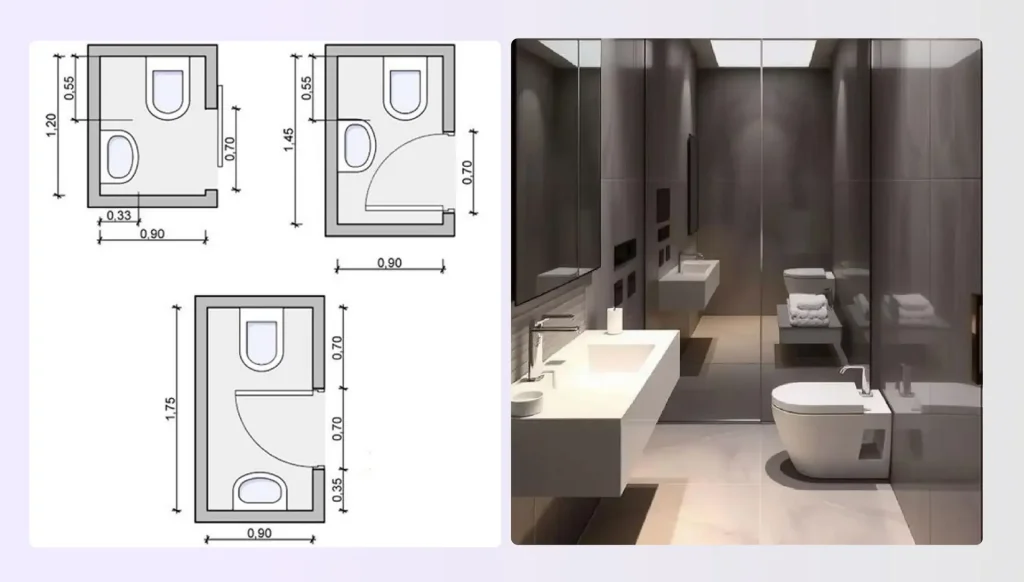
1. Narrow/Galley Powder Room Layout
- Best for: Hallway powder rooms, older homes, or narrow spaces where the room width is limited.
- Size example: 3′ x 6′ or 4′ x 7′
In this layout, the toilet and sink are positioned along the same wall, creating a narrow walkway on the opposite side.
This configuration keeps plumbing simple and works well when the powder room is placed along a hallway. The main challenge here is managing the door swing so it doesn’t block either fixture.
Pros:
- Makes efficient use of a long, thin footprint
- Clear, logical fixture flow
Cons:
- Limited circulation space
- Door placement can interfere with fixtures
- Requires a compact sink or vanity
2. Square Powder Room Floor Plan
- Best for: Homes where the powder room is intentionally designed rather than squeezed into leftover space.
- Example size: 5′ x 5′ or 6′ x 6′
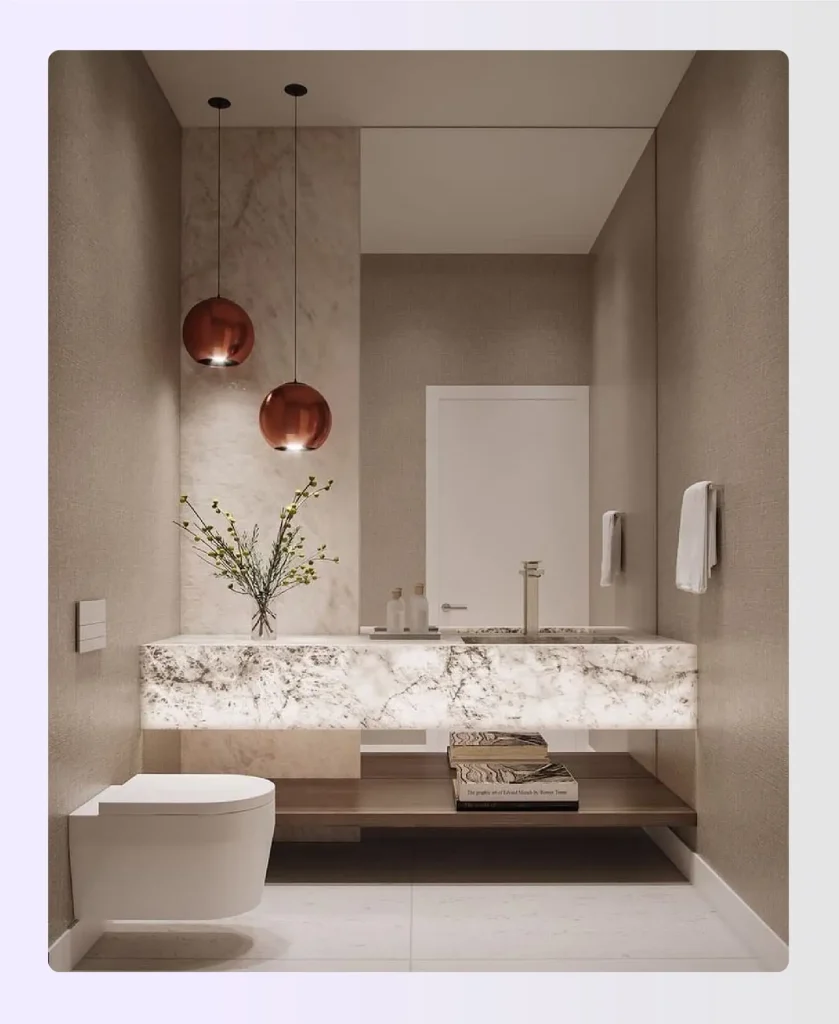
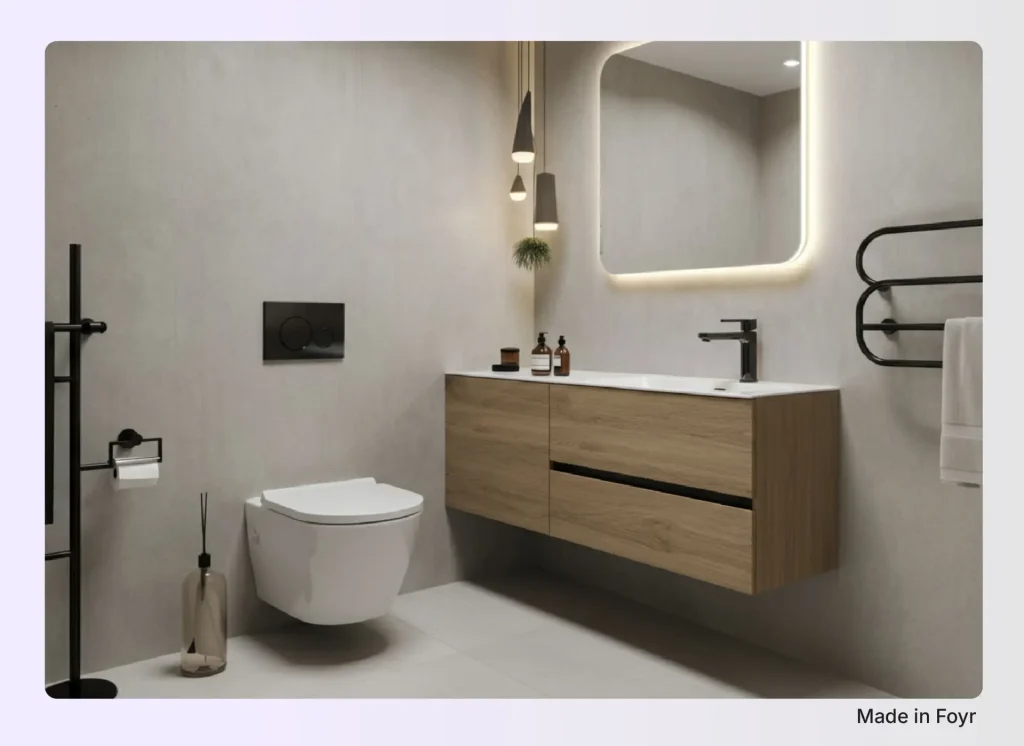
A square powder room allows for a more balanced layout. Designers often use this layout creatively and keep the floating vanity on one wall, the toilet on the adjacent wall, and the remaining corner used for a small design moment.
This arrangement improves circulation and keeps the vanity as the visual focal point when someone enters the room.
Pros:
- Maximum layout flexibility
- Room for design details beyond just fixtures
- Door placement is rarely a problem
Cons:
- Requires more square footage than other configurations
- Can feel boxy without thoughtful design
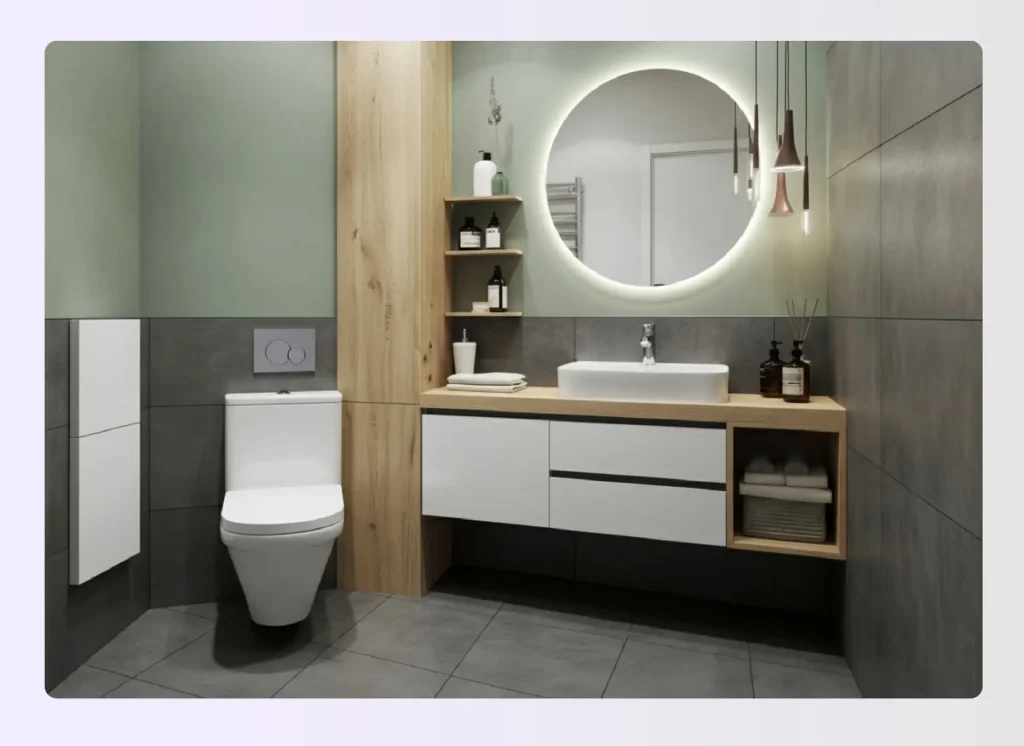
3. Corner Entry Powder Room Plan
- Best for: Rooms with doors positioned at corners due to structural constraints
- Size example: 5′ x 7′ or 4′ x 6′
When the door opens into a corner of the room, the layout logic shifts entirely. Why? Because the door swing immediately eats into your usable wall space, which limits where fixtures can go.
It is best to use a pocket door in this case. It helps you reclaim that wall and opens up the layout significantly. With the door sorted, the toilet can go on the wall opposite the entry and the sink on the adjacent wall.
Pros:
- Workable with the right door choice
- Can feel more private than a straight-entry layout
Cons:
- Inward-swinging door kills the layout entirely
- Requires a pocket or outward-swinging door to function well
4. L-Shaped Powder Room Layout
- Best for: Under-stair spaces, rooms carved out of irregular floor plan corners
- Size example: 4′ x 8′ with an angled or offset wall
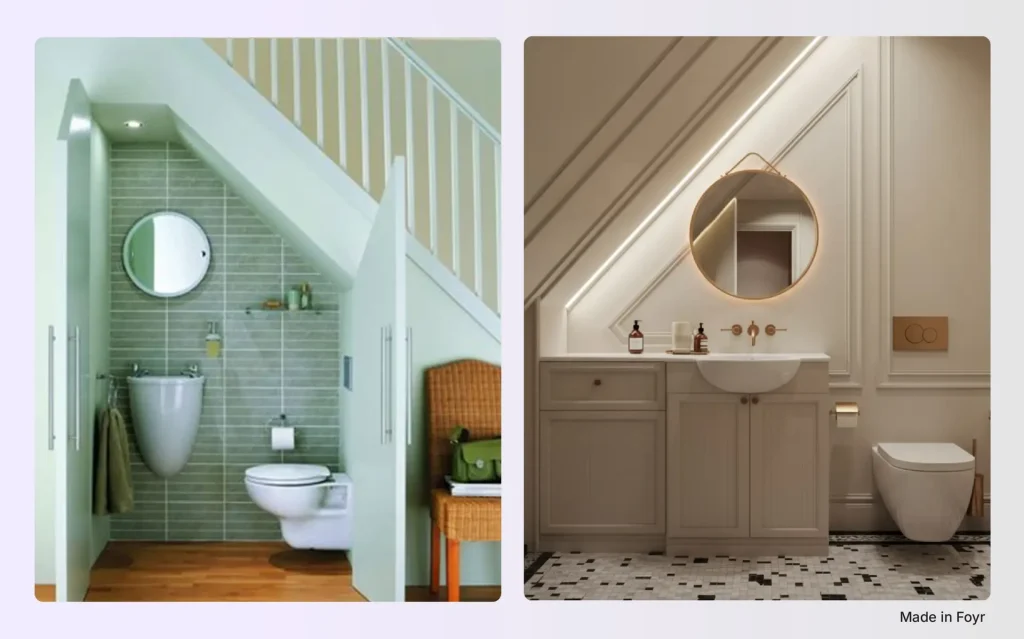
This layout shows up in powder rooms carved out of larger spaces like under a staircase or tucked into an odd corner of a floor plan.
The walls aren’t all parallel, which means standard fixture placement rules don’t apply here. The approach is to follow the longest wall for the toilet and use the shorter or angled wall for the sink.
Note: Don’t fight the geometry, it never works. It’s best if you work with it and try to leverage it.
Pros:
- Makes use of otherwise wasted space
- Unique geometry can create interesting bathroom design opportunities
Cons:
- Limited fixture placement options
- Requires more planning than a standard rectangular layout
5. Awkward / Under-Stair Powder Room Plan
- Best for: Older homes, attic conversions, rooms built under staircases with sloped ceilings
- Size example: Varies but most often it’s somewhere around 5′ x 6′ with one angled wall
This layout is designed to fit under a staircase, making use of otherwise unused space.
Now, because the ceiling height slopes downward, the toilet is typically placed in the area with the highest headroom while the sink sits where the ceiling is slightly lower. Plus, wall-mounted sinks work better here than pedestal or vanity options because they can be positioned precisely without being constrained by floor space.
This layout demands the most planning but can result in some of the most characterful powder rooms when done right.
Pros:
- Can produce highly unique, characterful spaces
- Forces creative thinking that often leads to standout design
Cons:
- The most complex layout to plan and execute
- Standard fixtures may not fit without modification
Design Tips to Make a Small Powder Room Feel Bigger
The layout is sorted. Now let’s talk about making the space actually feel good to be in.
Here are a few design moves that consistently make a difference in a tight powder room:
- Large or floor-to-ceiling mirror: visually doubles the space without taking up any floor area
- Floating vanity or wall-mounted sink: keeps the floor visible, which instantly gives a sense of openness
- Vertical tile or paneling: draws the eye upward and makes the ceiling feel taller
- Layered lighting: sconces at mirror height add depth that a single overhead light never will
- Bold wall color: a deep, moody tone can make a small space feel intentional rather than cramped. Don’t shy away from it.
Visualize It Before You Finalize It With Foyr
A 2D floor plan can tell you if a layout fits on paper. But it can’t tell you how it will actually look to a person who’s using it.
That’s the limitation of planning in 2D. Everything looks fine until it’s built.
That’s why many designers use interior design software like Foyr Neo that lets you test your powder room layout before anything gets committed to construction.
All you need to do is drop your room dimensions, place bathroom fixtures from the library, and see how the clearances actually look in three dimensions.
You can also swap between the five layout configurations we covered, adjust the door type, and even move the sink.
It’s the difference between guessing and knowing.
Pro Tip: Try Foyr Neo free for 14 days and design your bathroom layout before you build it.
FAQs
What are some common mistakes to avoid in powder room layout design?
The most common mistakes (apart from door swing clearance) in powder rooms are placing the toilet too close to the wall, undersizing the exhaust fan, and picking fixtures that are proportionally too large for the space. Most of these mistakes are invisible on a 2D plan and only show up once construction is done.
What are the essential elements of a powder room layout?
A toilet, a sink, proper clearances (15″ centerline to wall, 21″ front clearance minimum), ventilation, and lighting. These are the most basic elements that any powder room must have.
What is the standard size for a powder room?
The standard size ranges between 18–25 square feet, with typical dimensions of 5′ x 5′ or 5′ x 6′. Anything below 20 square feet starts to feel tight but is workable with the right layout.
What is the narrowest a powder room can be?
3 feet is the absolute narrowest a powder room can be while still meeting IRC 2021 code requirements. At that width, fixture placement and door type become critical. In such cases, a pocket door is also non-negotiable.
What kind of flooring is best for a powder room?
Porcelain or ceramic tile is the most practical choice because it is durable, water-resistant, and easy to clean. If you prefer a design-heavy look then go with natural stone or patterned encaustic tiles. Since the room is small, even premium materials are affordable.
What is the best vanity size for a small powder room?
A 24″ wide vanity is the sweet spot for most small powder room layouts. It provides enough counter and storage space without overwhelming the room. In very tight layouts, a wall-mounted sink is the better call. It keeps the floor open and makes the space feel larger.
What is the most common powder room layout?
The narrow/galley layout is the most common, particularly in older homes and hallway conversions. A small footprint with the sink near the door and toilet at the far end is the configuration designers encounter most frequently.
Is a powder room the same as a half bath?
Yes, completely. Both terms refer to the same two-fixture bathroom: toilet and sink, no shower or tub. The names are used interchangeably.